

By J. K. Nabary, GNA
Winneba, July 09, GNA- University graduates have been urged to be watchdogs in society, point out corrupt practices and offer ways of eradicating the canker to make a difference.

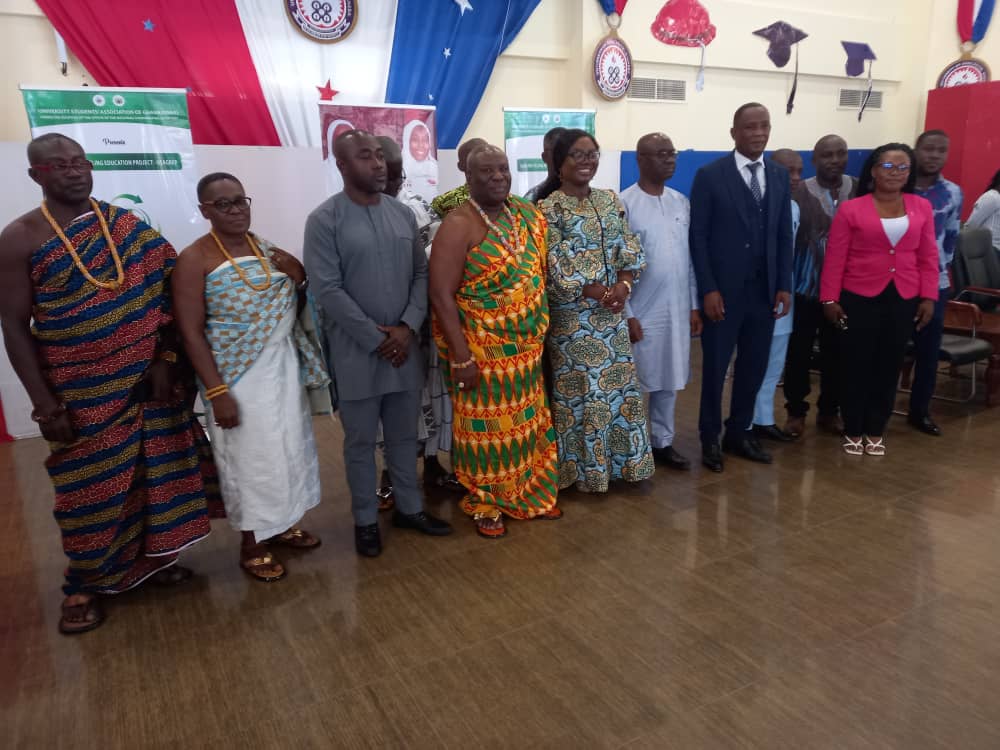
Professor Mawutor Avoke, Vice-Chancellor of the University of Education, Winneba (UEW), made the call in an address delivered on his behalf by Professor Dominic K. Danso Mensah, Principal of College of Languages Education at the 21st Annual Residential Congress of the University Students Association (USAG), held at Winneba.

The Congress on the theme: “Eradicating Corruption: the University Student’s Role”, was to review their performance, strategize towards the growth of the association, let their voices be heard in a positive way and to contribute towards curbing corruption in the society.

According to the VC, the theme for the congress was appropriate, especially at a time when there was global downtrend of economies due to the war in Europe and the battling of COVID-19 pandemic which had made living stressful.
Prof. Avoke applauded the association for starting from the middle to be able to police old folks and equally teach the younger generation to be upright.

He pointed out that student leaders who used their position to abuse their offices without seeing anything wrong with that were breeding corruption right from the early stages and this must stop.
“It is my wish that you will use the congress to let your voice be heard as those who do not glorify thievery so that society will see you differently as you act positively.


“In so doing, the fight of corruption should begin from your inner self, before you will be bold enough to voice the rot in the system,” he stressed.

Commissioner of Police (COP) Mrs Maame Tiwaa Addo-Danquah, Executive Director of Economic and Organized Crime Office (EOCO), spoke on the enforcement of laws on corruption.
COP Addo-Danquah, one of the panel members, who answered questions and deliberated on issues on corruption in Ghana, stated that corruption had a long history, however, it was only in 1960 that an Act of Parliament, the Criminal Offences Act (Act 29), led to the criminalization of the menace.
She informed the gathering that to strengthen Ghana’s Anti-corruption laws, Parliament in 2003 passed the Financial Administration act, 2003 (Act 654), the public procurement Act, 2003 (Act 663) and the Internal Audit Agency Act. 2003 Act (658).
The country enacted these financial management laws to sanitize the financial management system in the country and to prevent illicit enrichment, but these financial administration Act has been repealed by the Public Financial Management Act 2016 (Act 921).
The objective of these strategic key intervention is to build public capacity, condemn and fight corruption and to make corruption a hag-risk, low gain activity, she noted.
COP Addo-Danquah, indicated that with strategic objectives, the role of educational Institution in the fight against corruption could not be discounted and this was because educational institutions and Universities in particular, provided the building blocks for training the teeming youth of the country who eventually take up leadership positions.
According to her university students over the years had played crucial role in shaping national aspirations through their vociferous activism and discussions on topical national issues such as corruption.
In recognising the university’s potential, as well as its responsibility to help shape the moral contours of society for the better, it is imperative therefore that, Institutions of higher education must endorse a cross-faculty approach to include components of ethics and anti-corruption in their curricula to complement the efforts of NACAP which seeks to incorporate ethics and anti-corruption modules in Institutions of Higher learning.
Answering questions on the recent corruption perception index by Transparency International which scored Ghana 43, she mentioned some of the factors facilitating corruption as poverty, high level of bureaucracy, lack of a culture of integrity, transparency and accountability.
She said prevailing laws on anti-corruption criminalised the act, but it could be minimized in Ghana if the existing structures in fighting it were properly implemented.
“Our Criminal justice System and Procedures are being developed to meet interactional best standards and this will go a long way to mitigate the occurrence and effects of corruption in the country.”
She said the measures taken to tackle corruption will work effectively, if rightly implemented, adding that the Ghanaian legal system had several laws that met international best practices, but the challenge, however, was with implementation and enforcement.
“With the needed political will and commitment to stem out the canker, Ghana would achieve a lot in the fight against corruption,” she added.
GNA

