
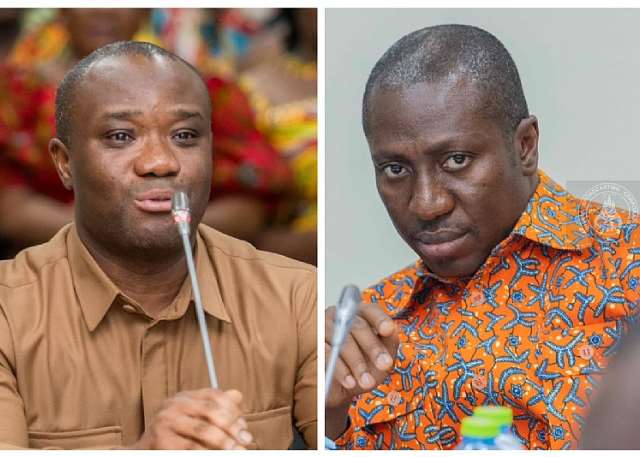

Minority Leader Alexander Afenyo Markin has appealed to President John Dramani Mahama to exercise his prerogative of mercy in favour of Camila Alhassan, who is serving a one year prison sentence over a TikTok publication, even as the government has cautioned political leaders against defending threats of violence under the guise of freedom of expression.
The two positions emerged during the 30th Ghana Journalists Association (GJA) Media Awards in Accra, where political leaders addressed the delicate balance between protecting citizens’ constitutional right to free expression and preventing the use of digital platforms to promote threats, intimidation and violence.

Mr Afenyo Markin, who represents the Effutu Constituency in Parliament, used the occasion to urge President Mahama to pardon Camila Alhassan, arguing that criminal sanctions must not create an atmosphere in which citizens become afraid to express their opinions or criticise political leaders.

He cautioned that democratic governance depended on the protection of divergent opinions and warned against the use of fear as an instrument for controlling public conversations.

The Minority Leader maintained that the punishment of individuals over their social media activities raised important questions about the limits of criminal prosecution and the need to protect freedom of expression in a democratic society.
“I appeal to President Mahama to pardon Camila Alhassan, who is in jail because of her social media activity. We must not allow fear and panic to become the new language of political control,” he stated.

Camila Alhassan was sentenced to one year imprisonment with hard labour by an Accra Circuit Court in July 2026 after pleading guilty to offensive conduct conducive to a breach of the peace.
Her conviction followed a TikTok video containing derogatory remarks directed at President Mahama and members of his family.

Mr Afenyo Markin’s intervention therefore brings renewed attention to the relationship between criminal accountability, online expression and the constitutional protections available to individuals who communicate their opinions through digital platforms.

However, the government’s position, presented by the Minister of State in charge of Government Communications, Felix Kwakye Ofosu, introduced an important distinction between the protection of controversial opinions and the criminal communication of threats intended to cause harm.
Speaking on behalf of President Mahama at the same awards ceremony, Mr Kwakye Ofosu strongly rejected attempts to justify threats against the President and his children as legitimate exercises of freedom of expression.
He warned political leaders against defending statements that threaten lives simply because the individuals responsible belong to their political camps or because such conduct could advance partisan interests.
“For instance, threatening to kill a president and his children is not free speech. It is brazen criminality. We, as political leaders, must not lend support to this level of criminality only because it enures to the benefits of our political fortunes,” he declared.
The government spokesperson argued that political actors must demonstrate consistency in defending freedom of expression, particularly when journalists face intimidation, threats and persecution for publishing reports that challenge powerful individuals or institutions.
He recalled instances in Ghana’s history when journalists were compelled to flee the country because of threats to their lives following the publication of reports considered uncomfortable by those in positions of authority.
Mr Kwakye Ofosu maintained that political leaders who genuinely supported press freedom must be prepared to defend journalists and citizens even when their publications or opinions are critical of the government.
“Our words in support of free speech must not ring hollow, especially when in the north, in the past, journalists had to flee our country for fear of their lives because they published uncomfortable truths,” he stated.
He further cautioned that efforts to confront hate speech and threatening communications must not become convenient justifications for suppressing legitimate criticism, dissenting opinions or investigative journalism.
According to him, democracy derives its strength from the ability of citizens to disagree with one another, challenge established positions and express unpopular opinions without fear of punishment or intimidation.
Nevertheless, he stressed that such freedoms should not be extended to deliberate attempts to incite hatred, promote violence or encourage intolerance against individuals and groups.
“Democracy thrives on disagreement, and what it cannot accommodate is the deliberate incitement of hatred, violence, and intolerance. A clear distinction must be struck between criminal conduct and the expression of free speech,” he emphasised.
The central issue: Where should Ghana draw the line?
The contrasting interventions by the Minority Leader and the government representative have brought two related but distinct questions into the national conversation: whether criminal sanctions imposed over offensive online publications are proportionate and whether threats of physical violence can legitimately enjoy the protection afforded to freedom of expression.
While Mr Afenyo Markin’s appeal focuses on presidential clemency and the possible implications of imprisonment for social media expression, Mr Kwakye Ofosu’s position emphasises the responsibility of political leaders to condemn genuine threats to human life, irrespective of their political origins.
The distinction is important because the protection of free expression does not automatically exempt every form of communication from the law. Equally, the existence of laws regulating offensive or threatening conduct does not remove the obligation of the state to respect constitutional freedoms and ensure that criminal sanctions are lawful and proportionate.
The President’s constitutional prerogative of mercy under Article 72 of the 1992 Constitution provides a mechanism through which he may grant a pardon, respite or substitute a less severe punishment in accordance with the constitutional requirements.
However, a presidential pardon would be a separate exercise from the judicial determination of the legality of a conviction or sentence.
The 30th GJA Media Awards, held under the theme “Celebrating Excellence, Advancing Media Freedom and Combating Hate Speech in the Digital Age,” brought together journalists, media organisations, political leaders and other stakeholders to recognise outstanding contributions to journalism while examining threats confronting the media industry in an increasingly digital environment.
The exchanges at the ceremony have reinforced the importance of maintaining a clear distinction between legitimate criticism, offensive expression, hate speech and credible threats of violence, while ensuring that neither political expediency nor the desire to control public discourse undermines constitutional freedoms.
Ultimately, the challenge confronting Ghana’s democracy is to protect the right of citizens and journalists to question authority, criticise political leadership and express unpopular opinions, while ensuring that threats to human life and deliberate incitement of violence are addressed through lawful and constitutionally defensible processes.

