
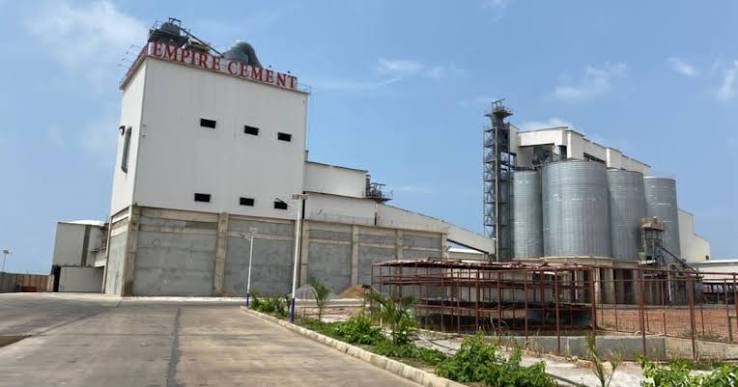

The Environmental Protection Authority has warned that Empire Cement Ghana Limited could be forced to relocate if it fails to resolve dust pollution concerns arising from its cement production activities, intensifying pressure on the company following the shutdown of its factory in September.
The warning comes after the Authority closed the facility on September 14 following investigations into allegations of air pollution and environmental nuisance associated with its operations.

The EPA’s Deputy Chief Executive Officer in charge of Operations, Professor Michael Ayamga Adongo, said the company had since engaged the Authority and expressed confidence that technological improvements could help control dust emissions from the factory.

He explained that the decision to shut down the facility was driven by concerns about public health and safety, stressing that the Authority had a responsibility to protect residents from potentially harmful environmental conditions.

“We know that where public health and public safety are at stake, we are supposed to act on behalf of the people, on behalf of human life. That is why we took that decision to close down Empire Cement,” he said.
Professor Ayamga Adongo disclosed that the EPA had previously advised the company to consider relocating. However, he said subsequent discussions had resulted in assurances from the management that the factory’s technology could be upgraded to reduce the amount of dust released during production.

“They have engaged with us, and they have assured us that they can upgrade their technology to accommodate and reduce the dust that is coming from the production of cement,” he stated.
The EPA official cautioned, however, that the company’s assurances would need to translate into effective pollution control, particularly because continued dust emissions could expose people living in nearby communities to environmental and public health risks.

He also acknowledged the longstanding friction between Empire Cement Ghana and residents in surrounding communities, saying the disagreements had generated persistent complaints and legal disputes involving the company and other parties, including the EPA.

“We must admit that the inhabitants and the neighbours of Empire Cement have consistently been at loggerheads with the company, and they are taking everybody to court, even including us,” he said.
Professor Ayamga Adongo further questioned the circumstances surrounding the establishment of the factory, describing the process as contentious and raising concerns about the decisions made by parties involved in setting up the operation.
He suggested that the investor might have been misled by individuals or institutions that should have properly considered the interests and welfare of the surrounding population before the factory was established.
“Much as we feel for the investor, we think that he was misled by some entities who should have known better and who should have acted on behalf of the people and not based on any interest that has brought us here,” he said.
The EPA official acknowledged that correcting the situation could carry financial consequences for the investor but maintained that addressing the environmental concerns was necessary.
“Unfortunately, it is now our time to do the correction, and correction is always painful,” he added.
The EPA’s position leaves the future of Empire Cement Ghana’s operations dependent on whether the company can demonstrate that its proposed technological improvements will adequately control dust emissions. If the measures fail to address the concerns, relocation remains a possibility, according to the Authority.
The dispute also highlights the challenge of balancing investment interests with environmental protection and the wellbeing of communities living near industrial facilities. The company’s assurances will therefore be central to determining whether its operations can resume without renewed concerns over dust pollution.

