

The controversy over Ghana’s GH¢49.72 million evacuation of citizens from South Africa has intensified following a fresh defence of the government by returnees, even as parliamentary scrutiny and investigative findings by JoyNews Research raise questions about the documentation of payments, flight records and some logistical expenses.
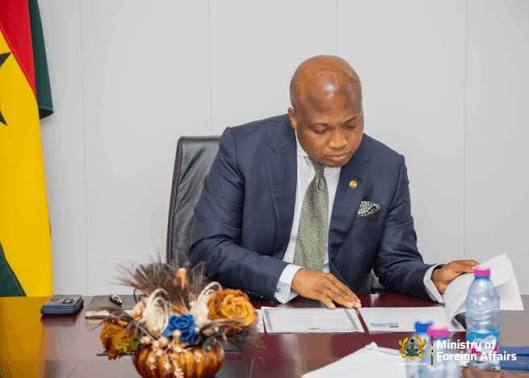
At the centre of the dispute are two competing accounts of the operation. Foreign Affairs Minister Samuel Okudzeto Ablakwa maintains that every evacuee received the promised GH¢5,500 assistance package and that no public funds are missing. The Minority in Parliament, however, says its examination of documents supplied by the Ministry of Foreign Affairs identified discrepancies requiring an independent audit. JoyNews Research has separately reported inconsistencies in the records it examined, including payments without signatures and expenditure for which supporting receipts were unavailable.

The latest development came on Monday, October 26, 2026, when Michael Addo, a representative of the returnees, rejected claims that some evacuees received only the GH¢500 transportation allowance while others received just the GH¢5,000 reintegration grant.

Mr Addo insisted that all members of the group received the complete GH¢5,500 package on their respective arrival dates and urged the public not to allow partisan political interests to distort their experiences.

“It is only fair that we state the facts and refuse to allow petty politics to make us liars,” he said, describing the allegations of incomplete payments as false.
His statement represents a significant defence of the government’s handling of the evacuation. However, it does not independently resolve the discrepancies subsequently reported in the payment records. The distinction is important because an individual’s confirmation of receiving assistance does not, by itself, establish that every payment across the entire group was properly documented or that every expenditure item has been reconciled.

Returnees accuse NPP of attempting to influence the narrative
Mr Addo also alleged that some members of the returnee group had received telephone calls and coaching intended to persuade them to criticise the government’s assistance package.

“We are aware that some members of our group have received calls and coaching to speak against the government, but our conscience will not allow us to do so, even if we support the opposition party rather than the government of the day,” he said.

The allegation, reported by Citi Newsroom on October 26, places the New Patriotic Party at the centre of a fresh dispute over the political interpretation of the evacuation exercise. However, the available account does not independently establish who made the alleged calls, what was said or whether the party formally directed anyone to make particular statements.
The allegation must therefore be treated as a claim by the returnees’ representative rather than proof of an organised political campaign.
It is equally important to distinguish this allegation from the Minority’s documented position on the expenditure. The Minority’s publicly stated demand has been for an audit of the evacuation accounts. Its request for scrutiny should not automatically be equated with an attempt to discredit the government, just as the returnees’ defence should not automatically be dismissed as partisan.
The central question is whether the evidence supports the competing claims.
What the Minority says the records reveal
The Minority’s concerns were outlined by Nana Asafo Adjei Ayeh, Deputy Ranking Member of Parliament’s Foreign Affairs Committee and Member of Parliament for Bosome Freho, following his examination of documents provided by the Foreign Affairs Ministry in response to a Right to Information request.
According to the Minority, the more than 200 pages of records contained inconsistencies in the registers for reintegration grants and transportation allowances, as well as discrepancies in commercial flight documentation, repeated entries and records relating to minors.
Its analysis initially identified only 824 names appearing on both payment registers, against the government’s reported total of 1,964 evacuees. It also said the commercial flight records it examined accounted for 247 passengers, in addition to 926 people it attributed to chartered flights.
On that basis, the Minority argued that substantial portions of the reported passenger numbers and expenditure required further explanation. It subsequently called for an independent audit by a reputable accounting firm, with the findings made public.
The Minority’s calculations have, however, been challenged by the Foreign Affairs Minister, who disputes its interpretation of the records and says the documentation supports the government’s figures.
It would therefore be premature to present the Minority’s estimate of the amount requiring reconciliation as money proven to be missing. The figure represents its assessment of discrepancies in the documents it reviewed, not an established finding of theft, embezzlement or financial loss.
Ablakwa’s defence and the figures he has presented
Mr Ablakwa has firmly rejected the suggestion that the evacuation funds cannot be accounted for. Appearing on JoyNews’ Newsfile programme on October 17, he declared that “not a cedi, not a pesewa is missing”.
The Minister said the evacuation, conducted between May 27 and September 4, 2026, cost GH¢49,721,786. Of that amount, GH¢33,721,786 came from direct government funding, while GH¢16 million was provided by Engineers and Planners, a company owned by businessman Ibrahim Mahama.
He said the expenditure covered chartered flights, commercial airline tickets, ground transportation, feeding, accommodation, medical care and other logistical requirements, in addition to the reintegration and transportation allowances paid to returnees.
According to his breakdown, GH¢38,835,512 was spent on flights and associated logistical costs, while GH¢10,802,000 covered the GH¢5,500 assistance package for 1,964 evacuees. A further GH¢84,274 was allocated to the repatriation of two bodies and related autopsy expenses.
The Minister also said 956 people travelled on chartered flights and another 1,008 returned on commercial services. He cited records involving Ethiopian Airlines, Air Tanzania, ASKY and EgyptAir, arguing that the documents supported the official total of 1,964 returnees.
His defence was that the Minority’s calculations did not adequately account for the full documentation supplied by the Ministry. He also pointed to inconsistencies within the Minority’s own reported figures, including differences between the amounts it cited in separate sections of its statement.
Mr Ablakwa further disclosed that he had requested an audit of government evacuation exercises undertaken since 2017. He has argued that the current operation should be assessed against the costs and arrangements of previous repatriation exercises rather than in isolation.
The Minister’s detailed account provides a substantive response to the questions about the funding and composition of the expenditure. Nevertheless, the existence of a breakdown, passenger lists and payment acknowledgement sheets does not automatically settle every discrepancy raised by other reviewers. The records must be reconciled and the disputed entries explained.
JoyNews Research introduces a separate evidential challenge
The debate acquired another dimension after JoyNews Research disclosed findings from its independent examination of data relating to the evacuation.
In a report published on October 24, the research team said its checks identified duplicate names, payments recorded without signatures and cases in which some evacuees appeared not to have received the full GH¢5,500 package. It also reported that supporting receipts were unavailable for certain expenditure items, including some accommodation and transportation expenses incurred in South Africa.
The team’s Head of Research, Isaac Kofi Adjei, said the review had involved testing the data and manually checking the records provided by its sources. The team also identified dates of birth that appeared impossible or inconsistent, although it said the Ministry or Ghana’s mission in Pretoria subsequently provided clarification on that particular issue.
These findings are particularly relevant to the returnees’ categorical assertion that everyone received the full package. The research findings do not, on their own, establish that the government deliberately withheld money or that the total expenditure was fraudulent. They do, however, raise questions that cannot be dismissed merely by citing the returnees’ collective statement.
There are also important distinctions between the issues raised. A duplicate name in a register does not necessarily establish a duplicate payment. A missing signature does not conclusively prove that money was not received. Similarly, the absence of a receipt in the records made available to a researcher does not automatically establish that an expense was fictitious. Each issue requires verification against the underlying documents and explanations from the officials responsible.
Conversely, the possibility of administrative explanations does not remove the obligation to provide adequate documentation. If the government maintains that the full package was paid to every eligible returnee, it should be able to reconcile the payment registers with the passenger lists and explain entries that appear incomplete or inconsistent.
The publication of the JoyNews findings also means the dispute can no longer be reduced to the question of whether the Minority is acting in good faith. Independent examination of records has identified issues that require substantive responses, regardless of the political affiliations of those raising them.
Minority insists it wants an audit, not a premature accusation
The Minority has explicitly rejected the suggestion that its call for an audit amounts to an accusation of personal wrongdoing against Mr Ablakwa.
Ranking Member of Parliament’s Foreign Affairs Committee Samuel Abu Jinapor said on October 17 that the caucus had not accused the Minister of embezzlement or misappropriation. He explained that the request arose from anomalies identified in the documents and was intended to establish whether the expenditure could be properly reconciled.
Mr Jinapor maintained that the Ministry’s presentation was useful but did not remove the need for an audit.
That clarification is important because the public debate has sometimes blurred the distinction between requesting accountability and alleging criminal conduct. A parliamentary minority has a legitimate oversight responsibility to examine public expenditure, while a minister is entitled to challenge calculations it considers inaccurate and to defend the integrity of the administration.
The appropriate test is whether the competing positions withstand independent scrutiny.
The Minority has proposed that an independent accounting firm examine the expenditure and that the results be made public. The Ministry, for its part, has indicated that the Auditor General has been invited to audit evacuation exercises undertaken by successive governments since 2017. These proposals provide a possible route towards resolving the dispute, provided the audit’s scope, methodology and findings are sufficiently transparent.
The wider question of public accountability
Beyond the disagreement over payments, the controversy raises questions about how emergency evacuation programmes should be financed, documented and evaluated.
The government’s argument is that the operation protected Ghanaian citizens facing xenophobic violence and provided financial support to help them return and reintegrate. The Minority’s position is that the humanitarian objective does not exempt the expenditure from rigorous scrutiny.
Both issues can be addressed without treating them as mutually exclusive. Protecting citizens abroad is a legitimate public responsibility, and public money used to discharge that responsibility must be accounted for with the same rigour expected of other government expenditure.
The returnees have also appealed for continued assistance for Ghanaians stranded in other countries who lack the means to travel home. Mr Addo urged the media to encourage the government to extend its repatriation efforts beyond those who returned from South Africa.
His appeal highlights a separate policy question: whether Ghana should establish a more comprehensive mechanism for assisting citizens who face serious difficulties abroad. Such a programme would require clear eligibility criteria, sustainable funding and safeguards to ensure that assistance reaches those who need it most.
The political controversy should not obscure that humanitarian concern. Nor should the need to help vulnerable citizens prevent the public from asking how the evacuation was organised and how the money was spent.
Ultimately, the dispute will not be resolved by competing press conferences, accusations of propaganda or assurances that all is well. It requires a transparent reconciliation of passenger records, payment registers, airline documentation, receipts and other expenditure records.
Until that process is completed and its findings made public, the returnees’ defence, the Minister’s explanation, the Minority’s allegations and the findings of JoyNews Research must each be assessed according to the evidence supporting them.
The central issue is not which political side succeeds in controlling the narrative. It is whether the GH¢49.72 million expenditure can be fully accounted for, whether the promised assistance reached every eligible returnee and whether the government can demonstrate, through verifiable records, that the operation was conducted transparently and responsibly.

