
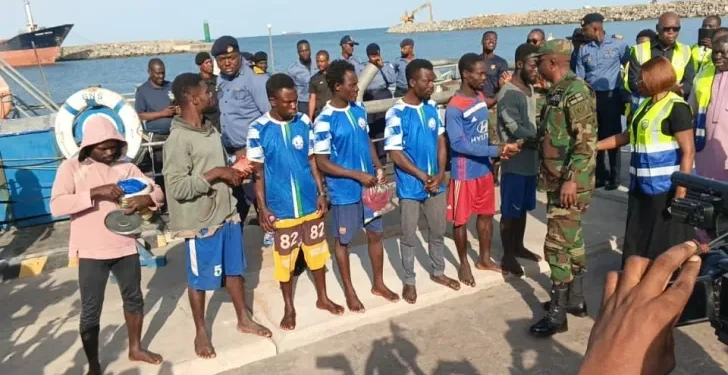

A 29 year old Ghanaian fisherman has recounted the harrowing experience he and six colleagues endured after their canoe’s outboard engine failed at sea, leaving them stranded for almost two weeks with dwindling supplies of food and drinking water.
Kwamena Nkum disclosed that the fishermen exhausted their provisions five days after the engine malfunctioned, compelling them to survive on freshly caught fish and eventually burn sections of their wooden canoe to prepare their meals.

The seven fishermen, all natives of Sekondi, had departed on a fishing expedition to Axim in the Western Region on October 9, 2026, aboard a canoe named Second Chance.

Their routine expedition turned into a desperate struggle for survival three days later when the outboard motor suddenly stopped working. Despite repeated attempts to restore the engine, the men were unable to get it running again, leaving them at the mercy of the sea.

“We usually spend five days at sea, but this time, our motor became faulty on the third day. It just went off. We tried to fix it, but it didn’t work. Our food and water got finished,” Mr Nkum recounted.
With their drinking water depleted, the fishermen resorted to consuming seawater, which they boiled in an attempt to reduce its salt concentration. However, seawater remains unsafe to drink even when boiled, and its high salt content can worsen dehydration.

The men initially relied on fish from their catch to sustain themselves, but some of the fish spoiled and had to be thrown away. They subsequently used hooks and fishing lines to catch fresh fish, providing them with an alternative source of food during their ordeal.
Although the fishermen had fuel and matches to start a fire, their charcoal supplies eventually ran out. With few alternatives available, they resorted to burning pieces of wood removed from their canoe to cook the fish they caught.

After drifting across the waters for several days, the exhausted men eventually spotted land during the night. One member of the group who remained awake noticed the coastline and alerted his companions, raising hopes that help might finally be within reach.

The fishermen switched on their mobile phones and later received a call from a friend identified as Kingsley, who had maintained contact with people on shore.
Mr Nkum said they subsequently contacted their fishing leaders and attempted to establish their whereabouts. Although they initially believed they had drifted into Togolese waters, further inquiries revealed that they had entered the maritime territory of neighbouring Benin.
“We had no food left. We were very hungry,” he recalled.
Through the intervention of Kingsley and their fishing leaders, the stranded men were connected to the chief fisherman in Benin, who provided them with food and drinking water.
The rescue effort subsequently received support from local fishing communities as well as the Beninese and Togolese navies, whose assistance helped bring the fishermen’s dangerous ordeal to an end.
On October 21, 2026, a Togolese naval vessel handed the seven men over to the Ghana Navy at the maritime boundary between Ghana and Togo.
They were later transported safely to the Fishing Harbour in Tema following a coordinated search and rescue operation involving the relevant authorities.
The survivors were identified as Kofi Emmanuel, 32; Uncle Amoah, 45; Kwamena Nkum, 29; Kofi Aboagye, 36; Doboa, 35; Agya Badu, 42; and Kwamena Akyem, 40.
Reflecting on the frightening experience, Mr Nkum said carrying a second outboard motor could have helped avert the crisis or reduced its severity. He emphasised the importance of equipping fishing canoes with backup machinery and essential emergency supplies before embarking on offshore expeditions.
Their survival highlights the dangers fishermen face when mechanical failures occur far from shore, particularly when access to reliable communication, adequate drinking water and emergency assistance is limited.

