
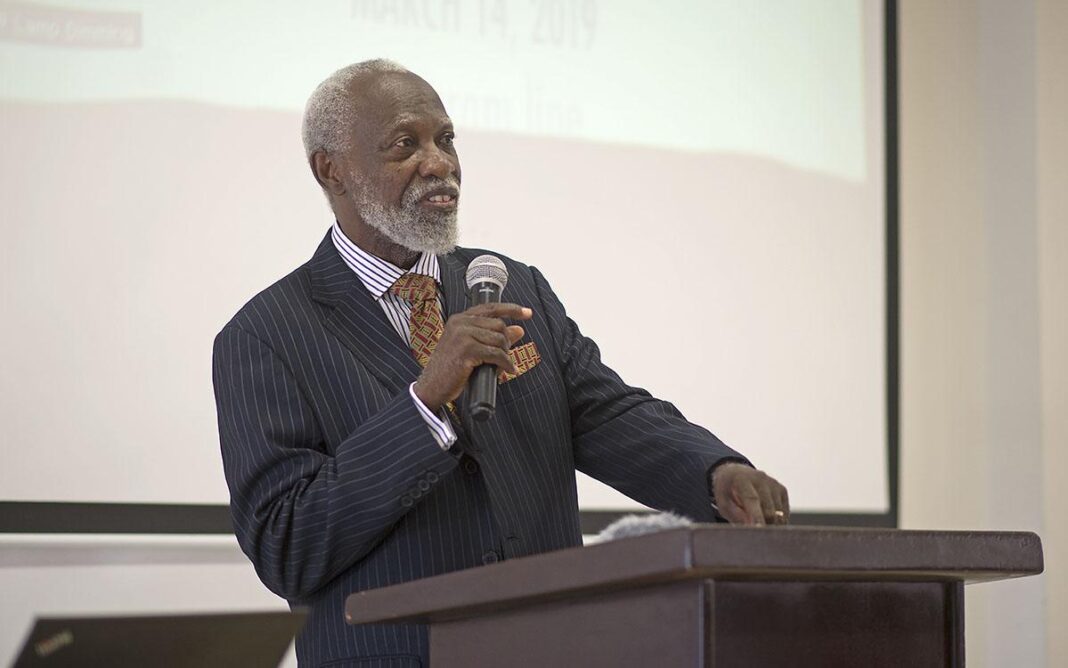

Former Rector of the Ghana Institute of Management and Public Administration (GIMPA), Professor Stephen Adei, has urged Ghana to convert its recent economic stabilisation into sustained economic transformation, cautioning that stability alone cannot guarantee long term development or significantly improve living standards.
He maintained that the country had reached a critical stage in its economic recovery and needed to build on the progress achieved so far by implementing measures capable of reshaping the economy and improving the welfare of its citizens.

Speaking at the 37th Chartered Institute of Marketing, Ghana (CIMG) Annual National Marketing Performance Awards at the Labadi Beach Hotel on Saturday, October 17, 2026, Professor Adei observed that Ghana had made some headway in stabilising its economy over the preceding two years.

He nevertheless stressed that the next challenge was to convert those improvements into meaningful structural change, rather than allowing the country to move repeatedly between periods of economic instability and recovery.

“I believe that in the past two years, Ghana has stabilised somehow in the economic area. But we are at an inflection point, and the challenge is how to translate stability into transformation because we cannot destabilise and stabilise,” he said, adding that the time had come for the country to pursue a more transformative development agenda.
Professor Adei identified stronger economic growth, easing inflation, improved foreign exchange reserves, better credit ratings and renewed domestic and international investment as important indicators of the country’s recovery.

He cited figures from the Ghana Statistical Service and international institutions indicating that Ghana had emerged among the relatively fast growing economies in Africa and across the world, recording economic growth of approximately six per cent.
He also referred to projections by the World Bank and the International Monetary Fund, which placed Ghana’s anticipated growth within a range of 4.8 per cent to 5.7 per cent.

The former GIMPA rector further highlighted the substantial decline in inflation, from 54 per cent in 2022 to 5.2 per cent, although he acknowledged a slight upward movement in the rate.

According to him, inflation was projected to close the year at 4.8 per cent, provided the prevailing trend remained under control.
However, Professor Adei emphasised the importance of distinguishing between falling inflation and declining prices, explaining that a reduction in the rate of inflation did not necessarily mean that goods and services had become cheaper.
He urged political leaders to communicate this economic distinction more effectively to the public, noting that prices could continue increasing even when inflation had dropped considerably. A lower inflation rate generally means that prices are rising more slowly, rather than that previous price increases have been reversed.
Turning to the external sector, Professor Adei said Ghana had strengthened its foreign reserve position and made progress in its international credit ratings, referring to assessments by Moody’s and S&P Global Ratings.
He attributed much of the recent stabilisation to favourable external developments and the government’s efforts to consolidate public finances. He also identified the achievement of a primary budget surplus as a positive step towards improving fiscal discipline.
Despite these gains, he warned that the recovery remained susceptible to setbacks, pointing to indications that the country’s foreign reserves had declined slightly.
Professor Adei also questioned the strategy for achieving the government’s reported objective of accumulating foreign reserves equivalent to 15 months of imports by 2028. He argued that the authorities needed to explain more clearly how the ambitious target would be attained and sustained.
He called for greater clarity regarding the policies, financing arrangements and structural reforms required to protect the progress already achieved and establish a stronger foundation for long term economic development.
Although he acknowledged that the government had introduced specific flagship initiatives, the former rector maintained that Ghana needed a broader and more comprehensive approach to economic transformation.
He stressed that the country must use the current period of relative stability to strengthen its economic structure, improve investment conditions and deliver lasting benefits to citizens, rather than treating stabilisation as the ultimate objective of economic management.

