
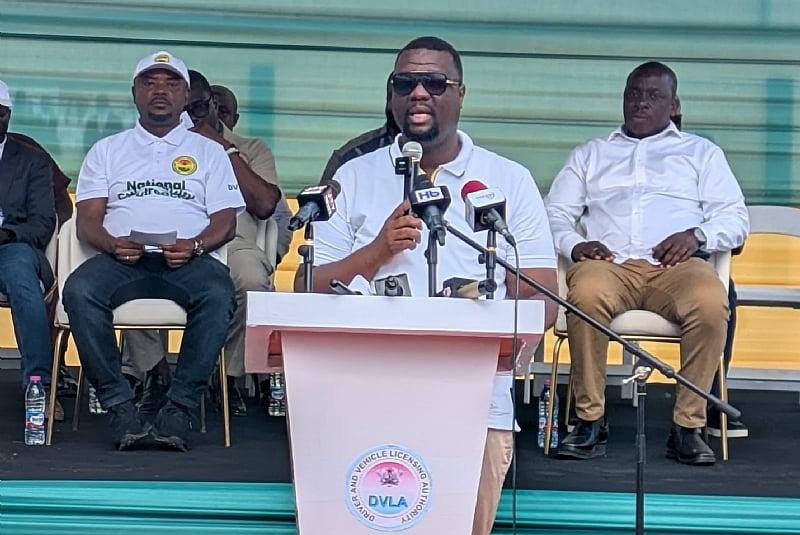

The Driver and Vehicle Licensing Authority (DVLA) says it has renegotiated its service level agreement for roadworthiness certificates, reducing the revised contract cost to GH¢2 million for the 2026 to 2028 period, following an earlier arrangement that was projected to cost US$155.4 million over three years.
The Chief Executive Officer of the DVLA, Julius Neequaye Kotey, announced the revised agreement during the Government Accountability Series on Monday, October 12, 2026, describing the move as part of efforts to contain expenditure, improve financial management and ensure more efficient use of public resources.

Mr Kotey explained that the previous agreement, which covered the period from 2023 to 2025, carried an annual cost of US$51.8 million, translating into projected expenditure of US$155.4 million over the three year term.

He said the authority subsequently reviewed the arrangement and renegotiated its terms, resulting in a new agreement valued at GH¢2 million for the three years covering 2026, 2027 and 2028.

“For the three years, we immediately reviewed the agreement, renegotiated, and reduced the SLA cost to 2 million Ghana cedis. That is from 2026, 2027, and 2028,” he said.
Mr Kotey contrasted the revised arrangement with the previous contract, which he said would have required annual payments of US$51.8 million and total expenditure of US$155.4 million over three years.

“Instead of paying $51.8 million annually, summing up to $155.4 million for three years, we are now paying 2 million Ghana cedis for the three years,” he stated.
According to the DVLA chief executive, the renegotiation would generate savings of approximately US$50 million annually.

“This translates to savings of about $50 million every year,” he added.

However, the financial figures presented require further clarification to establish the precise scale of the savings. The previous agreement was denominated in United States dollars, whereas the revised contract is expressed in Ghana cedis. A direct comparison therefore requires the applicable exchange rate and confirmation that both figures cover equivalent services, contractual obligations and associated costs.
The stated annual savings of approximately US$50 million also warrant further explanation, given that the revised agreement is valued at GH¢2 million for the entire three year period. Details of the calculation would help establish how the authority arrived at the projected savings and whether the figures account for all relevant contractual expenses.
The renegotiation nevertheless represents a significant change in the reported cost structure of the roadworthiness certificate service arrangement, according to the DVLA’s account.
Further disclosure of the revised contract terms, the services covered and the methodology used to calculate the savings would enable the public to assess the financial implications of the agreement more comprehensively.
The announcement formed part of the Government Accountability Series, which provides a platform for public institutions to report on their activities, expenditure and measures intended to improve the management of public resources.

