
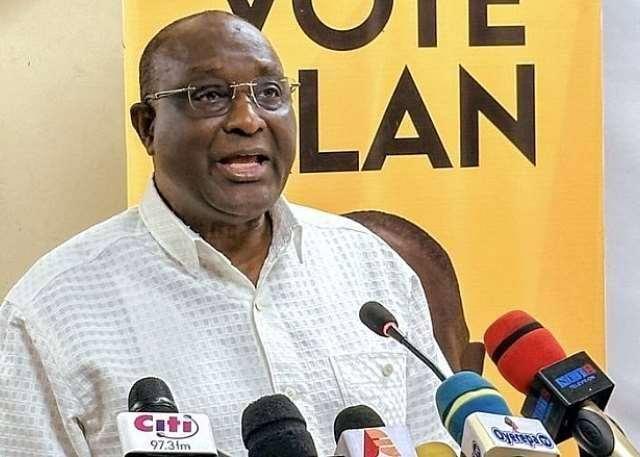

United Party leader Alan John Kwadwo Kyerematen has renewed his call for Ghanaians to consider moving beyond the longstanding dominance of the New Patriotic Party and the National Democratic Congress when the country goes to the polls in 2028.
Speaking in an interview with Joy Prime host Nathaniel Attoh, Mr Kyerematen said his extensive experience in Ghanaian politics and his recognition across the country positioned him to present what he describes as an alternative to the established political order. His comments were reported on Monday, September 28, 2026, as the political conversation surrounding the 2028 presidential election continues to develop.

Mr Kyerematen described himself as an experienced participant in Ghanaian politics and argued that his years in public life had given him substantial national visibility. He said that in almost every part of the country, people either recognise him personally or identify with his popular political name, Alan Cash.

“I am an old horse in this game,” he said, while maintaining that his conduct throughout his political career had helped him build goodwill among sections of the Ghanaian electorate.

The United Party leader said his expectation was that voters would make what he called a “strategic choice” at the 2028 general election, with the objective of altering the political configuration that has prevailed for decades.
“My hope is that in 2028, the people of Ghana will make a strategic choice to move our country forward by ending the duopoly,” he stated.

Mr Kyerematen’s call is centred on his contention that Ghana’s political system has been dominated by two major parties for an extended period without resolving a number of persistent developmental concerns. He attributed what he described as the country’s continuing underdevelopment to the prolonged political dominance of the NPP and NDC, making clear that this represents his own political assessment of the country’s development record.
He questioned why, after what he described as 34 years of alternating political dominance, successive administrations had continued to confront challenges involving basic infrastructure and essential public services.

Among the issues he cited were the condition of roads, reliability of electricity and access to potable water. He questioned why some communities continue to experience difficulties with basic infrastructure despite the length of time that the two dominant parties have exercised political power.

“Our lights don’t stay on,” he said, while also claiming that there are Ghanaians who have lived for decades without having running water in their homes.
The former Trade and Industry Minister also turned his attention to education, pointing to recurring difficulties associated with Ghana’s Computerised School Selection and Placement System.
He argued that the repeated problems surrounding the placement of students demonstrate what he considers to be continuing weaknesses within the education system, particularly because similar difficulties arise from one placement cycle to another.
“Our educational system has so many challenges. Even we can’t work with the computerised system to place students. Every year we have a repeat of these challenges,” he said.
Mr Kyerematen further identified healthcare as another area in which he believes Ghana continues to experience significant difficulties, adding that the challenges within the sector form part of his broader argument about the need for a different approach to national development.
His latest comments form part of a broader political positioning by the United Party as an alternative to the two parties that have alternated in government since Ghana’s return to constitutional multiparty democracy in 1992.
The United Party emerged from Mr Kyerematen’s Movement for Change, which he established around his independent presidential campaign for the 2024 election. The organisation subsequently transitioned into the United Party, positioning itself as a separate political platform. Reports from the party’s 2025 rebranding described its stated objective as providing Ghanaians with an alternative political vehicle outside the established NPP and NDC structure.
Mr Kyerematen has continued to emphasise this alternative political identity in his public engagements. In another interview earlier in September, he said he remained committed to challenging what he described as the NPP and NDC duopoly and argued that Ghana could have achieved greater development after decades of alternating governments.
His position has also extended into economic policy. On September 24, he called for Ghana’s economic transformation to be driven more strongly by private enterprise, industrialisation, agricultural transformation and export expansion, arguing that private initiative and ownership should play a central role in the country’s development.
Mr Kyerematen has also recently commented on the country’s economic performance under the current administration, acknowledging improvements in some macroeconomic indicators while arguing that a longer period of sustained growth would be necessary before those improvements could be characterised as lasting economic stability.
His latest intervention therefore combines his criticism of the existing political arrangement with his broader argument that Ghana requires a different approach to governance and economic development. However, the specific statements in the Joy Prime interview focused principally on his assessment of the country’s longstanding developmental challenges and his call for voters to consider an alternative political direction in 2028.
The debate over the structure of Ghanaian politics is consequently likely to remain an important feature of the political conversation as the 2028 election approaches. Mr Kyerematen is presenting the United Party as an alternative political platform, while his argument for ending what he calls the NPP and NDC duopoly is based on his assessment that persistent problems in infrastructure, electricity, water, education and healthcare demonstrate the limitations of the existing political arrangement.
For now, his message is directed towards the 2028 electorate and centres on a call for voters to consider whether Ghana’s established two party political pattern should continue or whether an alternative political configuration should be considered.

