
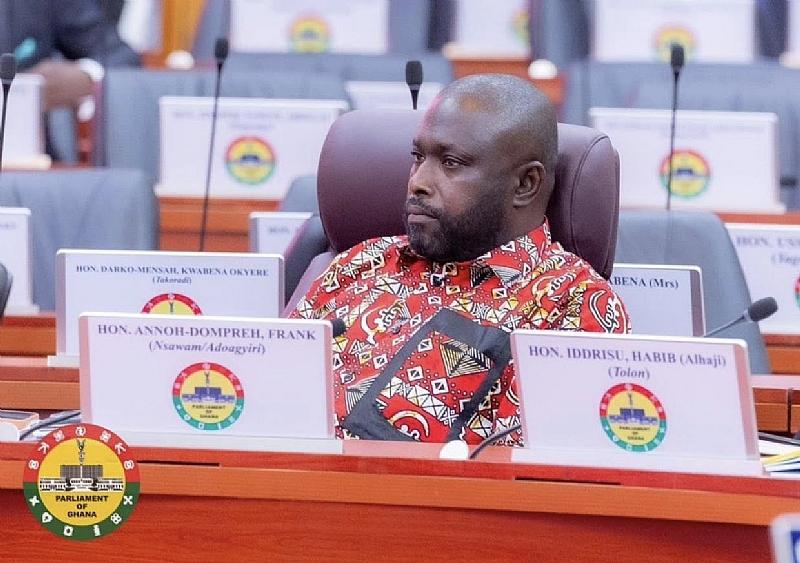

First Deputy Minority Whip and Member of Parliament for Tolon, Habib Iddrisu, has formally initiated moves for Parliament to investigate a series of major narcotics seizures connected to consignments originating from Ghana, intensifying scrutiny of the country’s ports, customs procedures and security systems ahead of Parliament’s extraordinary sitting on Tuesday, September 29, 2026.
Mr Iddrisu submitted a Private Members’ Motion to the Clerk to Parliament on Monday, September 28, invoking Standing Order 102 and calling for the establishment of an Ad Hoc Committee to conduct an extensive, transparent and bipartisan examination of the circumstances surrounding the seizures. The motion is backed by nine other New Patriotic Party Members of Parliament, namely Reverend John Ntim Fordjour, Alexander Afenyo Markin, Kojo Oppong Nkrumah, Dominic Nitiwul, Abena Osei Asare, Patrick Boamah, Alhassan Tampuli, Mahama Abdul Kabiru and Samuel Awuku.

The proposed parliamentary investigation comes just hours before the House is scheduled to reconvene from recess for an extraordinary sitting summoned by Speaker Alban Sumana Kingsford Bagbin. The Speaker directed Parliament to assemble at noon on Tuesday, September 29, under Article 112(3) of the 1992 Constitution and Order 53 of the Standing Orders.

The motion seeks the creation of the Ad Hoc Committee pursuant to Article 103 of the Constitution and Order 262 of Parliament’s Standing Orders. Its proposed mandate would extend beyond any single seizure and examine a broader pattern of narcotics interceptions associated with Ghana since the commencement of the Ninth Parliament.

At the centre of the proposed inquiry is the seizure of almost 3.9 metric tonnes of cocaine by French Customs at the Port of Dunkirk on September 10, 2026. According to the parliamentary motion, the consignment has an estimated value of about US$261 million, while French authorities have separately placed its value at approximately €225 million. The cocaine was reportedly concealed within a container of plastic waste that had arrived in France from Ghana.
The proposed investigation would also examine the seizure of approximately 320 kilogrammes of methamphetamine by Australian authorities in June 2026 from a consignment reportedly linked to Ghana. The motion further refers to significant cocaine interceptions recorded in Ghana during 2025 and seeks authority for the proposed committee to examine any additional narcotics seizure associated with Ghana since the beginning of the Ninth Parliament.

A central question before the proposed committee would be how the consignments were able to move through Ghana’s export and clearance systems before being intercepted abroad.
The sponsors want Parliament to establish the precise circumstances under which the consignments were processed, examined, cleared and ultimately exported from Ghana. This would include determining the ports or other points from which the shipments departed and examining the security procedures applied before the consignments left the country.

Particular attention would be directed towards intelligence profiling, scanning arrangements, physical inspections, customs clearance procedures and other safeguards intended to prevent prohibited substances from being concealed within legitimate commercial shipments.

The inquiry would also seek to identify the companies, government institutions and other organisations that participated in processing, handling, inspecting or clearing the consignments. The proposed investigation, however, would have to take account of restrictions associated with ongoing criminal investigations and the legal rights of persons who may be under investigation.
Beyond the individual shipments, the proposed committee would be expected to examine whether Ghana’s existing surveillance and security architecture is sufficiently equipped to detect international narcotics trafficking.
This would include an assessment of scanning equipment, intelligence gathering, surveillance mechanisms and other security arrangements operating at the country’s seaports, airports and points of entry and departure.
The inquiry would also consider the actions taken by Ghanaian authorities after the various seizures were announced, including the status of investigations, arrests and prosecutions. Another proposed area of examination is the extent to which Ghanaian agencies have exchanged intelligence and cooperated with authorities in France, Australia and other jurisdictions involved in narcotics investigations connected to Ghana.
The sponsors are further seeking an examination of efforts to identify the financiers, organisers, facilitators and wider networks allegedly responsible for large scale narcotics trafficking operations.
Such an examination would potentially bring several state institutions into focus, including agencies responsible for national security, customs administration, port management, immigration, narcotics control and transportation.
The parliamentary initiative follows a formal petition previously submitted by the Minority Caucus to Speaker Bagbin requesting the recall of Parliament from recess over what the Caucus described as urgent national security concerns arising from the narcotics seizures.
The petition argued that the incidents raised questions about the security and integrity of Ghana’s ports and export systems, customs controls, intelligence gathering and the effectiveness of the country’s narcotics enforcement arrangements.
The Speaker subsequently issued a formal notice recalling Parliament for Tuesday, September 29. His notice did not initially specify the detailed business for the sitting, with the Order Paper expected to set out the matters to be considered by the House.
The move has nevertheless generated discussion within Parliament over the appropriate mechanism for examining the narcotics seizures. While the Minority has pushed for parliamentary scrutiny, some members of the Majority have questioned the necessity of recalling the House, pointing to ongoing investigations and the existing oversight responsibilities of parliamentary committees.
There has also been support for parliamentary examination from outside the House. University of Ghana political scientist Dr Joshua Ebuntie Zaato has argued that parliamentary oversight could provide an additional avenue for examining information surrounding the seizures and the responses of relevant security institutions.
The proposed inquiry therefore arrives at a particularly significant moment for Ghana’s narcotics control and border security framework. The latest developments have raised questions not only about the quantities of prohibited substances intercepted abroad, but also about the systems through which legitimate cargo is processed before leaving Ghanaian territory.
If Parliament proceeds with the proposed Ad Hoc Committee, its work could consequently extend from individual narcotics consignments to the broader architecture governing Ghana’s ports, customs operations, intelligence systems, cargo inspections and international security cooperation.
The sponsors have indicated that the ultimate purpose of the exercise would be to identify weaknesses and recommend legislative, administrative, institutional and security reforms capable of strengthening the country’s ability to detect and prevent international narcotics trafficking.
For Parliament, Tuesday’s extraordinary sitting is therefore expected to place the circumstances surrounding the recent seizures firmly before the national legislature, with particular attention likely to centre on how the consignments passed through Ghana, which institutions handled them, what safeguards were applied and what measures can be adopted to prevent similar incidents in the future.

