
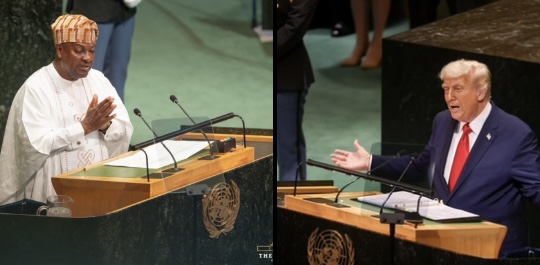

President John Dramani Mahama has called for dialogue and respect for human life in resolving international conflicts, telling world leaders at the 81st United Nations General Assembly that no human civilisation deserves to be annihilated.
The Ghanaian President made the statement in New York on Thursday, September 24, 2026, two days after United States President Donald Trump used the word “annihilate” while addressing the same global gathering and discussing the continuing conflict involving Iran.

Although President Mahama did not mention President Trump by name, his reference to the annihilation of a human civilisation came shortly after the American leader had publicly raised the possibility of annihilating the Islamic Republic of Iran if diplomatic efforts failed to produce an agreement.

President Trump, speaking at the United Nations on Tuesday, September 22, said he faced a choice between reaching a deal that would allow Iran to rebuild and what he described as annihilating the Islamic Republic. He also said he believed an agreement could ultimately be reached.

Against that backdrop, President Mahama urged the international community to return to negotiations and pursue diplomatic avenues for resolving even the most difficult disputes.
“The current Middle East crisis is having a deleterious effect on the world economy. We call for a return to the negotiating table,” he told the Assembly.

He subsequently declared that “no human civilisation deserves to be annihilated, certainly not a member state of the United Nations,” before adding that dialogue could resolve even the most intractable international problems.
President Mahama also called for a consistent application of international standards in dealing with armed conflicts across different regions of the world. He urged states to respect sovereignty, protect civilians, guarantee unhindered humanitarian assistance and ensure accountability for alleged violations of international humanitarian law.

“Across every conflict, whether in Europe, the Middle East, or Africa, the standard must remain uniform,” he said.

His intervention formed part of a wider address in which he warned against what he described as the erosion of multilateral norms and the growing tendency towards unilateral action in international affairs.
President Mahama said the United Nations Charter should remain central to the international system and argued that sovereign equality should apply consistently to all nations rather than being conditioned by their relationships with major global powers.
The President’s remarks on Iran came within a broader discussion of conflicts affecting the international system. He referred to instability in the Middle East, the war in Sudan, the situation involving Palestinians and conflicts affecting parts of Africa, while calling for greater international cooperation in addressing humanitarian crises.
Beyond the Middle East crisis, President Mahama used his appearance before the General Assembly to renew Ghana’s call for structural reform of the United Nations Security Council.
He argued that Africa should receive permanent representation on the Council, including the rights, responsibilities and veto powers attached to permanent membership. Ghana’s position is that the continent’s exclusion from permanent representation does not adequately reflect its population, political importance or role within the United Nations system.
President Mahama noted that Africa has approximately 1.5 billion people and represents more than 18 percent of humanity, while also constituting the largest regional voting bloc within the General Assembly. Yet, he observed, the continent has no permanent seat on the Security Council.
He also called for reform of the international financial architecture, arguing that developing countries face substantially higher borrowing costs than industrialised economies.
According to the President, developing nations affected by climate related disasters are frequently compelled to borrow to rebuild after floods, droughts and other events despite contributing relatively little to global greenhouse gas emissions. He called for longer term, affordable and accessible concessional financing to support human capital development, industrialisation and climate adaptation.
Climate finance also featured prominently in his address, with President Mahama urging developed countries to provide climate support through predictable grants rather than loans. He argued that countries contributing least to global emissions should not be pushed further into debt when responding to climate related disasters.
The Ghanaian leader further advanced the country’s campaign for reparatory justice relating to the transatlantic trafficking and enslavement of Africans.
He recalled that on March 25, 2026, the United Nations General Assembly adopted Resolution A/RES/80/250, with 123 countries voting in favour of recognising the transatlantic slave trade and chattel enslavement as the gravest crimes against humanity. He argued that recognition should be followed by practical measures addressing the continuing structural consequences of those historical injustices.
President Mahama linked that agenda to broader questions surrounding international trade, resource extraction, debt and economic development, arguing that Africa should receive greater value from its natural resources rather than continuing primarily as an exporter of unprocessed commodities.
He specifically called for greater African participation in the processing of critical minerals needed for the global transition towards cleaner energy. His position is that African countries should process more of their mineral resources domestically, develop industries around them and retain a larger proportion of the resulting economic value.
The President also presented the African Continental Free Trade Area as an important mechanism for promoting intra African commerce, industrialisation and economic transformation, noting that its Secretariat is located in Accra.
His remarks at the United Nations therefore combined an appeal for restraint in the Middle East with a broader argument for changes to the structures governing international peace, finance, trade and development.
The immediate context, however, was the escalating dispute involving the United States and Iran. President Trump’s September 22 address placed the possibility of an agreement with Tehran alongside his stated willingness to contemplate further military action, including the language concerning annihilation.
President Mahama’s subsequent statement did not explicitly identify the United States or President Trump, but its timing and its use of the same term drew attention to the contrast between the two addresses. Ghana’s President instead emphasised negotiations, civilian protection, sovereignty and adherence to international law as principles he said should apply across conflicts.
His intervention adds Ghana’s voice to the broader diplomatic discussion surrounding the Iran conflict, while also placing the country’s longstanding calls for multilateral reform, African representation and greater economic equity at the centre of its participation in the 81st United Nations General Assembly.

