
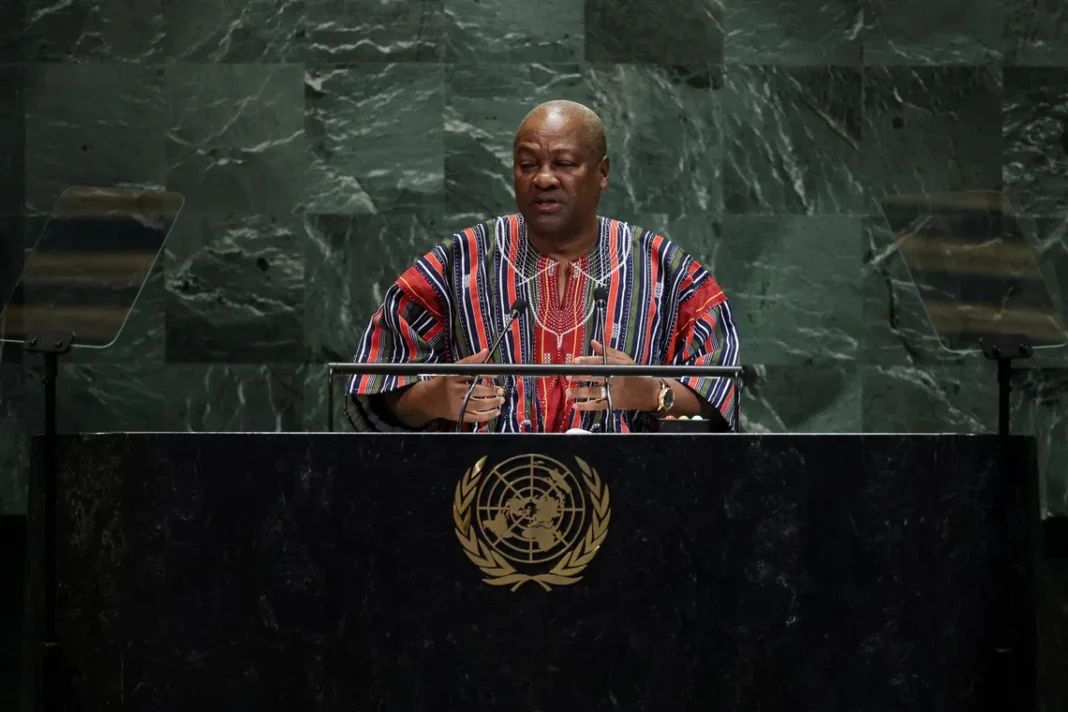

President John Dramani Mahama has outlined three principal measures Ghana is proposing to transform the global reparatory justice campaign from international recognition of historical injustices into concrete programmes for restitution, cultural restoration and development.
President Mahama presented the proposals on Wednesday, September 23, 2026, during a High Level Side Event on the Next Steps in New York, held on the margins of the 81st United Nations General Assembly.

The meeting focused on implementing the Accra Next Steps Commitments on Reparatory Justice, which emerged from the High Level Consultative Conference convened in Accra in June 2026 following the adoption of United Nations General Assembly Resolution A/RES/80/250 in March. Ghana has established international advisory, cultural heritage and legal mechanisms to help translate those commitments into practical measures.

President Mahama said the international community must now move beyond acknowledging the historical consequences of the trafficking and enslavement of Africans and concentrate on implementing measures capable of addressing their continuing effects.

“We must move from acknowledgement to action, from commitments to implementation,” he said.
The President identified the establishment of a permanent and institutionalised international framework for restitution as the first pillar of Ghana’s proposed approach.

Under the proposal, the United Nations and countries that currently hold African cultural property would be encouraged to develop clearer and more consistent legal and diplomatic procedures for restitution. Such mechanisms, he said, should facilitate provenance research, expand access to historical archives and reduce legal obstacles that can prevent the return of cultural property to its countries and communities of origin.
President Mahama also placed the unconditional return of African human remains among the immediate priorities of the restitution agenda.

His argument extends the debate beyond the recovery of artefacts to the repatriation of the remains of Africans held in museums and other collections outside the continent.

“Human remains are not collectibles. They are not specimens. They are our ancestors. They are our fathers, mothers, kings, and elders,” President Mahama said.
The second pillar concerns Africa’s ability to receive, preserve, research and manage cultural heritage that is returned to the continent.
President Mahama rejected the argument that restitution should be postponed because some African countries may not yet possess sufficient facilities for conservation and preservation.
“Capacity constraints must never be used as a justification for continued possession. Capacity must serve as a bridge to return, not a barrier to justice,” he said.
The President pointed to ongoing continental initiatives intended to strengthen Africa’s cultural heritage infrastructure, including the proposed Great African Museum of the African Union and the AU EU Museum Partnership.
Ghana’s Foreign Affairs Ministry has similarly identified the protection of cultural property, preservation of heritage and the accelerated return of cultural property, human remains, archives and other heritage resources as central components of the Accra Next Steps Commitments.
President Mahama said the third pillar should involve transforming cultural heritage into a contributor to economic and social development.
He called on multilateral development banks, international financial institutions, philanthropic organisations and private sector institutions to support investment in Africa’s cultural infrastructure.
Such investment, he said, should encompass regional archives, conservation laboratories, digitisation programmes and specialised professional training.
The President argued that cultural heritage, when properly preserved and made accessible, could contribute to education, strengthen national and continental identity, stimulate tourism and support the creative economy.
His proposals form part of Ghana’s continuing campaign to translate the United Nations’ March 2026 resolution into practical measures addressing the historical and continuing consequences of the trafficking and enslavement of Africans.
The United Nations General Assembly adopted Resolution A/RES/80/250 on March 25, 2026, following a Ghana led diplomatic initiative. The resolution recognised the transatlantic trafficking of enslaved Africans and racialised chattel enslavement of Africans as the gravest crime against humanity and provided a basis for further international discussion on reparatory justice.
Ghana subsequently convened a High Level Consultative Conference in Accra in June to determine the next steps following the United Nations resolution. The process produced the Accra Next Steps Commitments and resulted in the establishment of three international bodies, namely the Global Advisory Panel on Reparatory Justice, the Global Experts Panel on the Restitution of Cultural Heritage and the Global Legal Panel on Reparatory Justice.
The September 23 meeting in New York was therefore designed to receive progress reports from those mechanisms and advance international cooperation on restitution and reparatory justice. Ghana’s Foreign Affairs Ministry said the objective was to move the international campaign from commitments towards practical implementation.
President Mahama also used the occasion to emphasise the particular importance of returning African cultural objects and human remains that were removed from the continent during periods of conquest, colonial expansion and military intervention.
He cited the destruction and looting of the Asante Royal Palace in Kumasi by British forces in 1874 as an example of the historical circumstances through which African cultural property was taken abroad. He noted that some objects removed from Ghana have subsequently been returned, including the Mpomponsuo sword in 2024.
He also referred to the case of King Badu Bonsu II of Ahanta, who was executed by Dutch authorities in 1838 and whose head was subsequently taken to the Netherlands for phrenological examination. His remains were eventually returned to Ghana in 2009.
For President Mahama, such cases demonstrate that the restitution debate cannot be confined to museum objects. It must also address the continued possession of African human remains by institutions outside the continent.
“Restoring them is not a matter of legal ownership; it is a fundamental test of our shared human dignity,” he said.
The President maintained that African cultural objects and human remains should ultimately be restored to the communities and institutions with which they are historically connected. He described the heritage not merely as material from a distant historical period but as an integral component of living African traditions and collective identity.
Ghana’s initiative is now entering a phase in which diplomatic recognition must be accompanied by institutional arrangements, legal frameworks, provenance investigations, cultural infrastructure and financial resources capable of supporting restitution.
The emphasis on implementation also reflects the official purpose of the New York side event, which was convened under the theme “From Commitments to Action on Reparatory Justice: Advancing International Cooperation for the Return and Restitution of Cultural Properties and Heritage.”
President Mahama’s three pillar framework consequently places restitution, African institutional capacity and cultural development at the centre of Ghana’s proposed next phase of the global reparatory justice campaign, as the country seeks to build international cooperation around the return of Africa’s cultural heritage and human remains.

