
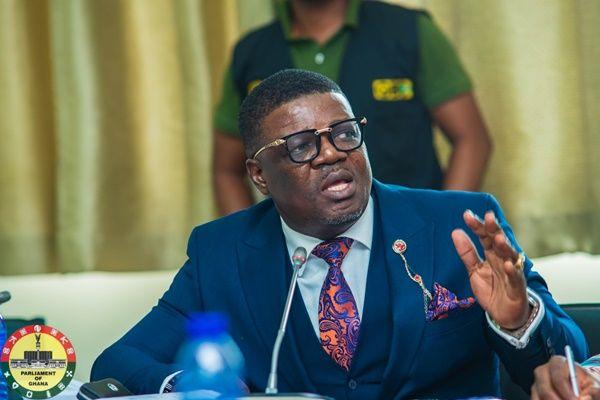

Majority Chief Whip and South Dayi Member of Parliament, Rockson Nelson Dafeamekpor, has warned that parliamentary leaders will resist any attempt by law enforcement authorities to circumvent what he describes as the established constitutional procedure for arresting sitting Members of Parliament.
His intervention follows the attempted arrest of Manhyia South MP Nana Agyei Baffour Awuah by personnel of the Economic and Organised Crime Office, EOCO, at the precincts of the Accra High Court on Wednesday, September 23, 2026.

Mr Dafeamekpor, who is also a lawyer, argued that any attempt by a law enforcement institution to arrest a sitting Member of Parliament must take account of the constitutional protections afforded to legislators.

In a post on X following the incident, he referred specifically to Article 117 of the 1992 Constitution, which provides that civil or criminal process originating from a court or place outside Parliament shall not be served on or executed against the Speaker, a Member of Parliament or the Clerk to Parliament while that person is travelling to, attending or returning from parliamentary proceedings.

Mr Dafeamekpor said the established parliamentary practice requires law enforcement agencies seeking to arrest a sitting MP to channel the process through the Speaker of Parliament.
He consequently described the reported attempt to arrest Nana Agyei Baffour Awuah at the court premises as unacceptable if the applicable parliamentary procedure had not been followed.

“It is therefore absolutely unacceptable for EOCO to seek to arrest a sitting Member of Parliament especially within the precincts of Court without applying the procedure in force regarding his Article 117 rights,” he stated.
The South Dayi legislator further cautioned EOCO and other state security institutions against conduct which, in his view, could undermine the authority, dignity and institutional standing of Parliament as a constitutionally recognised arm of government.

He maintained that parliamentary leaders would oppose any attempt to undermine the established relationship between Parliament and state institutions responsible for law enforcement.

“As leaders in Parliament, we would resist any attempt to breach the established protocol and the cordial relationship that exists between Parliament and other institutions of state including EOCO,” he wrote.
Mr Dafeamekpor also invoked the principle that where legislation establishes a procedure for exercising a legal right or power, that procedure ought to be followed. In making the argument, he cited the case of Boyefio v NTHC.
His comments come amid competing accounts concerning Wednesday’s confrontation between Nana Agyei Baffour Awuah and EOCO personnel.
EOCO has confirmed that its officers attempted to arrest the Manhyia South MP in connection with an ongoing investigation. The agency said the action formed part of lawful measures intended to secure his attendance after he allegedly failed to honour two invitations issued to him in February 2026.
According to EOCO, the attempted arrest was not completed because the situation escalated and its officers assessed that continuing with the operation could have endangered public safety. The agency has maintained that the investigation remains active.
Nana Agyei Baffour Awuah, however, has disputed the circumstances surrounding the attempted arrest and said he drove away from the court because he feared for his safety. He has also questioned the authority of the woman who approached him and said she was unable to produce an arrest warrant when he requested one.
The confrontation occurred after Nana Agyei Baffour Awuah had appeared before the Accra High Court as legal counsel for detained nurse Salomey Baffoe Awiti. The court subsequently adjourned the nurse’s bail application to Thursday, September 24, after the prosecution requested additional time to respond to the defence application.
Mr Dafeamekpor stressed that his objection was not intended to prevent lawful investigations or place Members of Parliament beyond the reach of the law.
Rather, he maintained that where allegations exist against a legislator, the appropriate legal processes should be followed.
“If the Hon Baffour Awuah is alleged to have committed any offence, for which EOCO requires his presence, by all means, let the law speak but let the law follow lawful procedure,” he stated.
The Majority Chief Whip also raised concerns about the timing of the incident, noting that Parliament was hosting a major conference of the ECOWAS Parliament in Accra.
He argued that disputes involving state institutions and Parliament, particularly in circumstances that could be perceived as procedural impropriety, could have implications for Ghana’s institutional image both domestically and internationally.
“As of this moment, the Parliament of Ghana is hosting the ECOWAS Parliament in a major conference here at Parliament House in Accra. Such seemingly casual cases of procedural impropriety hurt the sterling image of Ghana here and abroad,” he said.
The controversy has consequently placed renewed attention on the scope and application of parliamentary privilege under Ghana’s Constitution, particularly Article 117 and the circumstances in which law enforcement authorities may execute criminal process against serving legislators.
Article 117 itself provides a specific protection in relation to parliamentary proceedings, rather than creating a general immunity from arrest for Members of Parliament. It protects the Speaker, MPs and the Clerk from service or execution of civil or criminal process while they are proceeding to, attending or returning from proceedings of Parliament.
The disagreement between Parliament and EOCO is therefore likely to turn partly on the circumstances in which the attempted arrest occurred, the nature of the investigation, the status of the February invitations and the applicability of Article 117 to the particular circumstances surrounding Nana Agyei Baffour Awuah.
For the moment, Parliament’s leadership has signalled that while it does not seek to obstruct lawful investigations, it expects law enforcement institutions to observe the constitutional procedures governing their interaction with sitting legislators. EOCO, for its part, maintains that its officers were acting within their statutory responsibilities when they attempted to secure the MP’s attendance.

