
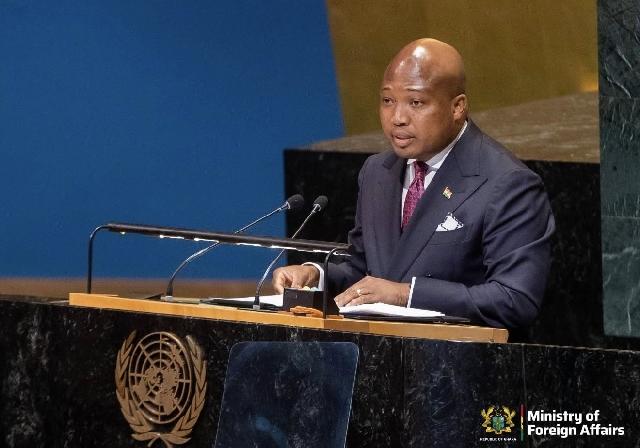

United States authorities have formally communicated their willingness to engage with Ghana on its reparatory justice agenda, Foreign Affairs Minister Samuel Okudzeto Ablakwa has disclosed, despite Washington having voted against the Ghana sponsored United Nations resolution on the historical legacy of the transatlantic slave trade.
Mr Ablakwa said the communication from the United States represented an indication that Washington remained prepared to engage Ghana on areas of mutual interest within the broader pursuit of reparatory justice.

He made the disclosure on Wednesday, September 23, 2026, while addressing the High Level Side Event on the Next Steps in New York, an initiative hosted by President John Dramani Mahama during the 81st United Nations General Assembly.

According to the Foreign Affairs Minister, Ghana had received formal communication from the United States expressing its readiness to cooperate with the country despite its position during the United Nations vote.

“We have received formal notice from the United States of America that even though they voted against this resolution, they are willing to begin to work with us towards that fair and just world we all seek,” Mr Ablakwa said.
The disclosure comes against the background of the landmark United Nations General Assembly resolution adopted on March 25, 2026, following an initiative spearheaded by Ghana. The resolution recognised the transatlantic trafficking of enslaved Africans and the system of racialised chattel enslavement of Africans as the gravest crime against humanity and called for measures addressing the historical and continuing consequences of slavery.

The resolution secured 123 votes in favour, while the United States, Israel and Argentina voted against it. Fifty two countries abstained. The resolution is not legally binding, although it carries political significance within the international debate over historical responsibility, restitution and reparatory justice.
Mr Ablakwa said the willingness of the United States to engage Ghana demonstrated, in his view, that the reparatory justice campaign should not be interpreted as an attempt to create divisions between countries.

He maintained that Ghana’s objective was to promote dialogue, reconciliation and a broader international effort to address the consequences of historical injustice.

“The Ghana led effort is not about dividing the world. It is rather about bringing us together. It is rather about healing. It is rather about genuine reconciliation,” he stated.
The Minister further emphasised President Mahama’s commitment to pursuing the reparatory justice initiative through international cooperation and dialogue.
He said the Ghanaian President, who has assumed a prominent role in advancing the global reparatory justice agenda, was approaching the initiative with the objective of securing practical international cooperation rather than pursuing concealed political or diplomatic interests.
“There are no hidden agendas. There is no secret motive. All we seek is to build a new world, a fair and just world, a world without racism, a world without discrimination,” Mr Ablakwa said.
The latest development forms part of Ghana’s broader effort to translate the March United Nations resolution from an international declaration into practical measures concerning restitution, historical accountability and the preservation and restoration of African cultural heritage.
Ghana has subsequently established three international mechanisms to advance the agenda, namely the High Level Advisory Council on Reparatory Justice, the Global Experts Panel on the Restitution of Cultural Heritage and the Global Legal Panel on Reparatory Justice. The panels were established following the Next Steps Conference on Reparatory Justice held in Accra in June 2026.
The New York meeting was organised to receive progress reports from those mechanisms and to deepen international cooperation on the restitution of cultural properties and heritage. The official programme describes the event as an effort to move from commitments towards practical action on reparatory justice.
Mr Ablakwa placed particular emphasis on the restitution of African cultural artefacts, describing their return as an important practical component of the reparatory justice process.
He said Ghana was pursuing the return of African cultural objects currently held by museums, institutions and private collections in Europe and the United States, arguing that such objects constituted an essential part of Africa’s historical identity and cultural inheritance.
“They represent our soul. They represent our spirit, our humanity, our culture, our heritage,” he said.
The Minister commended France, Germany and the Netherlands for their stated willingness to return African cultural artefacts and encouraged other countries holding African heritage objects to pursue similar arrangements.
Ghana’s Foreign Affairs Ministry has identified the return of looted African artefacts as one of the tangible areas through which the reparatory justice agenda could progress beyond declarations and towards concrete outcomes.
The Netherlands has previously been highlighted by Mr Ablakwa for its approach to the restitution of African cultural property, while Ghana has also engaged European governments over the return of objects removed from the continent during periods of colonial expansion and conflict. In April 2026, Mr Ablakwa said the Netherlands had provided Ghana with a list of additional artefacts it intended to return.
The United States position therefore introduces a new dimension into Ghana’s diplomatic campaign, particularly because Washington was among the three countries that rejected the March resolution.
The American vote was part of a wider disagreement surrounding the wording and implications of the United Nations initiative. Reuters reported after the March vote that the United States and the European Union had raised concerns about the creation of hierarchies among crimes against humanity and the application of contemporary international legal concepts to historical events.
Mr Ablakwa’s latest disclosure, however, indicates that Ghana considers the subsequent communication from Washington an opportunity for engagement despite the disagreement over the resolution itself.
The development comes as President Mahama leads Ghana’s reparatory justice engagements at the 81st United Nations General Assembly, where the country is seeking to build wider international cooperation around restitution, cultural heritage, historical truth and other forms of redress. Ghana’s official programme for the New York meetings places particular emphasis on advancing international cooperation for the return and restitution of cultural properties and heritage.
For Ghana, the immediate challenge is now to convert the international momentum surrounding the March resolution into concrete diplomatic, legal and cultural initiatives. The government has indicated that the process will involve continued engagement with countries, international organisations, legal experts, cultural institutions and members of the African diaspora.
The reported willingness of the United States to engage Ghana could therefore become part of those continuing diplomatic discussions, although the precise scope, form and substance of the proposed cooperation have not yet been publicly detailed by Washington.

