
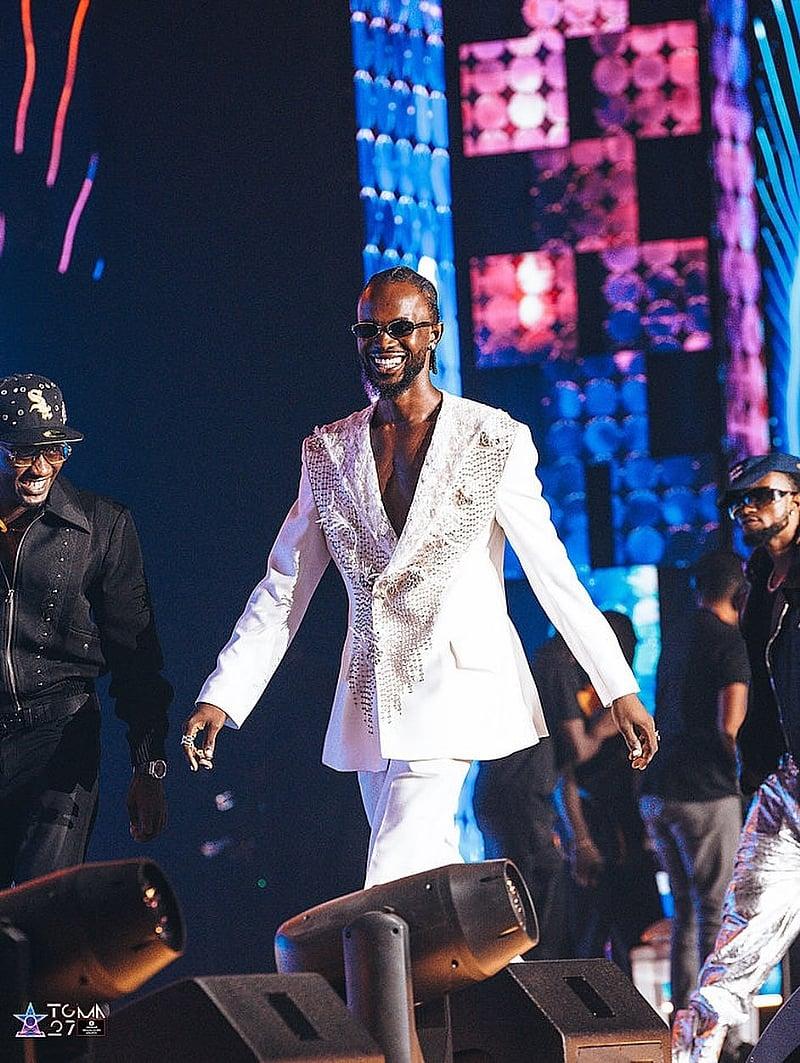

Black Sherif has rejected the notion that a single Ghanaian musician can shoulder the responsibility of taking the country’s music industry to the international stage, arguing instead that sustained global recognition will require a coordinated effort involving artistes and other stakeholders across the industry.
The musician made the observation while speaking on the Afternoon Show, where he reflected on Ghana’s aspirations for greater international prominence, the expectations frequently placed on individual artistes and the structural differences between Ghana’s music industry and more established global music markets. His comments were reported on September 23, 2026.

Black Sherif maintained that it is unrealistic to expect one artiste to serve as the principal representative and international ambassador for an entire national music industry. While individual musicians can undoubtedly contribute to the expansion of Ghanaian music beyond the country’s borders, he stressed that the capacity of any one artiste remains limited when measured against the broader demands of building an internationally competitive music ecosystem.

“It is not realistic for one person to carry the entire Ghanaian music to the global stage as people assume,” he said.

He further explained that the responsibility for advancing Ghanaian music internationally must extend beyond the achievements and promotional activities of individual musicians. In his view, the industry requires a broader network of people working together to create the momentum necessary for Ghanaian music to gain deeper and more sustained international exposure.
“There’s only so much one person can do; we need people and collective motion in the industry,” Black Sherif stated.

His remarks also extended to comparisons frequently drawn between Ghana’s music industry and those of other countries. Black Sherif questioned whether such comparisons always take sufficient account of the differences in the way music is produced, distributed, consumed and promoted across different markets.
He suggested that Ghana’s international music ambitions should therefore be considered within the particular circumstances of the country’s own industry rather than through direct comparisons with countries whose populations, music markets, consumption patterns and promotional structures may differ considerably.

The musician’s comments come as Ghanaian artistes continue to seek greater international visibility through streaming platforms, international collaborations, festivals and performances outside the country. Ghanaian music has already developed an international audience, while artistes from the country have increasingly appeared on major African and international platforms.

Beyond his observations about the broader music industry, Black Sherif also used the interview to discuss his own artistic transformation, describing his latest musical direction as a reintroduction of himself.
He explained that his present sound cannot be separated from the various stages of his musical development. According to him, the music he created while he was still in high school, his early recordings in 2019 and the material he produced during the COVID 19 pandemic each represents a different layer of the artiste he has subsequently become.
“The music I was making in 2019 and in high school, the music I was making during the pandemic, they sound like Sun Sherif. So this is a reintroduction of me and how many layers there are to me,” he said.
The description provides an insight into how Black Sherif views his current creative phase. Rather than presenting his latest direction as a complete departure from his earlier work, he has characterised it as an extension and rediscovery of the different musical influences and experiences that have shaped his identity over the years.
His reference to his high school period, his early work in 2019 and the music he produced during the pandemic consequently places his current artistic identity within a longer creative progression. Each period, he suggested, has contributed something to the sound and personality that audiences encounter in his music today.
The discussion consequently centred on two interconnected aspects of Black Sherif’s outlook. On the broader industry question, he argued that Ghana’s international musical ambitions should not be placed on the shoulders of a single artiste. On the personal level, he presented his current musical direction as an opportunity to reveal additional dimensions of an artistic identity that has developed through several distinct stages.
Black Sherif’s latest comments therefore combine a call for greater collective participation in Ghana’s international music ambitions with a reflection on the evolution of his own artistry, as he continues to explore the different influences and experiences that have shaped his musical identity.

