
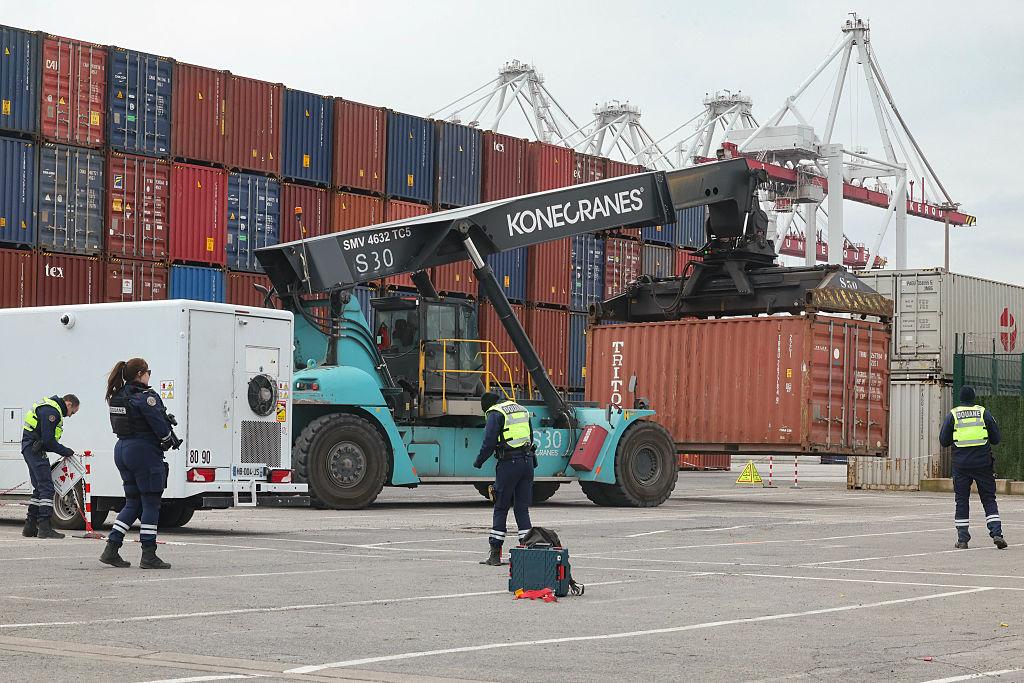

The Kwabenya Circuit Court in Accra has denied bail to six people accused of involvement in the export of nearly four tonnes of suspected cocaine from Ghana to France.
The six appeared before the court on Thursday, September 17, 2026, in connection with four 40 foot containers that allegedly departed from the Tema Port before being intercepted by French authorities with approximately 3.9 tonnes of substances suspected to be narcotic drugs.

The court subsequently remanded all six accused persons in custody and adjourned the case to September 24, 2026, to allow investigations to continue.

Those before the court are Francis Narh Amanor, Frank Adu Boahen, Togbe Agbeti, Andrews Tetteh Amponsah, Daniel Laryea and Helena Akua Denkyi.

Four of the accused persons are linked to the Ghana Revenue Authority and are facing allegations connected to the processing and interpretation of Customs scanning images at the Tema Port.
The prosecution’s case centres heavily on the Customs scanning procedure through which the four containers were examined before they were permitted to leave Ghana.

According to the charge sheet, the containers, identified by the numbers SELU4549480, FFAU2242304, MSDU5642699 and SELU4809801, were subjected to scanning before their export.
The prosecution alleges that the resulting scan images contained abnormalities that should have prompted additional scrutiny of the containers. Despite the concerns allegedly identified in the images, however, the containers were reportedly cleared and subsequently exported.

Investigators are now examining the circumstances under which the scan images were assessed, who reviewed them, what irregularities were identified and what decisions were subsequently taken before the containers were allowed to leave the port.

The allegations have consequently placed the operations of the Customs scanning system at the centre of the criminal investigation.
The prosecution further alleges that Frank Adu Boahen provided his login credentials to other individuals to enable them to conduct scan image analysis on his behalf, despite being responsible for undertaking the analysis himself.
According to the prosecution, abnormalities were detected during the scanning process but the containers were allegedly not subjected to the additional physical examination that the circumstances were said to require.
The prosecution has also alleged that Adu Boahen was the owner of the four containers at the centre of the investigation.
According to the charge sheet, investigators arrested him at an alleged hideout in Community 19, Tema, on September 16, a day before the six accused persons appeared in court.
The prosecution says Adu Boahen admitted during interrogation that he owned the four 40 foot containers and that the cargo was loaded at a warehouse in Community 12, Tema.
He is also alleged to have told investigators that he shipped the containers together with the first accused person, Francis Narh Amanor.
Amanor, who is described in the charge sheet as a freight forwarder and Managing Director of Fresna Commodities Limited, was reportedly arrested on September 15.
Investigators are said to have used information contained in the Integrated Customs Management System to establish that Fresna Commodities Limited was listed as the exporter of the shipment.
According to the prosecution, Amanor’s telephone number was recorded as the contact number for the exporter. The same telephone number was reportedly linked to F and F Logistics, which investigators identified as the freight forwarding company involved in the transaction.
The prosecution alleges that Amanor told investigators that he owned F and F Logistics and had facilitated the exportation of the containers.
He reportedly informed investigators that the containers contained pet flakes or plastic scraps.
Amanor is further alleged to have identified Frank Adu Boahen as the owner of the shipment and said that Adu Boahen had engaged his services to facilitate the export.
The prosecution’s case therefore seeks to establish how the containers were prepared, declared, scanned, cleared and ultimately shipped out of Ghana before the suspected narcotics were discovered in France.
The six accused persons are facing three broad allegations.
The first charge concerns conspiracy to export narcotic drugs.
The second allegation relates to the exportation of narcotic drugs without the requisite licence.
The third charge concerns abetment of the exportation of narcotic drugs and is directed specifically at the four officials associated with the Ghana Revenue Authority.
The prosecution alleges that the first and second accused persons were responsible for exporting the four containers from Tema Port and that the containers contained approximately 3.9 tonnes of suspected narcotic substances.
The case forms part of a wider investigation into the movement of a large quantity of suspected cocaine from Ghana to France.
French customs authorities intercepted the consignment at the northern French port of Dunkirk on September 10, after the containers arrived from Ghana. The suspected cocaine was reportedly concealed inside a consignment declared as plastic waste, with part of the shipment believed to have been destined for Antwerp, Belgium.
The seizure has prompted investigations in both France and Ghana into the circumstances surrounding the shipment and the wider network allegedly responsible for its movement.
The latest court proceedings have also intensified scrutiny of Ghana’s port security arrangements, particularly the effectiveness of cargo screening and the procedures used by Customs officials to assess potentially suspicious consignments.
At the centre of the Ghanaian investigation is the question of whether the abnormalities allegedly detected during the scanning process were properly identified and acted upon before the containers were cleared for export.
Investigators are also expected to establish whether the individuals involved in the preparation and exportation of the containers acted independently or as part of a wider network.
For the six accused persons, however, the allegations remain matters before the court and do not amount to established criminal liability. The prosecution will be required to prove its case through the appropriate judicial process.
Their denial of bail means they will remain in custody while investigators continue their work.
The Kwabenya Circuit Court has adjourned the case to September 24, 2026, when the accused persons are expected to return before the court as investigations into the alleged shipment and the circumstances surrounding its clearance from Tema Port continue.

