
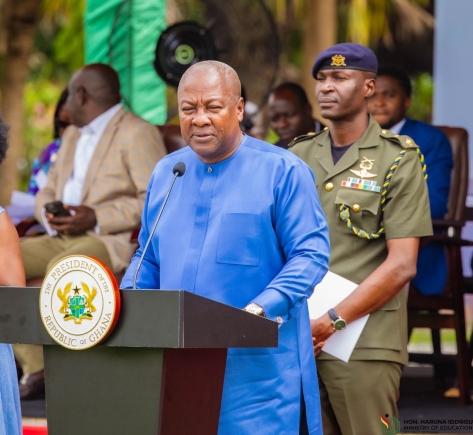

The New Patriotic Party has called on President John Dramani Mahama to either apologise to Ghanaians or remove Education Minister Haruna Iddrisu from office, following a dispute over the reported development and proposed implementation of Arabic and Chinese language curricula in Ghanaian schools.
The opposition party says the President’s recent declaration that his administration has approved no new policy introducing Arabic or Chinese into public schools conflicts with a series of actions it attributes to the Education Ministry and the National Council for Curriculum and Assessment.

In a statement issued by its Education Sector Policy Committee on Wednesday, September 16, the NPP argued that the central issue now concerns whether the Education Minister proceeded with the policy direction without presidential and Cabinet authorisation, or whether the work undertaken by the Ministry and its agencies was known to and authorised by the Government.

The party consequently presented two possible explanations. It said that if Mr Iddrisu announced and pursued the initiative without the authority of President Mahama and Cabinet, then the President should dismiss him. Conversely, if the Education Minister acted with presidential or Cabinet knowledge and approval, the NPP said the President should apologise to Ghanaians for subsequently denying that such a policy had been set in motion.

The controversy follows President Mahama’s statement on September 12 that Cabinet had not approved any new policy to introduce Arabic and Chinese across Ghana’s public schools.
Speaking during an engagement in the Upper West Region, the President said that because he chairs Cabinet, he was aware that no such curriculum had been presented to Cabinet for approval. He also questioned the practicality of introducing Chinese when Ghana continues to face difficulties securing sufficient teachers to teach French.

President Mahama also explained that Arabic instruction already exists within the English Arabic school system, which was established during the administration of former President Jerry John Rawlings to encourage greater participation in formal education among Muslim communities.
He maintained, however, that there was no new Government policy requiring Arabic and Chinese to be introduced throughout Ghana’s public school system.

The NPP has challenged that position by pointing to a sequence of events that it says demonstrates that work on the languages had advanced considerably within Government institutions.

According to the party, Mr Iddrisu announced on April 24, 2026 that Arabic and Chinese would become compulsory foreign languages at the secondary school level and linked the initiative to President Mahama’s vision for education.
The party says the announcement was subsequently followed by curriculum development work undertaken by NaCCA, with approximately 160 writers and reviewers reportedly engaged to prepare a revised curriculum.
The NPP further states that the revised curriculum was presented to Mr Iddrisu on July 22. According to the party’s account, rather than rejecting the document, the Minister referred it to the Ghana Education Service and directed the service to prepare for implementation.
There is independent evidence that curriculum development involving Chinese was indeed underway. The University of Cape Coast confirmed that NaCCA organised a national training programme on September 3 to equip basic school teachers with the knowledge and skills required to implement a new Chinese language curriculum. The training was conducted with the involvement of the Confucius Institute at the University of Cape Coast and included sessions on the curriculum’s structure, content, teaching methods and assessment.
NaCCA’s own published curriculum materials also show that Arabic already forms part of Ghana’s secondary education curriculum. Its current secondary education curriculum page lists Arabic among the available subjects, while its Common Core Programme materials also list Arabic.
That distinction is important to the current controversy because the dispute is not simply about whether Arabic has ever been taught in Ghanaian schools. Rather, the disagreement concerns the scope and status of any proposed expansion, the position of Chinese within the revised curriculum, whether either language was intended to be compulsory, and the level at which any new arrangement was supposed to operate.
The NPP argues that subsequent Government explanations that Arabic and Chinese would be optional at the basic school level do not fully resolve the issue because the Education Minister’s earlier announcement, as characterised by the party, concerned compulsory foreign language instruction at the secondary school level.
The party has consequently questioned whether the Government has provided a sufficiently consistent explanation of the relationship between the earlier ministerial announcement, the curriculum development process and the President’s later declaration that no new policy had received Cabinet approval.
The opposition has also raised questions concerning the use of public resources during the curriculum development process.
It wants the Government to explain why curriculum writers, reviewers and technical personnel were engaged and why teacher preparation proceeded if no policy had received the necessary approval.
The NPP has further questioned the logic of progressing with teacher preparation for Chinese while the President has publicly raised concerns about the availability of Chinese language teachers and Ghana’s continuing shortage of French teachers.
The party has nevertheless emphasised that Arabic and Chinese should not automatically be treated as identical policy questions.
According to the NPP, Arabic was already available as an optional subject within parts of Ghana’s education system before the current administration assumed office. Chinese, by contrast, is being presented by the party as part of a new 2026 curriculum development process involving curriculum preparation, ministerial consideration and teacher training.
The Government’s earlier public clarification also indicated that foreign languages such as French, Arabic and Chinese were not intended to be compulsory within the proposed basic school arrangement. Other reporting on the revised curriculum similarly indicates that the curriculum submitted to the Education Minister included Chinese and Arabic among foreign language options.
The disagreement has therefore developed into a wider question about policy formulation, ministerial authority, Cabinet approval, institutional coordination and public accountability.
The NPP says parents, teachers, school administrators and taxpayers are entitled to a clear explanation of the Government’s position, particularly where public institutions have already undertaken substantial curriculum development and teacher training activities.
The party has consequently maintained its demand that President Mahama either dismiss Mr Iddrisu if the Education Minister acted without the necessary authority, or acknowledge and explain the Government’s involvement if the initiative was undertaken with presidential or Cabinet knowledge.
For now, President Mahama’s publicly stated position remains that Cabinet has not approved a new policy requiring Arabic and Chinese to be introduced throughout public schools, while the NPP continues to point to the documented curriculum development and teacher training activities as evidence that significant preparatory work had already taken place.
The unresolved issue is therefore not simply whether Ghana should teach Arabic or Chinese, but how the policy was initiated, what level of Government approval it received, what exactly the proposed curriculum provides, and what public resources have been committed to its development.

