
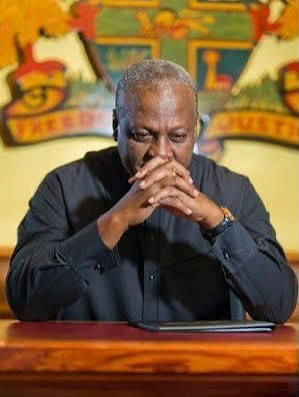

President John Dramani Mahama has expanded a high level security meeting on Ghana’s border controls and the fight against narcotics trafficking to include the Ministers responsible for the Interior and Transport as well as the Comptroller General of the Ghana Immigration Service.
The decision follows concerns raised by Minority legislators over the reported omission of key sector ministers from the original invitation to a meeting convened by the President in response to mounting concerns over Ghana’s exposure to international drug trafficking networks.

The meeting is scheduled for Thursday, September 17, 2026, at 12:30 p.m. at the Jubilee House, where the participating institutions are expected to undertake a comprehensive assessment of Ghana’s border security architecture and identify urgent measures to strengthen the country’s capacity to detect and disrupt the movement of narcotic substances.

The revised invitation, issued by the Secretary to the President, Callistus Mahama, now includes the Minister for the Interior, the Minister for Transport and the Comptroller General of the Ghana Immigration Service among the officials expected to participate.

The development comes shortly after French customs authorities intercepted nearly 3.9 tonnes of cocaine concealed in a container that had arrived from Ghana. The consignment was reportedly valued at approximately US$261 million on the street market, intensifying scrutiny of Ghana’s ports and border control systems.
The reported exclusion of the sector ministers from the initial invitation had attracted criticism from the Member of Parliament for Akuapem North, Sammi Awuku, who questioned the logic of convening officials responsible for border, port, aviation and narcotics operations without the ministers exercising political and administrative responsibility over those institutions.

In a Facebook post on Monday, September 14, Mr Awuku specifically drew attention to the absence of the Interior and Transport Ministers and questioned why officials operating under those ministries would be summoned to address the country’s security vulnerabilities without the relevant political heads being present.
The expanded meeting is expected to examine weaknesses within Ghana’s border management systems, with particular attention to the country’s ports, airports and land borders.

It will also assess the effectiveness of intelligence sharing between security institutions, cargo and passenger screening arrangements, interagency cooperation and the deployment of technology to identify suspicious consignments and prevent narcotics trafficking.

The participating institutions have been instructed to present concise assessments of existing security deficiencies and submit practical recommendations for strengthening intelligence coordination, surveillance, screening procedures and joint enforcement operations.
The Presidency has directed that each institution be represented by its head, accompanied by no more than one relevant technical officer. The instruction underscores the seriousness attached to the meeting and the expectation that decisions arising from the discussions will be based on direct institutional assessments.
Among the institutions expected to participate are the Ministries of Finance and Foreign Affairs, the Ghana Ports and Harbours Authority, the Customs Division of the Ghana Revenue Authority, the Ghana Shippers Authority, operators of terminal scanning systems, Ghana Link Network Services Limited, the Ghana Maritime Authority, the Ghana Navy, Meridian Port Services Limited, the Bureau of National Intelligence, the Criminal Investigations Department of the Ghana Police Service, Interpol, the Narcotics Control Commission and the Ghana Airports Company Limited.
The meeting assumes even greater significance following the latest developments surrounding the cocaine shipment intercepted in France. Ghana’s Narcotics Control Commission has already arrested three suspects in connection with the consignment and says the individuals are assisting investigators as inquiries continue into their alleged roles in the trafficking operation.
NACOC has also indicated that further arrests could follow as Ghanaian authorities deepen cooperation with French and other international law enforcement agencies to establish how the consignment was able to leave Ghana and trace the wider network allegedly connected to the shipment.
The Commission has separately reaffirmed the importance of stronger cross border intelligence sharing, coordinated investigations, joint enforcement operations and more effective border management, arguing that international trafficking networks exploit gaps between national jurisdictions.
Against that background, the September 17 meeting is expected to place particular emphasis on whether existing security arrangements are sufficiently robust to prevent Ghanaian ports, airports and land borders from being exploited by international narcotics organisations.
The Presidency has stressed that the discussions carry significant national security implications and has therefore required the personal attendance of the heads of the invited institutions.
The expanded composition of the meeting consequently places both political leadership and operational security agencies at the centre of an urgent examination of Ghana’s border control framework, as the government comes under increasing pressure to demonstrate that the country’s ports and borders cannot be exploited as conduits for the international narcotics trade.

