
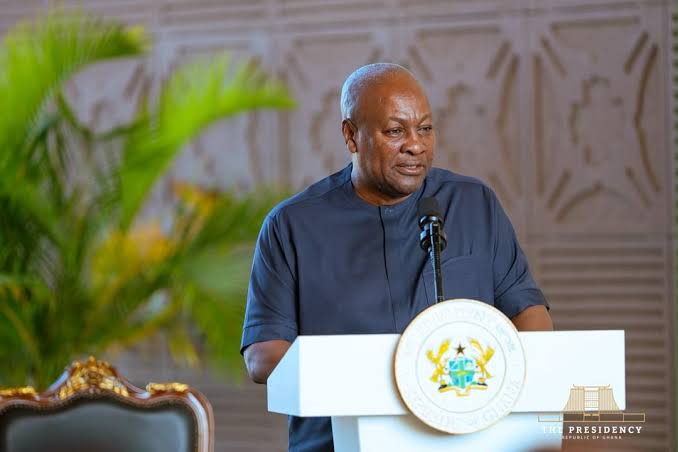

President John Dramani Mahama has summoned the heads of key security, border management, customs, maritime and port institutions to an emergency high level meeting aimed at identifying weaknesses in Ghana’s border control system and strengthening the country’s capacity to prevent narcotics and other illicit substances from passing through its ports, airports and land borders.
The meeting, scheduled for Thursday, September 17, 2026, at 12:30 p.m. at the Jubilee House, comes amid mounting concern over a succession of major drug seizures involving consignments linked to Ghana and growing questions about whether weaknesses within the country’s security and cargo screening systems are being exploited by international trafficking networks.

The Presidency is expected to use the meeting to undertake a comprehensive assessment of Ghana’s existing border security arrangements, with particular attention to intelligence sharing, passenger and cargo screening, inter agency coordination and the deployment of technology to detect and disrupt the movement of narcotics.

According to the invitation issued on behalf of President Mahama, the discussions will focus specifically on “existing vulnerabilities, intelligence sharing arrangements, cargo and passenger screening systems, inter agency coordination, and the deployment of technology to detect and disrupt narcotics trafficking.”

The meeting assumes added significance because Ghana’s ports, airports and land borders constitute critical gateways for legitimate international trade and travel, while also presenting potential avenues for criminal networks seeking to conceal illicit consignments within lawful commercial and passenger movements.
The Presidency has therefore instructed every institution invited to send its head, accompanied by no more than one relevant technical officer. Participants have also been directed to arrive with a concise assessment of security deficiencies within their respective areas of responsibility and concrete proposals for addressing them.

They are expected to present practical recommendations for improving intelligence sharing, surveillance, screening procedures and coordinated enforcement operations.
The invitation states that, given the urgency and national security implications of the matter, the personal attendance of the heads of the institutions is required.

Among the officials and institutions expected to participate are the Ministers of Finance and Foreign Affairs, the Director General of the Ghana Ports and Harbours Authority, the Commissioner of the Customs Division of the Ghana Revenue Authority, the Sector Commander of Customs at Tema, the Chief Executive Officers of the Ghana Shippers Authority, Ghana Link Network Services, Meridian Port Services and Ghana Airports Company.

The Chief of the Naval Staff, the Directors General of the National Intelligence Bureau and the Narcotics Control Commission, representatives of the Ghana Police Service Criminal Investigations Department and Interpol, as well as operators responsible for terminal scanning systems, are also expected to attend.
The presidential intervention follows a series of significant narcotics seizures that have placed Ghana’s border security architecture under increasing scrutiny.
One of the most prominent cases occurred in March 2025 when the National Intelligence Bureau intercepted a tipper truck at Pedu Junction in Cape Coast carrying more than 3.3 tonnes of cocaine concealed beneath sand. The consignment was estimated to have a street value exceeding US$350 million and was being transported from Takoradi towards Accra.
The narcotics were subsequently destroyed following a court order, although questions about the identities and alleged roles of the financiers and principal traffickers behind the shipment have continued to generate political controversy. In July 2026, Interior Minister Muntaka Mohammed Mubarak told Parliament that the cocaine had been destroyed after the necessary legal procedures had been completed, while suspects connected to the case remained before the courts.
The controversy has intensified following international seizures involving consignments traced to Ghana.
In June 2026, Australian authorities seized approximately 320 kilogrammes of methamphetamine concealed in a charcoal consignment traced to Ghana. The seizure triggered an investigation by Ghana’s Narcotics Control Commission, which subsequently announced the arrest in Accra of a suspected lead shipper after months of intelligence gathering and surveillance.
The valuation of that Australian seizure has been reported differently by various sources. The Minority has placed its value at about US$261 million, while other reporting has cited an Australian valuation equivalent to approximately US$208 million.
More recently, French customs authorities seized nearly 3.9 tonnes of cocaine at the port of Dunkirk from a container that had arrived from Ghana. The shipment, concealed within plastic waste, was valued at more than US$260 million, according to reports. French authorities have opened investigations into the criminal network suspected of being behind the consignment.
The series of seizures has prompted the Parliamentary Minority to demand greater scrutiny of Ghana’s border security arrangements and the progress of investigations into major narcotics cases.
The Minority has questioned why alleged financiers and principal traffickers connected to the US$350 million Pedu Junction cocaine seizure have not been identified and prosecuted, arguing that the continued focus on lower level suspects raises concerns about whether investigations are reaching the networks responsible for financing and organising the trafficking operations.
Against this backdrop, President Mahama’s decision to bring together the principal institutions responsible for border management, intelligence, customs, ports, aviation, maritime security and narcotics control signals a renewed attempt to address the issue at the level of the country’s entire security and trade infrastructure.
The meeting is expected to move beyond individual seizures and examine whether existing systems are sufficiently capable of identifying suspicious consignments before they leave Ghana or enter the country.
Particular attention is also expected to be paid to information sharing between agencies, the effectiveness of cargo and passenger scanners, surveillance at ports and border crossings, and the capacity of security agencies to act on intelligence quickly.
The Narcotics Control Commission has itself recently called for stronger and more practical cross border cooperation among African countries, warning that the increasingly sophisticated nature of synthetic drug trafficking, cocaine smuggling and transnational organised crime requires intelligence sharing, coordinated investigations, joint operations and stronger border management.
President Mahama’s September 17 meeting could therefore mark an important moment in the government’s response to mounting concerns over Ghana’s vulnerability to international narcotics trafficking.
With senior officials expected to account for security gaps within their respective jurisdictions and present concrete proposals for closing them, the Presidency is seeking to ensure that Ghana’s ports, airports and land borders do not become convenient channels through which international drug trafficking organisations can move illicit consignments into and out of the country.
The immediate challenge for the government will be to translate the assessments and recommendations emerging from the meeting into stronger surveillance, more effective intelligence coordination, tighter cargo screening and sustained enforcement capable of identifying not only couriers and individual consignments, but also the networks that finance, organise and facilitate the trade.

