
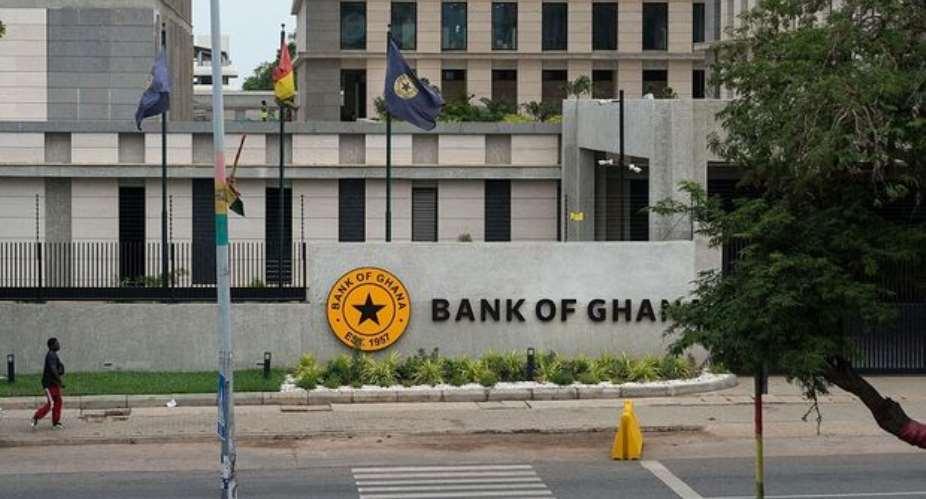

Ghana’s banking industry recorded a modest decline in profitability in the first half of 2026, with aggregate profit falling to GH¢7.1 billion by the end of June from GH¢7.2 billion during the corresponding period of 2025, according to the Bank of Ghana’s July 2026 Monetary Policy Report.
The latest figures indicate a reversal in the sector’s previously strong earnings momentum, as profit after tax contracted by 1.3 percent in June 2026, compared with the substantial 32.6 percent expansion recorded a year earlier. Profit before tax similarly weakened, declining by 1.5 percent year on year after registering growth of 32.2 percent in June 2025.

The moderation in earnings was largely associated with slower expansion across the banking industry’s principal income streams. Fees and commissions remained comparatively resilient, increasing by 18.2 percent in June 2026 from 17.8 percent in the corresponding period of 2025. However, net interest income, which constitutes a critical source of revenue for banks, contracted by 3.1 percent after registering growth of 20.2 percent a year earlier.

The Bank of Ghana attributed the weaker performance in interest income largely to the prevailing lower interest rate environment. With lending rates declining considerably, banks faced reduced earnings from interest generating assets, thereby exerting pressure on overall revenue performance. The central bank reported that the average lending rate fell to 15.6 percent in June 2026 from 27.0 percent a year earlier, while the Ghana Reference Rate declined to 10.0 percent from 23.8 percent.

At the same time, the banking industry recorded a more moderate increase in expenditure. Operating costs expanded by 6.0 percent in June 2026, a significant slowdown from the 21.4 percent growth registered during the same period of 2025. The deceleration was principally associated with slower growth in personnel expenditure, while expenses unrelated to staff declined during the review period.
However, the improvement in operating cost growth was accompanied by a substantial increase in provisions associated with depreciation, bad debts and impairment losses on financial assets. Such provisions climbed by 38.2 percent in June 2026, reversing the 14.8 percent contraction recorded a year earlier and signalling continued pressure from credit related risks despite broader improvements in banking sector conditions.

The weakening earnings position was also reflected in the industry’s key profitability indicators. Return on Equity declined sharply from 32.2 percent in June 2025 to 22.9 percent in June 2026, while Return on Assets fell from 5.6 percent to 4.4 percent over the same period.
Despite the moderation in profitability, the wider banking sector maintained notable improvements in several fundamental indicators. The Bank of Ghana reported that total banking sector assets expanded by 30.7 percent to GH¢502.4 billion in June 2026, supported by stronger deposits, borrowings and shareholders’ funds. The industry’s Capital Adequacy Ratio also improved substantially to 20.4 percent from 10.6 percent, while the Non Performing Loan ratio declined from 23.1 percent to 16.1 percent.

The changing interest rate environment also affected the industry’s interest spread and gross yields. The banking sector’s spread narrowed from 6.0 percent in June 2025 to 4.4 percent in June 2026, while gross yields fell from 8.9 percent to 6.1 percent. Interest payable also declined from 2.8 percent to 1.7 percent, reflecting the broader reduction in market interest rates.

Meanwhile, asset utilisation, measured through the ratio of gross income to total assets, decreased from 7.4 percent to 5.4 percent. In contrast, the profitability ratio edged upward from 25.3 percent in June 2025 to 25.9 percent in June 2026, providing a limited counterpoint to the broader decline in earnings and returns.
The latest performance therefore presents a banking sector operating within a significantly changed monetary environment. Although lower lending rates have helped stimulate demand for credit, they have simultaneously compressed some traditional sources of bank income. Private sector credit consequently expanded by a striking 41.2 percent in June 2026, compared with 8.6 percent a year earlier, indicating that the easing cost of credit has begun translating into stronger borrowing activity.
The figures suggest that Ghana’s banks are entering a period in which profitability may depend increasingly on expanding credit volumes, strengthening fee based income and maintaining rigorous control over operating and credit related costs. The immediate challenge for the industry will be to convert stronger lending activity and improved balance sheet conditions into sustainable earnings while preserving asset quality and financial stability.

