
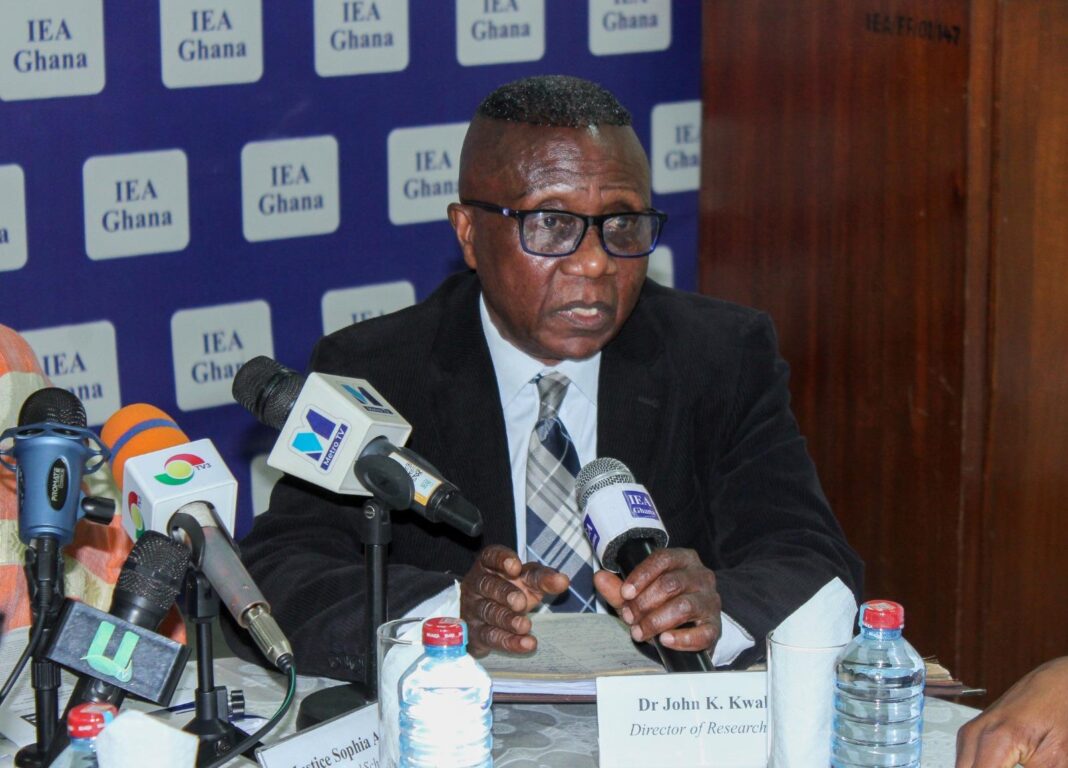

The Institute of Economic Affairs, IEA, has rejected the government’s proposed framework for electing Metropolitan, Municipal and District Chief Executives, arguing that presidential control over the nomination of candidates would undermine the democratic purpose of introducing direct local elections.
In a position issued on Wednesday, September 2, 2026, the policy think tank said it supports the election of all MMDCEs but strongly opposed any arrangement under which the President would determine who is eligible to appear on the ballot. The Institute instead called for every citizen who meets the required qualifications to have the opportunity to contest through a non partisan electoral process.

The disagreement centres on the government’s proposed model for replacing Ghana’s longstanding system under which MMDCEs are appointed by the President, subject to approval by the relevant assemblies. Under the government’s proposed arrangement, the President would nominate five prospective candidates, after which a vetting committee would assess the nominees and shortlist three for the electorate to choose from.

The IEA contends that such a structure would leave substantial presidential influence intact because citizens would only be permitted to choose among individuals who had first been selected through a presidential nomination process.

The Institute consequently argued that genuine local democracy requires citizens to determine not only who ultimately becomes their MMDCE but also who has the opportunity to compete for the position. In its assessment, removing the final appointment from the President while retaining presidential control over the candidate selection process would fall short of meaningful political decentralisation.
The position differs from the recommendation presented by the Constitution Review Committee chaired by Professor H. Kwasi Prempeh. The Committee recommended that MMDCE elections should be introduced progressively, with implementation taking account of the financial and administrative capabilities of individual districts. It also proposed that the elections should be conducted on a non partisan basis.

The IEA has therefore aligned itself with the broader principle of electing MMDCEs while rejecting the presidential filtering mechanism contained in the government’s proposal. The Institute argues that a more open system would strengthen accountability because local executives would derive their authority directly from residents rather than from a selection process controlled by the national executive.
The debate forms part of a much wider constitutional reform process initiated under President John Dramani Mahama. The President established the Constitution Review Committee in 2025 to examine previous proposals for constitutional change, conduct consultations with the Ghanaian public and develop recommendations for reform. Professor Prempeh’s committee subsequently submitted its report to the President in December 2025.

The government has since begun the process of determining how the accepted recommendations should be translated into constitutional amendments, legislation and administrative measures.

As part of that process, Attorney General and Minister for Justice Dr Dominic Ayine inaugurated an eleven member Constitution Review Implementation Committee on August 28, 2026. The committee has been tasked with examining the government’s position on the recommendations of the Prempeh Committee and developing an appropriate framework for implementing the reforms that have been accepted by the government.
The implementation committee is chaired by Presidential Legal Counsel and former Attorney General Marietta Brew Appiah Oppong, placing the question of local government reform within a broader institutional process aimed at reshaping aspects of Ghana’s constitutional governance framework.
The IEA’s objection to presidential nomination also reflects its wider position that Ghana’s constitutional architecture should contain stronger safeguards against excessive concentration of authority in the Presidency. In its latest assessment of the constitutional reform proposals, the Institute called for substantial reductions in presidential appointment powers and advocated greater institutional independence, stronger parliamentary oversight and deeper citizen participation in governance.
The Institute has also cautioned the government against moving too quickly with the constitutional review process, maintaining that reforms of such national significance require extensive public education, consultation and consensus building before final decisions are taken.
The disagreement over MMDCE elections is consequently emerging as one of the important questions in Ghana’s constitutional reform debate. At its core is the issue of whether local democracy should merely replace presidential appointment with a limited electoral contest or whether citizens should receive unrestricted authority to determine which qualified individuals compete for leadership of their respective metropolitan, municipal and district assemblies.
For the IEA, the latter approach is essential if the proposed reform is to produce genuine decentralisation and make local government leadership more directly accountable to the communities it is intended to serve.

