
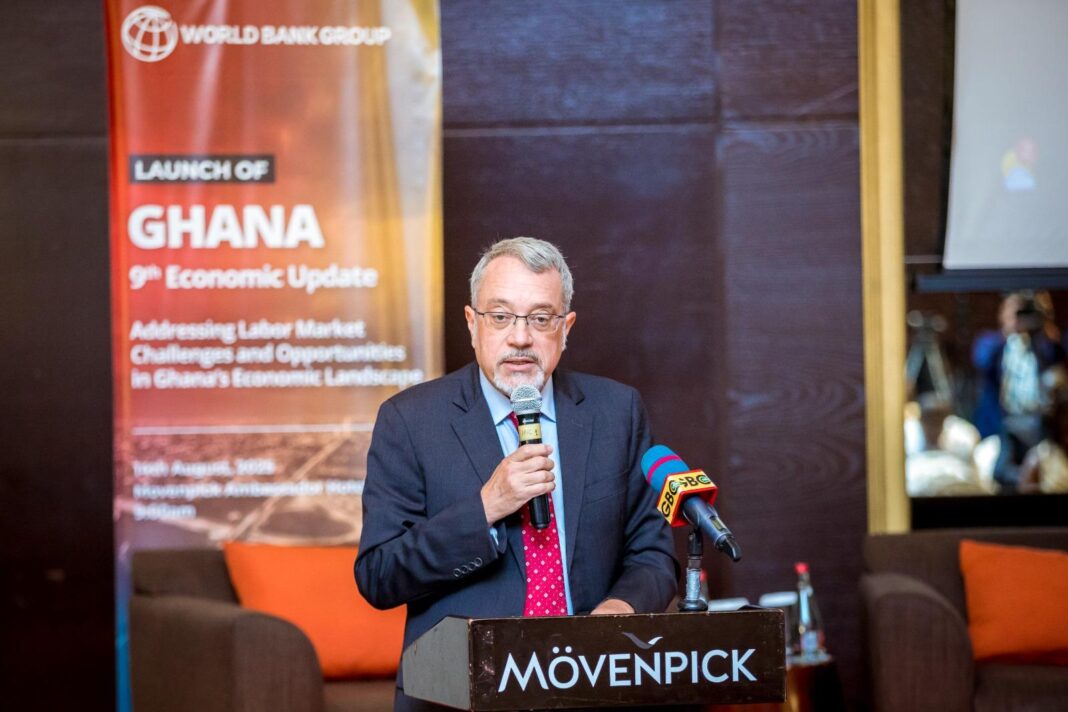

Ghana’s improving economic indicators have yet to translate into better living conditions for a substantial share of the population, with the World Bank reporting that 56.4 per cent of Ghanaians remain in poverty while regional inequalities continue to widen.
The assessment was delivered by Robert R. Taliercio O’Brien, the World Bank Division Director responsible for Ghana, Liberia and Sierra Leone, during the launch of the institution’s Tenth Ghana Economic Update in Accra on Wednesday, August 26, 2026. The latest report examines Ghana’s economic recovery and the structural measures required to ensure that renewed expansion produces broader improvements in employment, productivity and household welfare.

Mr Taliercio O’Brien said the latest poverty figures exposed a significant gap between Ghana’s encouraging macroeconomic performance and the circumstances confronting millions of households. Although national output has expanded considerably, the benefits of that expansion have not been distributed sufficiently across the population or across the various regions of the country. He consequently stressed that economic progress must be accompanied by stronger efforts to create employment and extend productive opportunities to communities that have remained outside the main benefits of the recovery.

Ghana recorded economic growth of 6 per cent in 2025 and subsequently registered an even stronger expansion of 6.4 per cent during the first quarter of 2026. The World Bank has recognised these figures as evidence of a substantial rebound in economic activity, alongside considerable improvements in macroeconomic stability. Nevertheless, the institution maintains that the strength of the recovery should not be assessed solely through aggregate growth figures when a large proportion of the population continues to experience economic hardship.

Mr Taliercio O’Brien explained that one of the central difficulties confronting Ghana is the composition of the country’s economic expansion. Much of the recent growth has been generated by sectors such as gold and services, which, although important to national output and foreign exchange earnings, do not possess sufficient capacity to absorb the rapidly expanding labour force. This creates a particularly serious concern as increasing numbers of young Ghanaians prepare to enter the employment market during the coming decade.
The World Bank therefore considers Ghana’s employment challenge to be structural rather than merely cyclical. Unless economic expansion is increasingly channelled towards activities capable of generating large numbers of productive jobs, higher national output may continue to coexist with widespread household deprivation. The institution has consequently urged greater emphasis on agriculture, agro processing and manufacturing, where productivity can be raised while simultaneously expanding opportunities for workers.

The concern is also linked to the uneven distribution of economic opportunities throughout the country. According to the World Bank, spatial disparities are widening, meaning that improvements in national economic performance are not being experienced uniformly by households in different parts of Ghana. The situation reinforces the need for policies capable of distributing investment, employment and productive opportunities more broadly rather than concentrating economic gains within a limited number of sectors and locations.
The World Bank has nevertheless acknowledged the significant progress achieved in Ghana’s economic stabilisation programme. Inflation declined sharply from 23.2 per cent in February 2025 to 3.2 per cent in March 2026, although it has subsequently risen to 4.6 per cent. Public debt also declined from 70.3 per cent of gross domestic product in 2024 to 49 per cent at the end of 2025, while Ghana recorded a primary fiscal surplus of 2.5 per cent of gross domestic product during the same year.

However, the World Bank has cautioned that preserving macroeconomic stability will require more than expenditure restraint and improved headline indicators. The institution has pointed out that Ghana’s fiscal surplus was achieved largely through expenditure compression, with capital expenditure ending 38 per cent below the approved budget. It has therefore urged the government to maintain fiscal discipline while protecting investments that can strengthen infrastructure, productivity and long term economic capacity.

The institution has also identified weaknesses in Ghana’s energy and agricultural sectors as important threats to the durability of the recovery. Delays in implementing energy sector reforms are reportedly costing the country approximately 1 billion dollars annually, while financial and operational difficulties within the cocoa sector continue to place pressure on farmers and public finances.
For Ghana, the central challenge now extends beyond restoring economic stability to ensuring that the recovery produces tangible improvements in household incomes and employment. The World Bank has consequently called for a development strategy centred on stronger productivity, broader job creation and greater economic participation, particularly among young people who will constitute an increasingly significant share of the labour force.
The institution’s assessment makes clear that the success of Ghana’s economic recovery will ultimately depend on whether improved growth figures can be converted into sustainable employment, higher household welfare and more evenly distributed economic opportunities. While the country has made considerable progress in rebuilding macroeconomic stability, the persistence of poverty among 56.4 per cent of the population demonstrates that the recovery remains incomplete and that stronger efforts are required to ensure that economic expansion benefits a much wider section of society.

