
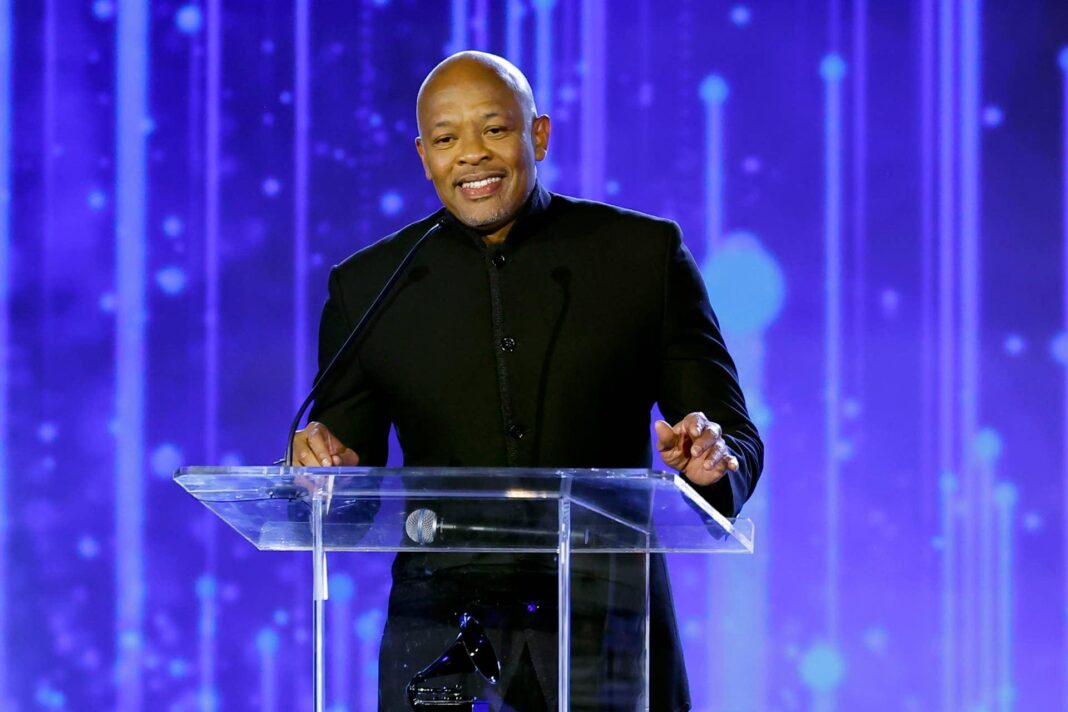

Legendary American rapper and record producer Dr. Dre has declared his support for the growing use of artificial intelligence in music production, describing the technology as an additional instrument for creative experimentation rather than an existential danger to musicians.
The influential producer made his position known in a recent interview with The New York Times alongside his longtime business associate Jimmy Iovine, as the global music industry continues to grapple with the rapid expansion of generative artificial intelligence and its implications for artistic creation.

Dr. Dre argued that resistance to artificial intelligence resembles the scepticism that accompanied earlier technological breakthroughs in music, including drum machines and synthesisers. In his view, such innovations initially generated concern among musicians but ultimately became important components of contemporary music production.

The producer confirmed that he is already incorporating artificial intelligence into his own creative process, explaining that he uses the technology to experiment with material he has already produced and to assess what additional possibilities it might generate.

Rather than regarding artificial intelligence as something that should be rejected, Dr. Dre said he is eager to explore its potential and discover how the technology could influence the future of music production. His position places him among a growing number of prominent musicians and producers who view artificial intelligence as a supplementary creative instrument rather than a replacement for human artistry.
Dr. Dre also dismissed the argument that artificial intelligence should inherently be regarded as a threat to musicians. He suggested that those who are most apprehensive about the technology may be struggling to adapt to emerging creative methods.

His longtime collaborator Jimmy Iovine expressed an equally favourable assessment of artificial intelligence, arguing that the technology could enable talented producers and musicians to create stronger records by expanding the tools available to them inside the studio.
Iovine acknowledged that the increasing use of artificial intelligence would inevitably produce some poor quality music, but argued that this should not be considered a unique consequence of the technology because the music industry has always produced material of varying quality.

The two music industry veterans also suggested that artificial intelligence may already be more widely used by professional producers than publicly acknowledged. Iovine referred to the existence of what he described as “closet AI producers”, while Dr. Dre agreed that some producers are experimenting with the technology privately despite being reluctant to disclose their involvement.

Dr. Dre’s position comes at a time when the music business is confronting increasingly complex questions over authorship, copyright, artistic authenticity, compensation and the rights of musicians whose work may be used in the development of artificial intelligence systems.
Streaming platforms and music industry organisations are consequently moving towards greater transparency regarding the use of artificial intelligence in recorded music. Apple Music is preparing to introduce visible labels identifying material created with artificial intelligence, while industry groups have also begun developing systems that distinguish between recordings that are entirely generated by artificial intelligence and those in which the technology has been used only as an assisting tool.
The debate has nevertheless produced sharply contrasting opinions among artists. While some musicians and producers believe artificial intelligence can accelerate experimentation, reduce production barriers and provide additional creative possibilities, others fear that widespread adoption could undermine human musicianship, reduce employment opportunities and encourage the production of formulaic material.
Dr. Dre’s position represents one of the more prominent endorsements of artificial intelligence from an established figure in contemporary music. His comparison with drum machines and synthesisers reflects his broader belief that technological change has historically transformed the creative process without necessarily eliminating the role of human talent.
The producer’s willingness to use artificial intelligence himself also distinguishes his position from purely theoretical support. By incorporating the technology into his own production process, he is effectively treating artificial intelligence as another component of the modern recording studio.
Dr. Dre and Iovine have maintained a longstanding professional partnership that stretches back decades and includes the creation of Beats Electronics, which Apple acquired in 2014 in a transaction valued at more than US$3 billion. Their continued involvement in discussions surrounding music technology therefore gives their views particular relevance as the industry attempts to determine how artificial intelligence should be incorporated into the creative economy.
For Dr. Dre, the central issue appears to be how musicians use the technology rather than whether artificial intelligence should be permitted to participate in the creative process at all.
As artificial intelligence becomes increasingly embedded in music production, his position is likely to contribute further to the debate over whether the technology should be regarded primarily as a disruptive force or as an advanced creative instrument that can expand the possibilities available to human artists.
For now, the legendary producer has made his position unmistakable. He is not retreating from artificial intelligence. Instead, he is embracing it as another technological resource through which musicians can experiment, develop ideas and potentially create new forms of music.

