
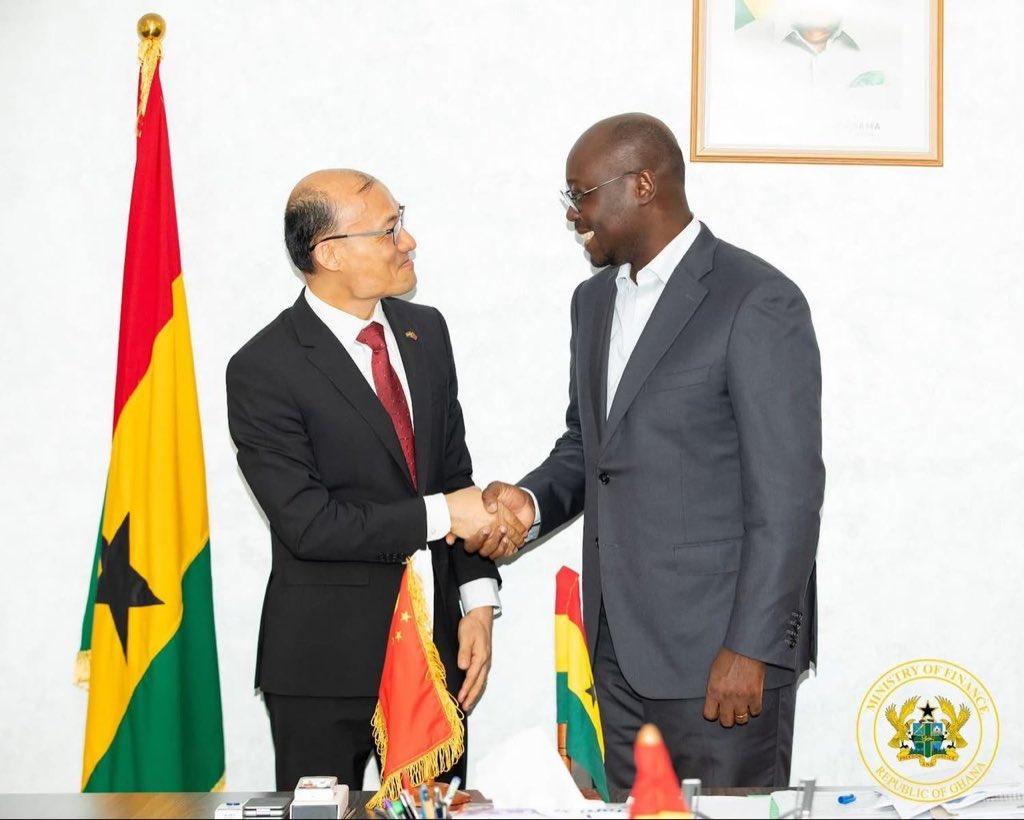

Ghana is set to adopt a more stringent approach to borrowing for development projects as the government intensifies efforts to preserve debt sustainability and avert a recurrence of the severe financial pressures that culminated in the country’s 2022 debt crisis, Finance Minister Dr Cassiel Ato Forson has announced.
Dr Forson said the government would no longer contract loans merely because funding was readily available, insisting instead that every proposed borrowing arrangement must be supported by a compelling economic justification and demonstrate clear value to the Ghanaian economy.

“Ghana will now proceed with discipline. We will not borrow simply because financing is available,” the Finance Minister stated.

He made the remarks during the Fifth Session of the Ghana China Joint Commission on Economic, Trade and Technical Cooperation, where he outlined the government’s approach to securing external financing while maintaining tighter control over public debt accumulation.

According to Dr Forson, Ghana’s future borrowing decisions will be guided by the economic viability, transparency and developmental impact of the projects for which financing is being sought. He explained that proposed investments must either stimulate economic expansion, generate sustainable revenue or reduce significant costs before the government considers financing them through borrowing.
The Finance Minister said infrastructure developments would therefore be subjected to greater scrutiny, particularly projects involving roads, railway networks, electricity generation facilities, industrial enclaves and other major public investments.

He stressed that such projects must produce tangible economic returns rather than merely increase the country’s infrastructure stock. In particular, investments financed through bilateral cooperation must contribute to higher productivity, employment creation, export expansion and an enhanced capacity for Ghana to meet its financial obligations.
“Any road, railway, power plant, industrial enclave or other infrastructure financed through this cooperation must improve productivity, create jobs, increase exports and strengthen Ghana’s ability to repay its obligations,” Dr Forson said.

The government’s position represents a significant emphasis on project based borrowing, with the Finance Minister making clear that the availability of external financing would no longer, on its own, constitute sufficient grounds for Ghana to assume additional debt.

The approach is also intended to ensure that borrowed resources generate economic returns capable of supporting debt repayment, rather than placing additional pressure on public finances without corresponding improvements in national productivity.
Dr Forson further disclosed that Ghana would pursue a broader financing strategy by expanding the range of sources from which it raises funds. The objective, he explained, is to reduce excessive dependence on any single financing channel while ensuring that new obligations remain consistent with the country’s debt sustainability objectives.
“We will diversify our financing sources, protect debt sustainability and avoid a return to the conditions that led to the 2022 debt crisis,” he stated.
The Finance Minister’s comments come against the backdrop of Ghana’s efforts to restore fiscal credibility following the economic and debt difficulties that forced the country to restructure portions of its domestic and external obligations.
The government has subsequently placed greater emphasis on fiscal discipline, expenditure control and the careful evaluation of major development commitments as it seeks to rebuild investor confidence and establish a more resilient public financial framework.
Within the Ghana China economic relationship, the revised financing philosophy could also influence the selection and implementation of future infrastructure projects. Rather than pursuing large scale investments solely because concessional or bilateral funding is accessible, the government intends to prioritise projects capable of generating measurable economic benefits.
Such a strategy would require proposed infrastructure investments to demonstrate their potential contribution to industrialisation, employment, exports, productivity and government revenue before financing agreements are concluded.
The emphasis on economic returns also reflects the government’s broader objective of ensuring that infrastructure development contributes directly to Ghana’s capacity to generate the resources required to service its obligations.
For Dr Forson, the central consideration is therefore no longer simply whether Ghana can secure financing for a particular project, but whether the resulting investment will strengthen the economy sufficiently to justify the additional financial commitment.
The government’s renewed borrowing discipline is consequently expected to shape Ghana’s engagement with development partners and international financiers as the country pursues infrastructure expansion while attempting to safeguard the progress made towards restoring macroeconomic stability.
By insisting on stronger economic justification, transparent procurement and demonstrable returns from debt financed projects, the Finance Ministry says Ghana can continue investing in critical infrastructure without repeating the borrowing practices that contributed to the 2022 debt crisis.

