

At present, the government of Ghana, using the Bank of Ghana, is engaged in an exercise it calls the Domestic Gold
Purchase Program (DGPP). The reason for this exercise is to shore up the Cedi, which has been in free-fall since its
creation by Ghana’s first Prime Minister, Dr. Kwame Nkrumah. This has led to some level of stability for the Cedi.
Before the DGPP, the government of Ghana, differently constituted, had the Gold for Oil Program (GOP), in which
the government used its rights under law to purchase specific amounts of gold from local producers, which it then
sold directly to buy oil for the Ghanaian market. This, at the time, helped to stabilize the price of fuel for the local
market.
I believe that for many Ghanaians, a stable currency and stable prices for fuel comes as a blessing. They would not
have complained about these godsends, but for the constant complaints that often emerge that these policies are
costing the State money. The ‘Gold for Oil’ Programme is reputed to have cost Ghana over four hundred million
dollars, money that could have gone into all manner of progressive policies. Then it is now suggested by the
International Monetary Fund (IMF) that the Bank of Ghana has lost a whopping (and scandalous!) GHC22 Billion
cedis (or one and a half billion dollars) constituting 17% of the Gross Domestic Product (GDP) as a direct result of
the DGPP program.
Whilst the number is speculative in a sense (apparently, they bought the gold at a higher price than they should have
or sold it lower than the value for which it was acquired), there is no doubt that if the policy had been backed by
pure economics and market value with profit as a motive, they would have decided NOT to engage in it.
Government spokespersons have been quick to point out that it has been directly responsible for ensuring a stable
currency. The question is; how sustainable is such a policy? And why disallow the Cedi to attain its real value? And
is this the best way to ensure a stable currency?
Currencies are the lifeblood of nations. When they experience loss of value, lives can be ruined. Salaries can erode,
overnight, into mere paper. In some nations, one needs a wheelbarrow full of currency to buy bread. There has
always been great pressure on Ghana’s currency, largely because, comparatively, it imports more than it exports.
Somehow, over the years, Ghanaians have been indoctrinated to believe that the best value is in the imported item,
even if the item is used and discarded by the citizens of other nations. Thus, the very real fact that our currency is in
constant peril as a direct result of our acquired taste and import-dependence.
Though we all know this fact, it is not politically palatable. A politician who advised Ghanaians to eat more
konkonte as against imported chicken and noodles has lived with the repercussions to date. He was right, but he
became a victim all the same. His political opponents, primarily members of the ruling party today, went to great
lengths to explain to gullible Ghanaians why it was an insult to suggest that they eat konkonte, which, for my money,
is one of the most delicious and healthy indigenous to the country. It was a political mind game that the National
Democratic Congress (NDC) played, and today, the Minority Leader Alexander Afenyo Markin is playing exactly
the same game.
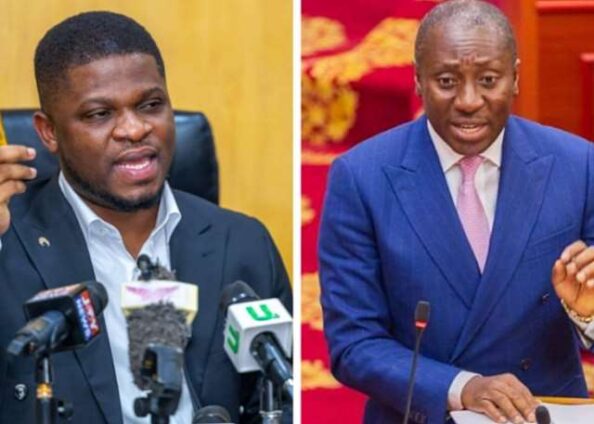
Over the past several weeks, he has waged a relentless war against the Chief Executive Officer of the Ghana Gold
Board (GOLDBOD), attributing directly to him and his organization the claim that they are responsible for the GHC
22 Billion loss (speculative as it is), in spite of the fact that his primary source, the IMF, attributes the loss to the
Bank of Ghana (BoG).
Once again, it becomes quickly clear that Minority Leader is playing exactly the same mind game that the NDC in
its turn played. He is looking for a whipping horse, right or wrong (he does not really care) and he seems to think
that he has found one in the CEO of the GOLDBOD.
Make no mistake; I am not defending Sammy Gyamfi of the GOLDBOD. Indeed, in his appointment, I believe that
the President has demonstrated his complete lack of regard and contempt for the nation and people of Ghana,
because gold trading is serious business. It is the height of recklessness to hijack the entire gold resource of one of
the biggest producing nations in the world, and hand it over to an individual with no background in the industry.
Ordinarily, Sammy Gyamfi, who is a lawyer with less than a decade at the Ghanaian Bar, would have been
employed as a junior associate in the legal department of a massive undertaking such as the GOLDBOD. He is at
where he is, because the President, in his wisdom, believes that he can play ‘chaskele’ with the entire gold resources
of Ghana, and get away with it.
The frightening aspect to the whole Afenyo-Markin and Sammy Gyamfi brouhaha, is that it has shifted the focus of
the IMF expose to matters that are truly peripheral. It is almost entirely unnecessary to establish whether it is
Sammy Gyamfi or the GOLDBOD that caused the loss (if there has been a loss). What should have mattered, is why
it had to take the IMF to alert this nation, including its very vociferous Minority, that such a loss could be taking
place, whether at BoG, GOLDBOD or elsewhere. Where were our experts and watchdogs?
The fact is that a nation that lacks the knowledge and expertise to keep track of a valuable resource like gold in these
modern times, has very little business owning the resource in the first place.
It is probably why, four centuries after the colonialists arrived on our shores looking for gold, and in spite of all the
universities and degrees being flaunted all over the place, that our mines are all owned by foreigners.
And it is understandable why this is so, because we prefer to play mind games with each other, instead of focusing
and educating ourselves on the things that could have saved us from our economic morass.
(PERISCOPE DEPTH of Monday, 24 th August, 2026).


