
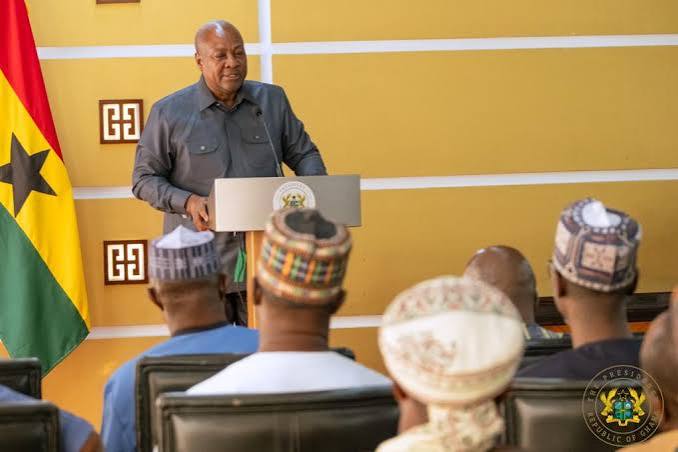

President John Dramani Mahama has called on religious leaders and their followers to exercise restraint and responsibility, warning that recent tensions involving religious figures must not be allowed to weaken Ghana’s longstanding tradition of peaceful coexistence among people of different faiths.
President Mahama made the appeal on Thursday, August 20, 2026, when he addressed the opening of the 32nd Biennial General Council Meeting of the Assemblies of God, Ghana, at Gomoa Fetteh in the Central Region.

The President described recent developments involving a pastor and an imam as deeply regrettable, particularly following comments attributed to the two religious figures and subsequent reports of physical attacks connected to the controversy.

He said the developments should remind Ghanaians that religious harmony cannot be taken for granted and must be deliberately protected by citizens, faith leaders and institutions.

President Mahama stressed that incidents of this nature should never be permitted to define relationships between Christians, Muslims and adherents of other religions in Ghana.
He noted that for generations, people belonging to different religious traditions had lived together peacefully, while sharing families, schools, workplaces, security institutions and other public establishments.

According to him, the ability of people from diverse religious backgrounds to coexist peacefully represents one of Ghana’s most valuable national strengths and must be preserved for future generations.
The President acknowledged that the Constitution guarantees freedom of religion and provides citizens with the right to profess and express their faith. He, however, emphasised that such constitutional freedoms do not authorise anyone to demean another person’s beliefs, encourage violence or resort to unlawful action.

He urged religious leaders and their followers to recognise the distinction between expressing religious conviction and provoking hostility towards people of another faith.

President Mahama warned that disagreements rooted in religious differences must never be allowed to deteriorate into hatred, intimidation, threats or physical attacks.
He stressed that violence cannot be justified in the name of religion and maintained that no individual honours God by attacking another person or threatening another human being because of differences in religious belief.
The President consequently appealed to pastors, imams and other religious authorities to demonstrate greater restraint when addressing sensitive issues, particularly through public sermons and social media platforms.
He cautioned that statements delivered from church pulpits, mosques or online platforms can spread rapidly and reach large audiences, potentially intensifying emotions and creating consequences that extend well beyond the original intention of the speaker.
President Mahama said senior religious authorities, including the National Chief Imam and other influential faith leaders, were expected to play a constructive role in encouraging reconciliation and supporting a peaceful resolution to the disagreement involving the individuals concerned.
He nevertheless emphasised that religious intervention should complement rather than replace the formal justice process, insisting that the law must be allowed to operate fairly, independently and without discrimination.
The President also urged religious institutions to help educate younger generations about the value of religious diversity and mutual respect.
He argued that differences in religious belief should not be regarded as a source of division, but rather as part of the diversity that can strengthen Ghanaian society when citizens interact with tolerance and understanding.
Addressing the Assemblies of God, Ghana, as the denomination began its 32nd Biennial General Council Meeting, President Mahama encouraged the Church to remain committed to prayer, evangelism and service to society.
He urged the denomination to translate its religious principles into practical initiatives that promote peace, support vulnerable members of society and contribute positively to national development.
The President further congratulated the Assemblies of God, Ghana, for convening the biennial gathering and expressed the hope that discussions arising from the meeting would strengthen the Church’s contribution to national progress, social cohesion and peaceful coexistence.
His intervention comes amid renewed public attention to the responsibility of religious leaders in maintaining social harmony and ensuring that disagreements over faith do not develop into hostility or violence.
President Mahama’s message ultimately placed emphasis on restraint, respect for religious diversity and adherence to the rule of law as essential principles for protecting Ghana’s established tradition of interfaith harmony.

