
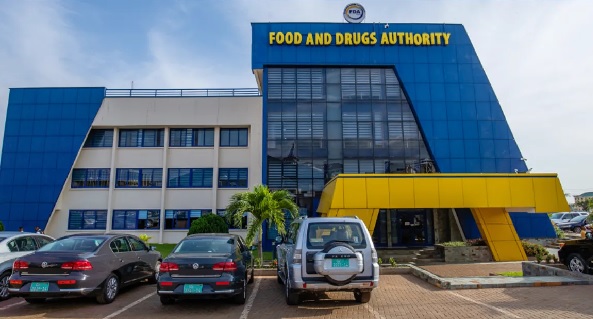

The Food and Drugs Authority, FDA, recorded a financial surplus of GH¢70 million in 2025, representing a 51 per cent increase from the GH¢46 million achieved the previous year, even as the regulatory institution identified deteriorating laboratory equipment and the circulation of illicit products among the major challenges confronting its public health protection mandate.
Deputy Director of Finance at the FDA, Samuel Adom Siaw, disclosed the figures during the Authority’s 2025 Annual Stakeholders’ Meeting in Accra, where he presented the institution’s audited financial statements and outlined its financial performance during the year under review.

According to him, the Authority’s total assets expanded from GH¢296 million in 2024 to GH¢358 million in 2025, while its liabilities fell considerably from GH¢12 million to GH¢3.4 million over the same period.

The FDA generated total revenue of GH¢420 million during the year, comprising GH¢278 million in internally generated funds, GH¢78 million in support from development partners and GH¢63 million in government subsidies.

Internally generated funds constituted the largest component of the Authority’s income, accounting for 66 per cent of total revenue, while donor contributions represented 19 per cent and government support made up the remaining 15 per cent.
Mr Adom Siaw said the Authority’s expenditure increased only marginally from GH¢266 million in 2024 to GH¢267 million in 2025, despite higher employee compensation costs and growing operational requirements associated with the FDA’s regulatory responsibilities.

He nevertheless disclosed that the Authority fell GH¢95 million short of its projected internally generated revenue target of GH¢374 million, with fluctuations in the exchange rate identified as one of the principal factors contributing to the revenue gap.
He said the FDA would consequently maintain prudent expenditure controls, intensify efforts to improve revenue mobilisation and periodically reassess its fee structure in consultation with relevant stakeholders.

Beyond its financial performance, the Authority reported substantial activity across its regulatory, inspection and public health operations throughout 2025.

FDA Quality Assurance Manager Joseph Ofosu Siaw said the institution received 24,446 applications for product registration during the year and processed 24,225 of them, resulting in 20,205 approvals.
The Authority also carried out 15,457 facility inspections as part of efforts to ensure compliance with established regulatory standards.
At Ghana’s ports, the FDA inspected 47,189 consignments, representing a 21.7 per cent increase compared with the previous year, as the regulator intensified scrutiny of products entering the country.
Its market surveillance programme also recorded significant activity, with 2,250 surveillance exercises conducted and inspections carried out at 24,755 retail outlets across the country.
Through these interventions, the FDA retrieved 215,876 products that were found to be non compliant with applicable regulatory requirements.
Mr Ofosu Siaw further disclosed that locally manufactured products accounted for 62 per cent of all regulated products registered by the Authority in 2025, compared with 33 per cent in 2024, indicating a substantial rise in the proportion of domestic production within the regulated market.
The Authority also expanded its food safety interventions by training 8,693 street food vendors and issuing 1,369 permits under its street food safety programme.
Despite these achievements, however, the FDA continues to face significant constraints within its laboratory operations.
Mr Ofosu Siaw said some laboratory equipment currently in use is between eight and 20 years old and has become increasingly difficult and expensive to maintain, particularly in facilities that operate continuously to meet the country’s testing requirements.
The challenge has become more pressing as demand for laboratory analysis continues to increase.
The FDA received 7,551 samples for laboratory examination in 2025, representing a 76 per cent increase over the number recorded in 2024. Despite the substantial rise in workload, the Authority achieved testing coverage of 77 per cent against its target of 85 per cent.
Mr Ofosu Siaw therefore appealed to stakeholders and development partners to assist the Authority with modern laboratory equipment to expand its analytical capacity and enable it to respond more effectively to growing testing demands.
The FDA’s official laboratory framework covers the analysis of medicines, food products, herbal medicines, cosmetics, medical devices and other regulated products, making laboratory capacity a critical component of its public health mandate.
The Authority also intensified enforcement against businesses and individuals found to have violated regulatory requirements during the year.
Director of Legal Services Perpetual Vicentia Yankson disclosed that the FDA issued approximately 80 warnings and imposed 233 administrative fines in 2025 in response to various regulatory breaches.
The violations included unauthorised advertising of regulated products, the sale of unregistered products, pharmaceutical recalls, the operation of unlicensed cold storage facilities and activities involving illicit tobacco products.
Mrs Yankson reminded businesses operating within the regulated sectors that advertisements for products under the FDA’s jurisdiction require prior approval from the Authority.
She also cautioned individuals and companies against manufacturing, importing, distributing or selling regulated products without the necessary registration and authorisation.
FDA management said it would strengthen intelligence led enforcement and risk based surveillance while deepening cooperation with the Customs Division of the Ghana Revenue Authority and other relevant institutions to tackle illicit imports and unregistered products.
The Authority said collaboration among regulatory and border control agencies would be particularly important in preventing prohibited and substandard products from entering the Ghanaian market.
The FDA further disclosed that its public education initiatives reached more than 12 million people in 2025, with campaigns focusing on tobacco consumption, medicine safety and food safety.
The institution said the extensive public education effort formed part of its broader strategy to improve consumer awareness and encourage members of the public to make safer and more informed decisions about food, medicines and other regulated products.
The FDA’s financial performance therefore presents a mixed picture, with the Authority recording stronger assets, lower liabilities and a substantially higher surplus while simultaneously confronting significant operational pressures arising from ageing laboratory infrastructure and the continued presence of illicit products within the market.
The institution is consequently seeking to consolidate its financial gains while directing greater attention towards modernising its laboratory infrastructure, strengthening regulatory enforcement and expanding its capacity to protect public health across Ghana.

