
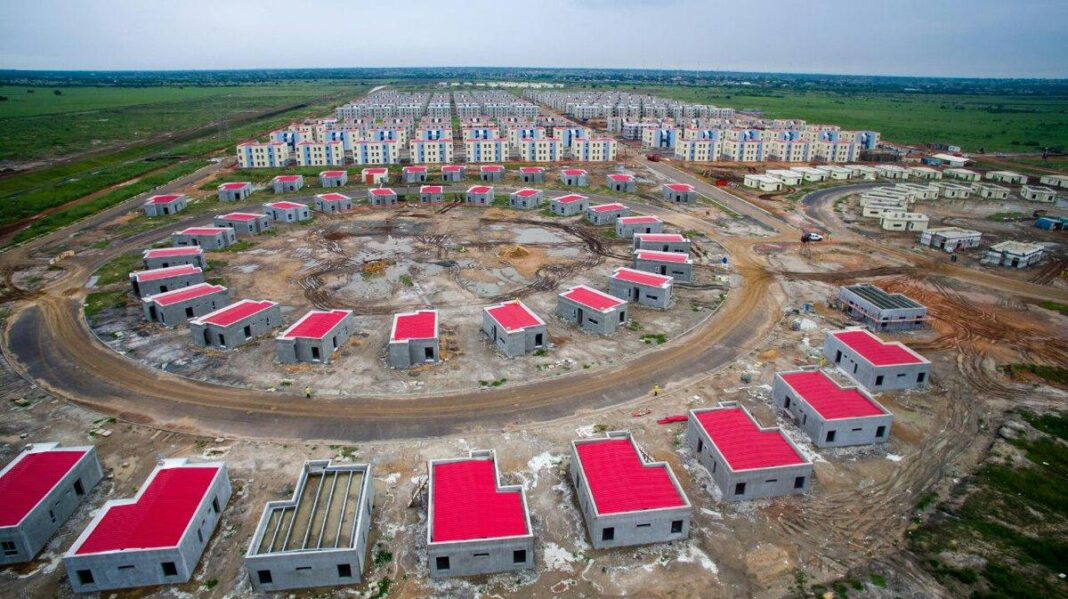

President John Mahama has announced that the first 700 homes under the redevelopment of the Saglemi Affordable Housing Project are expected to be completed and officially commissioned by March 2027, as government intensifies efforts to restore the long delayed residential development.
The President has further projected that 1,500 housing units will be ready by December 2027 as the government collaborates with private sector partners to complete the initial phase of the expansive housing scheme.

President Mahama disclosed the timelines during an inspection tour of the Saglemi Housing Project, where construction activities have resumed as part of efforts to transform the stalled development into a functional residential community.

He encouraged Ghanaians who are interested in acquiring homes under the project to prepare to register once the government opens the official registration platform.

According to President Mahama, the Saglemi project originated under the administration of the late President John Evans Atta Mills and was intended to contribute to efforts to address Ghana’s persistent housing deficit. However, he explained that the initiative subsequently encountered difficulties following a change in administration, as questions surrounding the project resulted in legal proceedings and investigations that contributed to the suspension of construction.
President Mahama explained that the prolonged inactivity eventually left the development vulnerable to extensive vandalism, resulting in the disappearance of valuable components and installations from several of the buildings.

He said electrical cables, bathroom fixtures, wash basins, bathtubs, lighting equipment and other fittings were removed by individuals who exploited the abandoned state of the project.
The President further disclosed that some underground telecommunications cables were also taken, thereby compounding the deterioration of infrastructure at the site and increasing the cost and complexity of reviving the development.

He explained that government subsequently adopted a private sector partnership model to facilitate the completion of the project, with LMI Holdings selected to lead the redevelopment programme.

President Mahama said the renewed investment would transform Saglemi into a viable residential community capable of providing suitable accommodation for families, workers and other residents within the surrounding areas.
He pointed to the project’s strategic location near major industrial centres in Tema and the Dawa Industrial Area as an important factor that could stimulate strong demand for the completed homes.
According to the President, workers employed by companies operating within the expanding industrial corridor could constitute a significant pool of potential homeowners once the properties become available.
He therefore encouraged prospective buyers to take advantage of the registration process when it is launched, warning that demand could become substantial because of the large number of employees working within nearby industrial communities.
President Mahama said the broader redevelopment plan envisages a 5,000 unit residential estate, with the first 1,500 homes constituting the initial phase of the renewed project.
He expressed confidence that the first phase would be completed by December 2027, after which construction would proceed with the remaining 3,500 units required to fulfil the broader housing target.
Beyond the construction of residential buildings, the President said complementary infrastructure was also being developed to ensure that the estate provides residents with the essential services required for comfortable living.
He noted that water supply facilities and solar power infrastructure were being incorporated into the development, thereby supporting the government’s objective of establishing a properly serviced residential community rather than simply constructing individual housing units.
President Mahama also disclosed that prospective homeowners would have access to mortgage and other financing arrangements designed to reduce the financial difficulties associated with purchasing a home.
He said a number of financial institutions, including the National Homeownership Fund, were prepared to assist eligible applicants with financing for deposits and mortgage obligations.
According to him, the proposed arrangements would enable beneficiaries to repay the cost of their homes over an agreed period while benefiting from comparatively affordable interest rates.
The President explained that the financing structure was intended to broaden access to home ownership by enabling Ghanaian workers and other qualified applicants to acquire properties without having to bear the entire financial burden upfront.
The government is expected to provide additional information on the cost of the houses, eligibility requirements and registration procedures when the official registration portal is launched.
The revival of the Saglemi project is consequently being positioned as a significant intervention in Ghana’s housing sector, with the government seeking to convert a development that remained dormant for years into a completed residential estate capable of serving thousands of households and workers in the rapidly expanding Tema and Dawa industrial corridor.

