
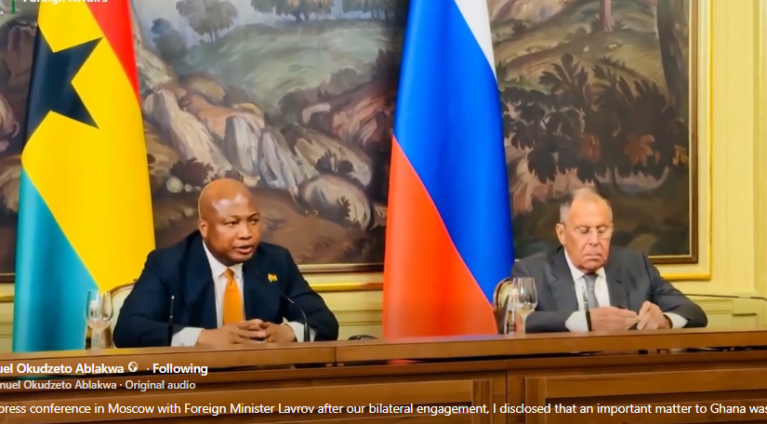

The Daily Searchlight does not agree with the Foreign Affairs Minister, Samuel Okudzeto Ablakwa that Ghana
should simply direct its outrage at Russia over the recruitment of Ghanaian youths to fight on the Ukrainian front.
There is, of course, nothing defensible about the loss of Ghanaian lives in a foreign war that has nothing to do with
the interests of Ghana or the overwhelming majority of Ghanaians. Mr. Ablakwa has reportedly stated that at least
62 Ghanaians have been killed, while another 15 remain missing, in connection with the Russia-Ukraine conflict.
These are not merely statistics. They represent sons, daughters, brothers, sisters and breadwinners whose lives have
been extinguished thousands of kilometres from home.
But the uncomfortable question Ghana must ask is this: Why are Ghanaian young people so readily prepared to risk
their lives in somebody else's war in the first place?
That question cannot be answered by blaming Russia alone.
The painful reality is that for many Ghanaians, particularly young people, life at home has increasingly come to
represent a struggle without a sufficiently convincing promise of a better tomorrow. Unemployment,
underemployment, low wages, rising living costs, inadequate opportunities and the pervasive perception that
connections rather than competence determine economic advancement have created a dangerous culture of
desperation.
For a young man or woman who sees little prospect of securing meaningful employment, establishing a business,
acquiring a home or building a respectable future in Ghana, an offer to travel abroad—even one involving
extraordinary risks—can begin to look attractive. Desperation has a way of making dangerous opportunities appear
preferable to safe hopelessness.
That is the uncomfortable part of this debate that politicians must confront.
It is easy to condemn a foreign government for exploiting vulnerable Ghanaian youths. It is considerably more
difficult to accept that the conditions that make such exploitation possible are, in substantial measure, conditions
created or tolerated by Ghanaian governments themselves.
The Ghanaian state is not powerless. The country possesses institutions responsible for intelligence, policing,
immigration, labour regulation and the protection of citizens abroad. Ghana has also accumulated considerable
experience with the recruitment and trafficking of vulnerable citizens into exploitative situations overseas.
The reports of Ghanaian women being lured or recruited into abusive and sometimes horrifying circumstances in
parts of the Middle East should have taught the country a fundamental lesson: desperate citizens will always be
vulnerable to predators who sell dreams of foreign prosperity.
Yet recruitment networks continue to emerge. Some recruiters have reportedly advertised opportunities openly,
including through radio and other public platforms. The question therefore arises: Where are the regulatory
agencies? Where are the investigations? Where are the prosecutions? And why does the state so often appear to
become interested in these schemes only after Ghanaian citizens have been harmed?
The Russia-Ukraine recruitment controversy should consequently be treated as more than a diplomatic quarrel with
Moscow. It should be regarded as a national warning about the vulnerability of Ghanaian citizens to exploitation
wherever economic desperation meets foreign opportunity.
If Ghanaian youths are prepared to travel thousands of kilometres to participate in a war in which they have no
national stake, the answer cannot simply be to tell them that Russia is wicked for recruiting them. The more
fundamental question is what Ghana has done—or failed to do—to make staying in Ghana a sufficiently attractive
alternative.
This is where the responsibility of politicians such as Mr. Ablakwa becomes particularly important.
The Foreign Affairs Ministry must certainly protect Ghanaian citizens abroad. It must investigate recruitment
networks, warn citizens against dangerous offers and work with foreign governments to prevent the exploitation of
Ghanaians. But foreign policy cannot substitute for domestic economic policy.
The ultimate protection for Ghana's youth is not a press statement from Accra or a diplomatic protest in Moscow. It
is a Ghana in which a young person can reasonably believe that honest work can produce a decent life.
That requires jobs, functioning institutions, affordable education and skills training, access to capital, reliable
infrastructure, predictable economic policies and—perhaps most importantly—a restoration of public confidence in
the idea that hard work in Ghana can actually lead somewhere.
Ghana must stop creating a generation that regards migration as the only credible escape from poverty and
frustration. When young people begin to believe that anywhere is better than here, the country has already lost an
important battle.
Mr. Ablakwa is therefore right to be concerned about the Ghanaian lives being lost in Ukraine. He is right to
demand that Ghanaian citizens should not be exploited as expendable manpower in a foreign conflict.
But the Government must look beyond Russia.
The deeper indictment is of a Ghanaian political and economic system that has allowed too many of its young
citizens to become sufficiently desperate to gamble their lives on promises from strangers.
If the Government genuinely wants to prevent more Ghanaian youths from dying on foreign battlefields, it must do
more than condemn those who recruit them. It must build a country from which its young people do not feel
compelled to escape at any cost.
The objective should not merely be to persuade Ghana's youth that they should not die in Russia or Ukraine.
It should be to give them compelling reasons to want to live—and build their futures—in Ghana.
(Editorial of The Daily Searchlight of 19 th August, 2026).


