
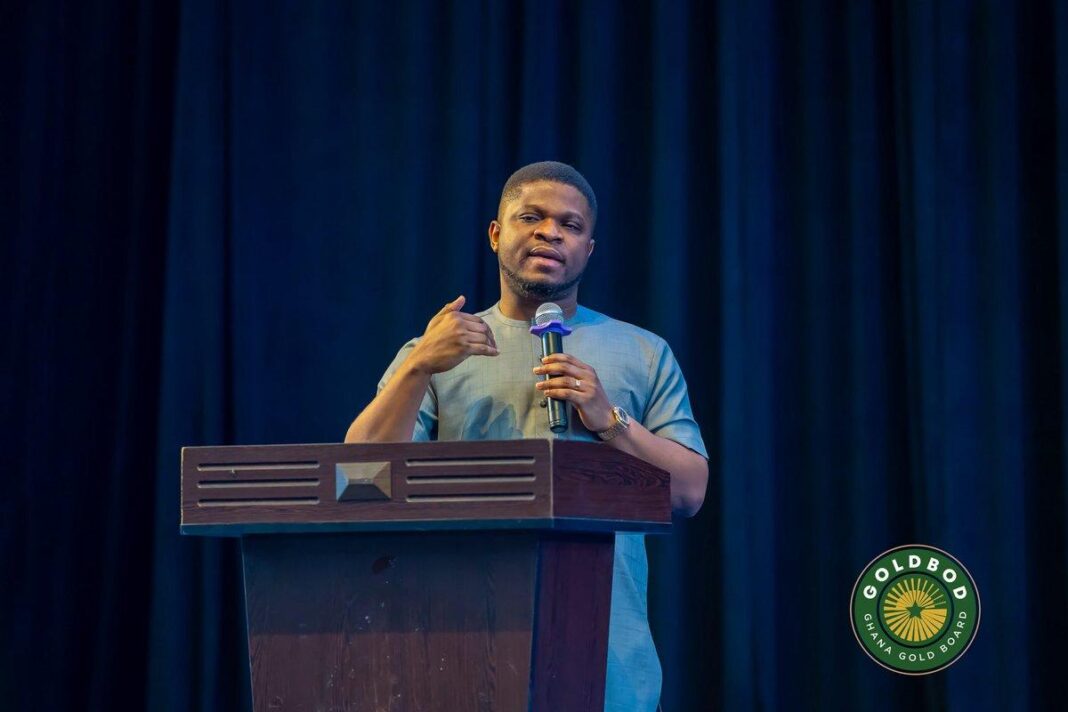

Chief Executive Officer of the Ghana Gold Board, Sammy Gyamfi, has challenged Minority Leader Alexander Afenyo Markin to invoke Parliament’s oversight powers and summon him to account for allegations that GoldBod was responsible for substantial losses associated with the Bank of Ghana’s Domestic Gold Purchase Programme.
Mr Gyamfi said he remained prepared to appear before Parliament at any time to present evidence, clarify GoldBod’s role in the programme and respond directly to claims concerning the institution’s financial operations.

Speaking at the Government Accountability Series on Wednesday, August 19, 2026, the GoldBod Chief Executive urged the Minority Leader to move beyond press conferences and use the appropriate parliamentary procedures to initiate a formal examination of the matter.

He said a parliamentary investigation would offer both sides an opportunity to place their evidence before the appropriate legislative body and allow the facts surrounding the reported losses to be properly established.

“There has been a call for a parliamentary probe, and I’ve already stated on public record that I’m waiting with bated breath for Afenyo Markin’s invitation,” Mr Gyamfi said.
He questioned why Mr Afenyo Markin continued to address the issue primarily through public statements when the Minority Leader could facilitate an appearance before Parliament’s Public Accounts Committee.

According to him, the committee already possesses the authority to invite him to explain GoldBod’s operations and respond to the allegations without requiring an additional parliamentary motion or a special directive from the Speaker.
Mr Gyamfi therefore urged the Minority Leader to activate the available parliamentary procedures and allow the matter to be determined through documentary evidence and direct questioning rather than competing narratives in the media.

“I don’t know why he’s delaying and holding press conferences when, as Minority Leader, he can get the Public Accounts Committee to summon me tomorrow or today, and I will appear,” he said.

The GoldBod chief executive also disclosed that he had personally approached the new Majority Leader, James Agalga, and asked him to facilitate his appearance before the committee if Mr Afenyo Markin did not extend the invitation.
He said he was willing to attend Parliament immediately and provide whatever information was required to establish the precise role GoldBod played in the Domestic Gold Purchase Programme.
Mr Gyamfi insisted that there was no procedural obstacle preventing the Public Accounts Committee from examining the matter.
“You don’t need any special motion; you don’t need any special order by the Speaker. Just get the Public Accounts Committee to invite us and come and sit down there and demonstrate to the whole nation where the Gold Board made losses or how the Gold Board is to blame for losses made by another institution,” he said.
His comments come amid an intensifying political and economic dispute over financial losses associated with the Domestic Gold Purchase Programme, which was initially operated by the Bank of Ghana before significant aspects of the programme were transferred to GoldBod.
The International Monetary Fund’s 2026 report states that the Bank of Ghana incurred losses under the programme and explains that those costs were associated with factors including service fees, assay charges, trading margins, off taker costs and the exchange rate applied to gold purchases. The IMF also reported that the Bank of Ghana’s losses under the programme amounted to 15.3 percent of gross gold purchases before falling to 11.7 percent in the first quarter of 2026.
Mr Gyamfi, however, has rejected assertions that GoldBod itself should be held responsible for the reported losses, maintaining that the institution should not be blamed for financial outcomes generated under a programme that was established and initially financed by the Bank of Ghana.
GoldBod has previously maintained that the Domestic Gold Purchase Programme was introduced as a monetary policy intervention by the Bank of Ghana and that its financial consequences were therefore recorded on the central bank’s books from the programme’s inception.
The GoldBod chief executive has consequently challenged Mr Afenyo Markin to identify specific evidence demonstrating that GoldBod incurred the losses being attributed to it.
The controversy has intensified following references to a figure of US$1.7 billion in connection with the programme. The IMF’s latest report, however, presents a broader assessment of losses associated with DGPP activities and identifies several components contributing to the Bank of Ghana’s negative equity position. It also states that an external auditing firm was conducting a special audit of the programme from its inception, with the results expected in the third quarter of 2026.
The distinction has become central to the dispute because the US$1.7 billion figure has been publicly presented in some quarters as a direct loss incurred by GoldBod, while other analyses have questioned whether the figure should instead be understood as a broader programme related accounting and valuation assessment.
Indeed, recent fact checking has challenged the interpretation that GoldBod itself lost US$1.7 billion, arguing that different figures in the IMF and Bank of Ghana records have been compared without sufficient consideration of what each figure represents.
Meanwhile, Chairperson of Parliament’s Public Accounts Committee, Abena Osei Asare, has called for a comprehensive investigation into the reported losses associated with the Domestic Gold Purchase Programme, saying the scale of the figures warrants closer examination to determine how the losses arose and whether public resources were adequately protected.
Mr Gyamfi has welcomed the prospect of parliamentary scrutiny while insisting that such an exercise should be grounded in evidence and should clearly distinguish between losses incurred by the Bank of Ghana under the programme and the operations of GoldBod.
He has also disclosed that an external audit of the Domestic Gold Purchase Programme is being conducted from its inception in 2021, a process he says should help establish the financial history and responsibilities associated with the programme.
The dispute comes at a time when GoldBod is assuming a more prominent role in Ghana’s gold purchasing and export structure. The IMF has noted that GoldBod now purchases artisanal and small scale mining gold domestically in cedis and exports the gold through private offtakers, while the Bank of Ghana’s role has been narrowed to that of fiscal agent for GoldBod in foreign exchange operations.
Mr Gyamfi has therefore maintained that a parliamentary hearing would be the most appropriate avenue for resolving the disagreement, enabling legislators, GoldBod officials and other relevant institutions to examine the available records and establish responsibility.
For now, the GoldBod chief executive remains adamant that he has nothing to hide and is ready to appear before Parliament whenever formally invited, challenging the Minority Leader to replace public accusations with a structured parliamentary inquiry where the claims can be tested against evidence.

