
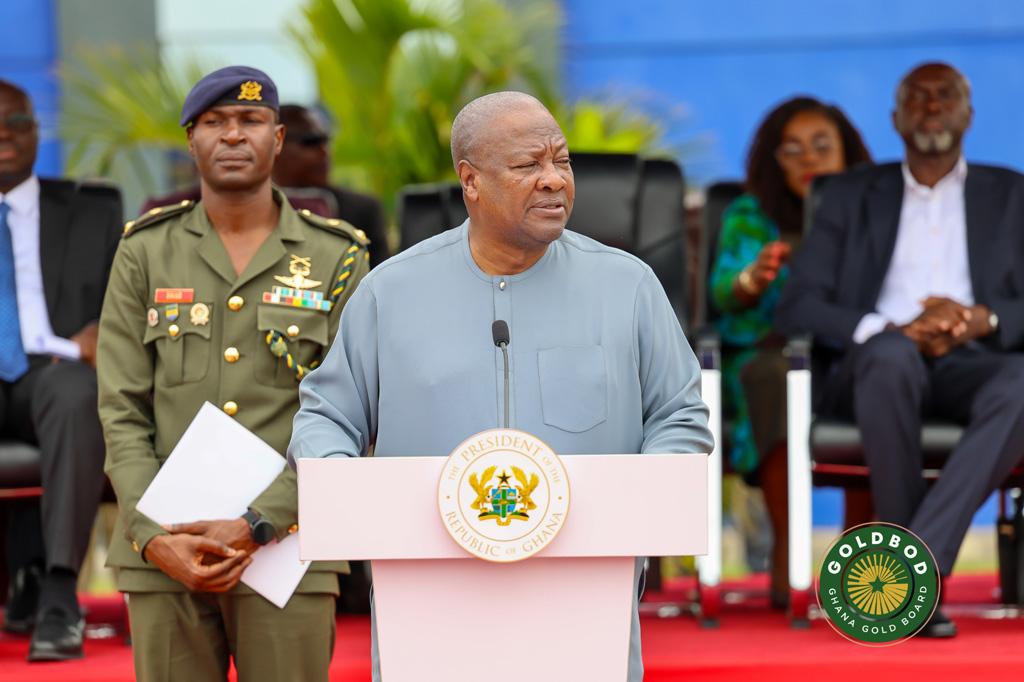

President John Dramani Mahama has announced a major change in the government’s strategy for combating illegal mining, declaring that military detachments will remain stationed inside forest reserves after galamsey operators have been driven out to prevent them from returning.
The President said the decision had become necessary after authorities discovered that clearing illegal miners from protected forests and subsequently transferring control of the areas back to the Forestry Commission had failed to provide lasting protection.

Speaking during his tour of the Upper East Region, President Mahama said enforcement agencies had made considerable progress in reclaiming forest reserves that had been invaded by illegal miners, but acknowledged that some operators had repeatedly returned once security personnel withdrew.

He said the National Anti Illegal Mining Operations Secretariat, known as NAIMOS, had intensified operations across affected areas, resulting in the seizure of excavators and Changfan mining equipment. However, according to the President, the displacement of illegal miners from one location often resulted in their movement to another area.

“We are working; NAIMOS is working very hard. We’ve seized excavators, we’ve seized Changfan machines, and you drive them out of this area, they run to this other area. But we are making progress,” he said.
President Mahama disclosed that the government had succeeded in reclaiming as many of the nearly 49 forest reserves affected by illegal mining as possible. Nevertheless, he said experience had demonstrated that physical clearance alone could not guarantee the long term security of the protected areas.

Under the former arrangement, reclaimed forests were handed back to the Forestry Commission for continued management. The President said illegal miners, however, had exploited the limited capacity of forest guards by forcing them out of protected areas before resuming their operations.
“Before, what we did was when we cleared, we handed over to the Forestry Services Commission. But they don’t fear the Forest Service; they go and drive the forest guards out, and they go back into the mine. And so now we put a military detachment,” he explained.

The government will therefore retain soldiers within reclaimed forest reserves after illegal mining operations have been dismantled, creating a continuous security presence intended to deter fresh encroachment.

President Mahama acknowledged that maintaining troops in remote forest locations would impose additional financial obligations on the state because government would have to provide food, accommodation and operational logistics for the personnel.
“After we’ve cleared the forest reserve, we leave a military detachment there. And that means we have to spend more money. One, you must feed the soldiers; you must provide them with the logistics to continue to stay there in the forest,” he said.
Despite the increased expenditure, President Mahama insisted that his administration would not retreat from its campaign against illegal mining.
“But we will not give up; we will continue the fight against illegal mining,” he declared.
The President’s announcement comes against the backdrop of persistent concerns over the ability of enforcement authorities to keep reclaimed forests secure after anti galamsey operations have been completed. A government assessment previously identified dozens of forest reserves as having been affected by illegal mining, while joint security operations have been used to reclaim several areas.
The administration’s revised strategy consequently places greater emphasis not only on removing illegal miners but also on preventing their re entry once enforcement operations have concluded.
Government Pushes for Formal Mining to Create Jobs
While reaffirming his determination to suppress unlawful mining, President Mahama said the government was not opposed to mining as an economic activity. Rather, he maintained that the sector must be properly regulated, formalised and organised in a manner that creates legitimate employment while protecting the environment.
He said the Upper East Region possessed considerable mineral potential and could benefit substantially from a properly structured mining industry capable of providing employment for young people.
“Upper East has good potential, and mining can create jobs, but we need to make sure that these are formalised mines so that they can employ our young people to operate,” he said.
The President referred to the opening of the Cardinal Mine in the region as an illustration of how legitimate mining enterprises could contribute to economic activity and employment.
He also cited the proposed Black Volta mine development in the Upper West Region as another indication of the employment opportunities that could emerge from properly regulated mining operations.
“In Upper West, they have the Black Volta mine development coming up. There are several other areas that we can see the potential for proper mining so that it can produce more jobs for our young people,” he said.
According to President Mahama, the government’s broader objective is to replace unregulated and dispersed illegal mining with a formal system that gives the state stronger oversight over mineral extraction.
“Our target is to formalise the mining activity so that we have greater control over it than the current scattered illegal mining that takes place,” he said.
The approach therefore combines enforcement with formalisation, with the government seeking to preserve protected ecosystems while directing legitimate mining activity towards areas where it can be properly supervised.
Mahama Says Upper East Mining Presents Different Environmental Risks
President Mahama also distinguished the nature of mining in the Upper East Region from the environmental destruction associated with illegal mining in heavily forested areas of southern Ghana.
He explained that much of the gold deposit in the Upper East is located within rock formations, meaning extraction generally involves breaking and processing rock rather than extensively clearing forest vegetation.
“The advantage with the Upper East Region is that most of the places where the gold is found are found in rock. And so it does not create the kind of environmental destruction that we see in the south,” he said.
He explained that operators in such locations typically blast the rock before processing the material to recover the gold.
“The gold is found in rock, and so they blast the rock, and they process it and take the gold out,” he said.
The President argued that this geological characteristic reduces the scale of environmental devastation compared with illegal mining operations that have penetrated forest reserves in southern Ghana.
“And so it doesn’t create the same extent of devastation that we’re seeing in the forest in the south. And so that’s a fortunate thing,” he said.
The government’s revised policy consequently signals a dual approach to Ghana’s mining sector. Within protected forest reserves, the administration intends to combine aggressive enforcement with a permanent military presence in reclaimed areas, while outside such protected zones, it plans to promote regulated and formalised mining capable of generating employment and economic opportunities.
The strategy reflects an acknowledgement that removing illegal miners from forest reserves is only the first stage of the battle. For reclaimed forests to remain protected, the government now intends to maintain security personnel on the ground and provide the logistical resources required to prevent renewed encroachment.

