
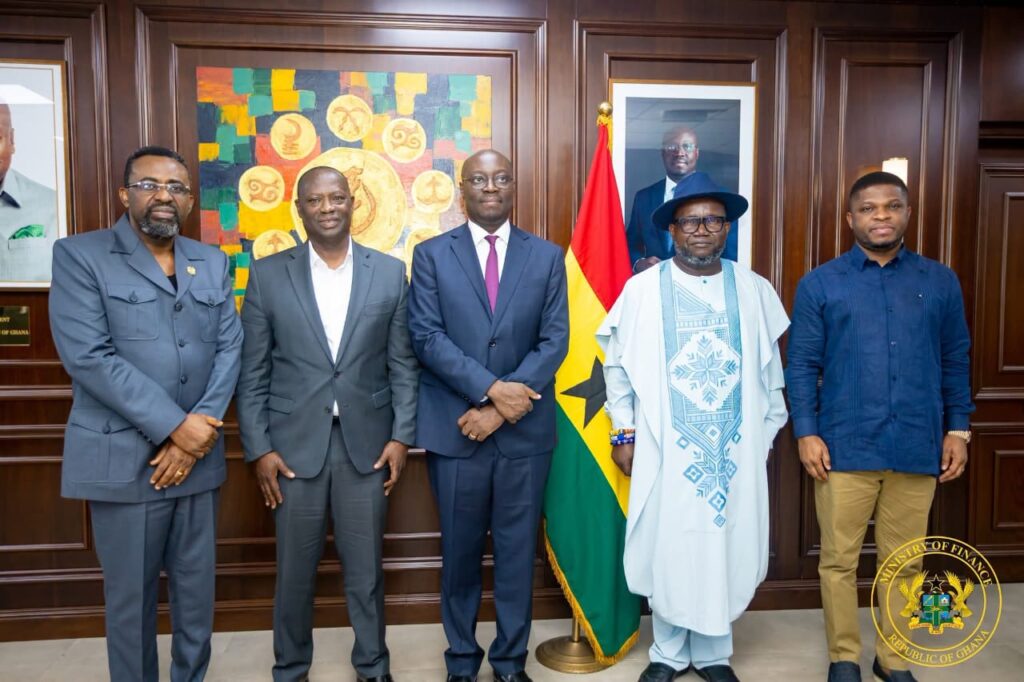

The Government of Ghana has concluded an agreement with major large scale mining companies to implement the Ghana Accelerated National Reserve Accumulation Programme, known as GANRAP, under which participating companies will supply 30 percent of their gold production to the Ghana Gold Board, commonly known as GoldBod, for domestic processing and refining before the refined bullion is incorporated into the nation’s international reserves.
The arrangement was formally established through a Memorandum of Understanding signed by the Ministry of Finance, the Ministry of Lands and Natural Resources, GoldBod, the Bank of Ghana and the Ghana Chamber of Mines, which represented the participating large scale mining companies.

Speaking during the signing ceremony, Finance Minister Dr Cassiel Ato Forson said the agreement represented the culmination of extensive discussions between the government and the mining industry following the introduction of GANRAP.

He explained that the initiative would enable a defined share of gold extracted by large scale mining companies to remain within Ghana, undergo local refining and subsequently be transferred to the Bank of Ghana for inclusion in the country’s international reserves.

Dr Forson described the agreement as an important step towards strengthening Ghana’s external financial position by using the country’s gold resources to build reserve holdings rather than depending excessively on additional external borrowing.
He said the signing demonstrated that government and the mining industry had reached a shared understanding on the implementation of the policy, which would take effect from the date the agreement was executed.

The Finance Minister said the agreement emerged from consultations involving government institutions, the Ghana Chamber of Mines, participating mining companies, the central bank and GoldBod, with all parties seeking to establish an arrangement capable of supporting Ghana’s reserve accumulation objectives while maintaining cooperation with the mining sector.
GANRAP is intended to use Ghana’s substantial gold resources as a strategic instrument for strengthening the country’s external reserves and creating a larger financial cushion against international economic disruptions.

Under the government’s medium term framework, the programme seeks to help Ghana build reserves equivalent to approximately 15 months of import cover, thereby providing the economy with greater protection against external financing pressures, commodity market instability and foreign exchange shocks.

The Minister for Lands and Natural Resources, Emmanuel Armah Kofi Buah, welcomed the agreement and pledged continued collaboration between his ministry, the Ghana Chamber of Mines and its member companies as the programme progresses from policy formulation into practical implementation.
Mr Buah acknowledged that GANRAP was a new initiative and therefore required a responsive approach capable of addressing difficulties that could arise as participating institutions and mining companies gained practical experience with the framework.
He assured stakeholders that the Ministry of Lands and Natural Resources would maintain close engagement with the Chamber of Mines and its members and would remain prepared to participate in resolving emerging concerns.
The minister stressed that although implementation challenges could occur, the government was committed to engaging the industry whenever necessary so that potential difficulties could be addressed without undermining the broader national objective.
He further emphasised that the central consideration throughout the process would be ensuring that GANRAP ultimately delivered meaningful benefits to Ghana while maintaining constructive relations between the state and the mining industry.
Bank of Ghana Governor Dr Johnson Pandit Asiama described the 30 percent commitment from participating mining companies as a substantial contribution to Ghana’s economic development and reserve accumulation efforts.
Dr Asiama commended the Ghana Chamber of Mines and its member companies for agreeing to participate in the programme and also recognised the contributions of GoldBod, the Ministry of Finance and the Ministry of Lands and Natural Resources towards bringing the various stakeholders together.
He said the central bank regarded the commitment as valuable to the country and would continue working with the participating institutions to ensure that the agreement was implemented effectively.
According to the Governor, the Bank of Ghana would remain closely involved in the implementation process and would cooperate with all relevant stakeholders to maximise the benefits of the arrangement for the Ghanaian population.
Chief Executive Officer of the Ghana Chamber of Mines, Ing Dr Kenneth Ashigbey, said the mining industry supported GANRAP because a sound and predictable macroeconomic environment was fundamental to the continued operation, investment and expansion of mining companies in Ghana.
He explained that the industry viewed the proposed 15 month reserve buffer as a useful objective because stronger international reserves could provide the country with greater capacity to absorb external economic shocks.
Dr Ashigbey said the mining sector therefore supported the central purpose of GANRAP and recognised the importance of developing a stronger reserve position through Ghana’s own natural resources.
He also welcomed the government’s objective of establishing internationally accredited gold refineries within Ghana, arguing that stronger domestic refining capacity would enable the country to retain more value from its gold production instead of exporting the mineral primarily in unrefined form.
The Chamber of Mines has already begun examining opportunities for greater participation in Ghana’s domestic refining ambitions, including visits to refineries such as Gold Coast and Royal Ghana Gold Refinery.
Dr Ashigbey said those engagements were intended to help the industry understand the capabilities of existing refining facilities and identify ways in which mining companies could contribute to the development of a stronger domestic refining ecosystem.
He nevertheless urged the government to consider transforming GANRAP into a more incentive based framework so that domestic gold processing and refining would remain commercially attractive after the current programme expires.
He argued that discussions about the future of GANRAP should extend beyond 2028 and should focus on creating sustainable incentives capable of encouraging mining companies to continue supporting local beneficiation.
According to him, Ghana could examine the experiences of jurisdictions such as Tanzania, India and South Africa, where policy incentives have been deployed to encourage domestic processing and refining of minerals.
He said Ghana could adapt relevant elements of those approaches to strengthen its own refining industry and potentially establish the country as a major gold refining centre serving the wider West African market.
Such an outcome, he suggested, would allow Ghana to move beyond simply producing gold and exporting it, towards becoming a regional centre for refining, value addition and bullion related activities.
The Ghana Chamber of Mines has consequently indicated its willingness to work alongside government agencies and other stakeholders during the pilot phase of GANRAP to identify operational difficulties, improve the implementation framework and develop mechanisms capable of sustaining the initiative beyond its current policy horizon.
The agreement represents a broader government effort to capture greater economic value from Ghana’s gold resources while simultaneously strengthening the country’s foreign exchange position and expanding domestic participation in the gold value chain.
The policy also aligns with the government’s wider strategy of using gold as a strategic financial asset rather than treating the commodity solely as an export product.
GoldBod has already pursued partnerships with domestic refining companies as part of efforts to ensure that a greater proportion of Ghana’s gold is processed locally before entering international markets.
If successfully implemented, GANRAP could therefore give Ghana a stronger position in the international gold market by linking domestic mining production with local refining, reserve accumulation and broader financial stability.
The success of the programme, however, will depend on sustained cooperation among government agencies, the Bank of Ghana, GoldBod, mining companies and the Ghana Chamber of Mines, together with the creation of commercially attractive conditions that encourage local refining beyond the immediate requirements of the policy.
Ultimately, the government’s objective is to transform Ghana’s gold resources into a more powerful reserve building instrument while simultaneously deepening domestic value addition and strengthening the country’s capacity to withstand external economic pressures.

