
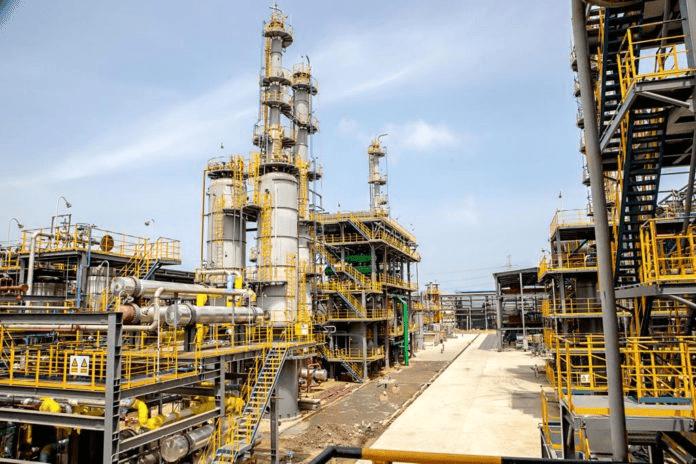

Ghana’s expanding petroleum refining capacity is expected to reinforce national fuel security, although the country will remain vulnerable to international energy market disruptions until domestic production is sufficient to satisfy the bulk of local demand, energy specialist Benjamin Nsiah has cautioned.
Mr Nsiah, Executive Director of the Centre for Environmental Management and Sustainable Energy, said the increasing availability of operational refining facilities represented an important development for Ghana’s downstream petroleum industry because it could lessen the country’s dependence on imported refined products and reduce the pressure that fuel imports place on foreign exchange resources.

Nevertheless, he explained that even if Ghana’s existing refineries operated at their maximum potential, domestic production would currently satisfy only about 60 per cent of national petroleum requirements. The remaining portion would therefore still have to be sourced from international markets, leaving domestic fuel prices susceptible to developments beyond the country’s control.

Speaking to the Ghana News Agency in Accra, Mr Nsiah said Ghana’s present consumption was estimated at between 120,000 and 140,000 barrels of petroleum products each day, making sustained investment in refining infrastructure essential to the country’s long term energy resilience.

He explained that the current refining capacity could cover a substantial share of national requirements, but it would not yet be sufficient to completely eliminate the need for imports.
According to him, this reality makes it premature to assume that the commissioning or expansion of local refineries would automatically protect Ghanaian consumers from international fuel price movements.

Mr Nsiah said Ghana’s deregulated petroleum pricing structure remained closely connected to conditions in international markets because a considerable quantity of refined petroleum products continued to be imported. Consequently, changes in global refined product prices, movements in the exchange value of the Ghana cedi against the United States dollar, shipping expenses, insurance charges and applicable statutory taxes and levies would continue to influence prices at domestic filling stations.
He therefore noted that a decline in international refining costs or a strengthening of the cedi could provide relief to consumers, while a surge in global petroleum prices or renewed foreign exchange pressures could produce the opposite effect, even as Ghana expands its own refining infrastructure.

The energy specialist, however, said developments involving both public and privately owned refineries provided encouraging prospects for a substantial increase in domestic petroleum production.

He particularly pointed to the Tema Oil Refinery, which has returned to crude processing after an extensive period of operational difficulty. Official information indicates that TOR resumed refining activities in December 2025, while the facility processed a new consignment of crude in June 2026 as part of efforts to restore sustainable operations.
Mr Nsiah also referred to the reported financial improvement at TOR, including the refinery’s announcement of profit after tax amounting to GH¢1.24 billion, as evidence of the potential gains that could emerge from operational reforms and stronger management.
He further observed that the expansion programmes being pursued by domestic refining companies could eventually transform Ghana’s position within the petroleum value chain by increasing local output sufficiently to satisfy national requirements and potentially generate volumes for export.
He said that if TOR succeeded in implementing its proposed capacity expansion while Sentuo Oil Refinery simultaneously increased its own processing capability, the combined production of the two facilities could potentially match Ghana’s daily petroleum requirements and create an additional surplus for regional markets.
Sentuo is currently operating at a refining capacity of about 40,000 barrels per day, while its Phase Two expansion is expected to raise that capacity to 100,000 barrels per day when completed. The expansion formally commenced in June 2026 and forms part of broader efforts to increase domestic refining and reduce reliance on imported petroleum products.
The Energy and Green Transition Minister, John Abdulai Jinapor, has separately indicated that expansion projects at TOR and Sentuo could enable the two refineries together to satisfy approximately 70 per cent of Ghana’s domestic demand for refined petroleum products.
Mr Nsiah said achieving even greater capacity would represent a significant step towards petroleum self sufficiency and could eventually position Ghana as a supplier of refined fuels to neighbouring countries across the West African sub region.
He argued that such a transformation would not only improve domestic fuel availability but could also generate foreign exchange through exports, retain a greater proportion of petroleum value within the Ghanaian economy and strengthen the country’s position within the regional energy market.
The specialist nevertheless maintained that Ghana should accompany the expansion of refining infrastructure with a gradual review of its petroleum pricing framework.
He said that as domestic refineries became increasingly capable of supplying the local market, the pricing system should progressively take greater account of the actual costs associated with producing petroleum products within Ghana, while still recognising the international components that remain relevant to the industry.
Mr Nsiah explained that a stronger domestic refining base presented Ghana with an opportunity to reduce its exposure to international pricing benchmarks that have traditionally exerted substantial influence over local fuel prices.
He stressed that the objective should not simply be to construct or expand refineries, but to establish an efficient, commercially sustainable and dependable petroleum industry capable of maintaining adequate fuel supplies under changing economic conditions.
Ghana’s medium term energy development strategy similarly identifies inadequate refining capacity, operational interruptions, maintenance difficulties and working capital constraints as important factors behind the country’s continued reliance on imported petroleum products. The national plan identifies TOR and Sentuo as key facilities in the effort to strengthen domestic refining capacity.
The broader direction of the sector has also gained momentum through the local processing of Ghanaian crude. In June 2026, Sentuo received one million barrels of Jubilee crude for domestic refining, while TOR was also processing crude following its operational revival. These developments have strengthened the government’s objective of retaining more value from Ghana’s petroleum resources within the domestic economy.
For Mr Nsiah, the ultimate measure of Ghana’s refining ambitions should therefore be the establishment of a dependable petroleum system that can consistently supply consumers, support industrial activity and reduce the economy’s exposure to external disruptions.
He said a resilient domestic refining industry would provide Ghana with greater control over its fuel supply, although complete protection from international petroleum market movements would remain difficult until local production becomes sufficiently large to cover virtually all domestic requirements.
The long term ambition, he suggested, should consequently be to develop refining capacity that not only satisfies Ghana’s consumption needs but also creates a sustainable surplus for export, thereby transforming the country from a major importer of refined petroleum products into a competitive refining and petroleum trading centre for the West African market.

