
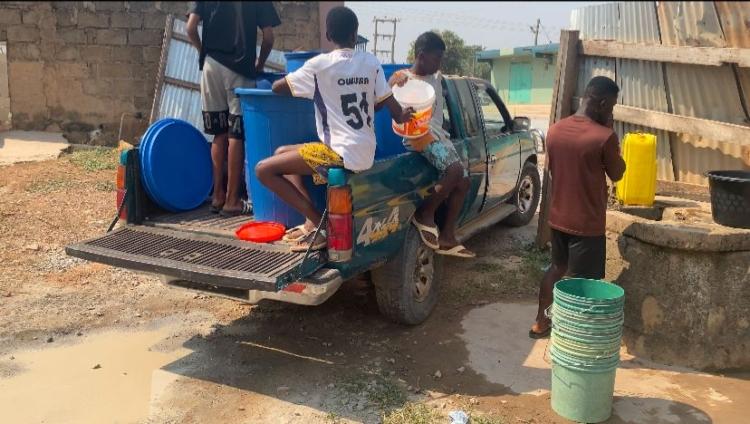

A persistent water supply crisis affecting sections of Dawhenya Community 25 is increasingly disrupting healthcare services, educational activities and everyday household routines, while residents warn that the prolonged shortage is creating serious sanitation and public health concerns.
Residents in Gbetsile, Sakibediako and Top 10 reportedly have endured irregular access to pipe borne water for approximately seven months, leaving numerous households dependent on boreholes and other alternative sources to meet their daily requirements.

The situation has consequently placed additional pressure on families, many of whom are compelled to obtain water from untreated sources for cooking, cleaning and other domestic purposes. Residents say the continued reliance on such sources has heightened concerns about hygiene and the potential spread of water related illnesses.

Healthcare delivery within the affected communities has also suffered considerably as a result of the shortage. At the Sackey Bediako Community based Health Planning and Services compound, health workers say the facility has been operating without a dependable water connection, making it increasingly difficult to maintain appropriate standards of hygiene while providing essential medical care.

One health worker appealed directly to the Ghana Water Company Limited to intervene and restore a dependable supply to the facility, stressing that access to water is fundamental to the effective operation of the health centre.
The shortage has also created difficulties for expectant mothers who require regular antenatal care and safe delivery services. Some pregnant women have reportedly been travelling beyond their communities to access healthcare because of inadequate facilities and the continuing absence of reliable water.

One resident explained that she delivered both of her children at hospitals outside the community and also sought antenatal care elsewhere because local healthcare facilities lacked some essential resources, with the persistent water shortage adding to the challenges.
Private healthcare operators in the area have likewise been forced to adopt costly alternatives to maintain their services. One facility operator disclosed that water had not flowed through the facility’s pipelines since January 2026, compelling the facility to depend on water tanker services.

The operator said the arrangement has imposed a substantial financial burden on the facility, with thousands of Ghana cedis reportedly being spent every week to purchase sufficient water to sustain daily operations.

The consequences of the shortage extend beyond healthcare, as schools within the affected communities are also experiencing difficulties associated with sanitation and hygiene. Residents have expressed concern that the absence of dependable water could compromise cleanliness within educational facilities and expose pupils and staff to avoidable health risks.
The prolonged disruption has consequently intensified concerns about the possibility of a broader public health problem, particularly because several households continue to depend on untreated water sources for essential domestic activities.
Residents and healthcare workers are therefore calling on the Ghana Water Company Limited and other responsible authorities to treat the situation as an urgent matter and take immediate steps to restore a dependable pipe borne water supply to the affected communities.
For residents of Gbetsile, Sakibediako and Top 10, the crisis has extended far beyond an inconvenience, as the continued absence of reliable water is now affecting healthcare delivery, maternal services, education, sanitation and the ordinary routines of households.
The affected communities are consequently urging authorities to provide a lasting solution rather than temporary interventions, stressing that consistent access to safe water remains essential to protecting public health and ensuring that basic community services can operate effectively.

