
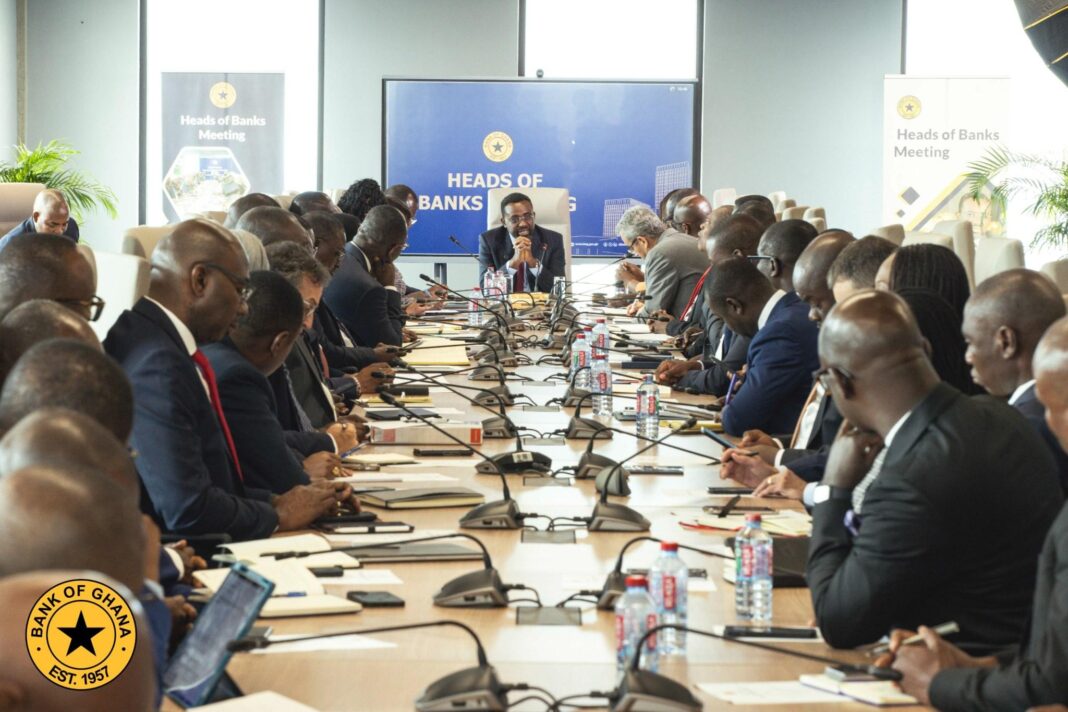

Private sector credit in Ghana expanded by 41.2 percent in June 2026, representing a substantial acceleration from the 8.6 percent growth recorded during the corresponding period of 2025, as declining borrowing costs and improving financial conditions begin to strengthen the flow of funds to businesses across the economy. The latest expansion also translates into real private sector credit growth of 34.1 percent, underscoring the extent to which the easing financial environment is beginning to influence actual economic activity. The figures were disclosed by the Governor of the Bank of Ghana, Dr Johnson Pandit Asiama, during an engagement with chief executives and senior executives of banks. Recent Bank of Ghana communications have similarly highlighted the recovery in private sector credit and the importance of ensuring that improved macroeconomic stability is transmitted more effectively into productive economic activity.
Dr Asiama explained that financial conditions had improved considerably, with interest rates across important segments of the money market continuing to moderate. According to the Governor, the decline in financing costs is increasingly being reflected in stronger demand for credit and greater lending to the private sector. The development marks an important shift for Ghanaian businesses, particularly after a prolonged period in which elevated interest rates constrained borrowing, discouraged investment and made it increasingly difficult for enterprises to secure affordable working capital. The Bank of Ghana has previously noted that lending rates had reached exceptionally high levels during the earlier period of economic instability, contributing to weaker credit expansion and greater caution among financial institutions.

The Governor described the latest acceleration in credit creation as a significant development, particularly against the backdrop of moderating inflation and relatively stable financial conditions. With the cost of borrowing declining and economic confidence improving, Dr Asiama said banks now have a stronger opportunity to expand their contribution to economic activity by directing more financing towards productive businesses and investment projects.

The improvement in lending conditions is also reflected in the broader banking sector. Average lending rates have fallen to approximately 15.6 percent from 27 percent, while the 91 day Treasury bill yield declined to 5.3 percent in June 2026 from 14.7 percent a year earlier. The Ghana Reference Rate also fell substantially, moving from 23.8 percent to 10 percent over the same period. These developments have helped create a considerably more favourable environment for businesses seeking financing and have contributed to the sharp acceleration in private sector credit.

Despite the stronger flow of credit, however, Dr Asiama cautioned that access to finance remains uneven, particularly among micro, small and medium sized enterprises. Businesses operating within the agricultural value chain continue to encounter considerable difficulties in securing bank financing because many financial institutions still regard such enterprises as relatively risky. The Governor therefore urged banks to develop a more detailed understanding of the sectors and enterprises they finance rather than relying exclusively on conventional lending models.
He called for the creation of more innovative and adaptable financial products capable of accommodating the distinctive circumstances of borrowers. This is particularly important for agriculture, where revenues frequently depend upon seasonal production cycles, harvest periods and fluctuating cash flows. Dr Asiama consequently encouraged banks to structure repayment arrangements around the actual timing of borrowers’ income rather than applying rigid schedules that may place unnecessary pressure on enterprises during periods when revenues are naturally lower.

The Governor’s position is consistent with the broader direction being pursued by the Bank of Ghana, which has been urging financial institutions to move beyond the traditional role of simply providing loans and instead become strategic partners in business development. Earlier engagements with banking executives saw Dr Asiama call for stronger support for entrepreneurs and export oriented enterprises, alongside innovative financial products capable of responding more effectively to the evolving requirements of households and businesses.
For Ghana’s smaller businesses, such an approach could prove particularly consequential because access to appropriately structured financing can determine whether an enterprise remains small, expands its productive capacity or creates additional employment. The Governor has also indicated that the Bank of Ghana is exploring alternative financing mechanisms, digital credit solutions and partnerships with development institutions as part of efforts to address persistent financing constraints affecting the private sector.

Dr Asiama therefore emphasised that commercial banks should view themselves as important partners in Ghana’s economic transformation rather than simply as financial intermediaries. His argument reflects the central bank’s broader objective of ensuring that improved macroeconomic indicators translate into tangible opportunities for businesses, investors and households.

The latest lending figures emerge against a backdrop of strengthening economic performance. Ghana’s real Gross Domestic Product expanded by 6.4 percent during the first quarter of 2026, supported substantially by activity in the services and industrial sectors. The Bank of Ghana has also reported stronger business and consumer confidence as economic conditions improve, while the expansion of private sector credit has become one of the factors supporting the broader recovery.
Inflation has also moderated significantly compared with earlier periods of economic pressure. Headline inflation stood at 4.6 percent in July 2026, down from 5.3 percent in June, reinforcing the broader improvement in price stability. At the same time, the Monetary Policy Committee has maintained the policy rate at 14 percent, with the central bank indicating that the prevailing monetary stance remains appropriate as policymakers continue to assess domestic developments alongside international and geopolitical risks. The Bank of Ghana has said that the current policy position seeks to preserve macroeconomic stability while allowing the recovery in economic activity, private sector credit and investment to continue.
Conditions within the banking industry have strengthened alongside the broader economic recovery. Total banking sector assets increased by 30.7 percent in June 2026, while the sector’s capital adequacy ratio climbed to 20.4 percent from 10.6 percent a year earlier. At the same time, the non performing loan ratio declined considerably, falling to 16.1 percent from 23.1 percent during the corresponding period of 2025. The improvement in capital strength and asset quality provides banks with a firmer foundation from which to expand lending while maintaining adequate protection against financial risks.
The acceleration in private sector credit therefore represents more than an isolated improvement in banking statistics. It signals a potentially important transmission of Ghana’s improving macroeconomic conditions into the real economy, particularly as lower interest rates reduce the cost of accessing capital and encourage businesses to increase investment, production and expansion.
Nevertheless, the sustainability of this recovery will depend significantly on whether the banking industry can ensure that the expanding supply of credit reaches enterprises that have historically remained underserved. Agricultural businesses and smaller enterprises in particular will require financing arrangements that recognise their operational realities, revenue cycles and risk profiles.
The Bank of Ghana’s challenge will consequently be to preserve financial stability while encouraging banks to deepen credit provision to productive sectors. For commercial banks, the opportunity is equally significant because stronger private sector activity can create new lending opportunities, broaden their customer base and strengthen the connection between financial sector performance and economic growth.
The 41.2 percent expansion in private sector credit in June consequently provides an important indication that Ghana’s improving monetary and economic conditions are beginning to produce stronger lending outcomes. The immediate priority, however, will be ensuring that this renewed credit expansion becomes sufficiently broad, affordable and sustainable to support investment, enterprise development, employment creation and long term economic growth across the country.

