

SOURCE: BBC
The countdown begins as millions of people across the UK and parts of Europe are getting ready for the most significant solar eclipse since 1999

Total eclipses are beginning across parts of Iceland and Greenland, before moving down further into Europe

More than 90% of the Sun will be covered by the Moon for most of the UK, while parts of Spain will also witness a rare total eclipse

In the UK, some will be able to view the eclipse from shortly after 18:00 BST before it peaks an hour or so later – where and when you could see it
One shopkeeper in London reports selling 26,000 pairs of special eclipse glasses; a woman paid £20 for a pair in Cardiff; and there has been a rush in Glasgow too

Experts say watchers should not look directly at the Sun without protection – how to watch the eclipse safely
One group of Irish scientists will be “chasing” the eclipse across the Atlantic to study the Sun’s corona – our reporter Jack Grey spoke to one of them

Hundreds of people are gathering on Calton Hill in Edinburgh to watch the eclipse.

It’s around a hundred metres above sea level and has a clear view across the city to the west. The view of the eclipse from here – if the clouds stay away – should be good.
There was a rush of people as staff from the Astronomical Society of Edinburgh handed out five hundred pairs of eclipse glasses.
A considerable number missed out but they are still here, still asking if any more eclipse glasses are available, and hoping that some of those who did get lucky will share them out for a few minutes.
Barbara Logan said it was strange not to know if it was day or night during the 1999 eclipse
As the most dramatic solar eclipse in almost 30 years gets under way in the UK, one woman has shared her experience of the total eclipse in 1999.
On 11 August 1999 a few minutes of the day turned to night as the Moon blocked out the sun’s light.
It was the last total solar eclipse of the 20th Century, with Cornwall and the Channel Islands the only parts of the British Isles to witness totality, the full blacking out of the sun by the Moon.
Barbara Logan, who watched the eclipse in Shortlanesend, near Truro, said the experience was a “weird sensation”.
“One minute it was light then it began to get dark and I could hear all the birds singing and getting ready to go to roost,” she continued.
“We were all gathered down in the square with our glasses ready.
“It was a weird feeling, you didn’t know if it was night-time or daytime.”
The eclipse is well under way in Iceland.
Icelandic musician Guðrún Árný is watching from Snæfellsnes in the west of the country. She tells the BBC News channel that she’s been playing music for all the people gathered to watch it passing over.
“We will get two minutes of darkness, so we are very excited,” she says.
“I think it will be the longest two minutes that we have experienced… it’s going to be pitch black in the middle of the day.”
Because the eclipse happens in the early evening in the UK, the Sun will be low in the sky – especially towards the end of the event, which is not too far off sunset.
To watch it from start to finish, you will need to look west, and have a clear view of the horizon – so finding a raised position with no tall buildings obstructing your view would be a good idea.
You should never look at the Sun directly as it could seriously damage your eyesight. That includes looking through sunglasses or swimming goggles with dark lenses. The same goes for welding goggles or visors.
And do not look through binoculars or telescopes unless they have a special solar filter. Using any of these can cause permanent eye damage or blindness.
Pinhole projector – card, paper and pen
Another safe way to watch this awe-inspiring celestial event is to create a pinhole viewer.
Make a hole in a piece of card using the tip of a ballpoint pen, pushing it through the centre.
Holding the card in one hand and a blank piece of paper in the other, face away from the Sun. Then line the card and paper up so that an image of the Sun becomes visible on the paper.
This pinhole projector will show you the shadow being cast on the Sun replicated in miniature.
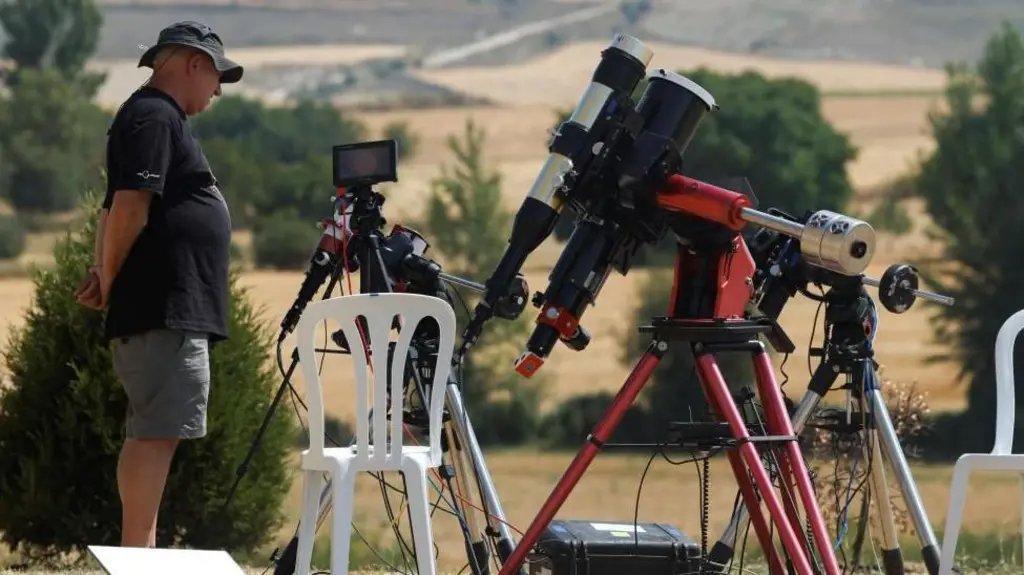
Astronomy enthusiasts in Burgos province making their preparations in the hours ahead of the eclipse
The path of totality is the narrow, fast-moving strip of Earth swept by the Moon’s darkest shadow.
Stand inside it and, for a minute or two, the Moon blocks the Sun completely: daytime falls away.
Move even a short distance outside that track and it is different. The Moon still takes a huge bite from the Sun — a big partial eclipse.
The shadow will first hit the far Russian Arctic at 17:58 BST, then races over the Arctic Ocean.
It reaches eastern Greenland, where the late-afternoon Sun slips briefly behind the Moon, before crossing western Iceland.
Reykjavík gets its moment at around 18:48BST.
The shadow then skims across the North Atlantic and heads for Europe: brushing north-west Portugal, then sweeping across northern Spain from Galicia towards to me in Burgos, then Bilbao, Zaragoza and Valencia.
Finally, as the Sun sinks, the shadow reaches the Balearic Islands.
Palma is among the last places to see totality, at about 19:32 BST.
It will be a black disc hanging low above the Mediterranean, before both eclipse and daylight fade away.
A total solar eclipse is a very special celestial event to witness – but they’re more common than you might think. They occur somewhere around the world about every 18 months.
But they feel very rare because each one can only be seen from a tiny patch of the globe.
During a total eclipse, as the Moon travels between the Earth and the Sun it casts its shadow on Earth’s surface – it’s called the umbral shadow.
But that shadow zips along a very narrow path – and this might fall over the ocean or other uninhabited areas – so it’s only if you’re lucky enough to be somewhere directly under the umbral shadow that you get to see the full eclipse.
The total eclipse happening today passes across five countries: Spain, Portugal, Russia, Greenland and Iceland – quite a lot of populated areas.
Whenever a total solar eclipse happens there’s also a much larger area of Earth that experiences a partial solar eclipse, where part of the Sun is covered by the Moon – millions more will be treated to that too.
The first place to get a total eclipse will be right at the northern tip of Siberia in northern Russia, where it will begin to show at 17:08 BST and reach its maximum just before 18:00 – midnight local time.
It’s so far north that the Sun doesn’t set in summer. That means even though it’s late at night, the eclipse would still be visible.
But Siberia is a very sparsely populated area – so don’t expect many photos.
The path of the total eclipse will now curve around between Iceland and Greenland and head on just west of the UK.
Smoke rises from a forest fire as people gather at Orzan Beach ahead of a solar eclipse in A Coruna in Galicia, Spain
Spain is one of the best places to see the total eclipse, and millions of tourists are expected to have travelled here. But they come as the country grapples with devastating wildfires.
The Spanish government has deployed tens of thousands of additional police officers and set up a major surveillance operation to minimise the risk of fires starting.
Extra soldiers have also been sent to the Balearic Islands, where there has been an increase in surveillance flights. With temperatures forecast to reach 40°C in some parts of the country, this is a challenging moment for the Spanish authorities.
The last total eclipse in Spain happened more than a century ago. But people here will now have the fortune of seeing two in as many years.
After today’s total eclipse, another is due to occur on the 2 August 2027, with totality lasting more than six minutes in some places – that one has been dubbed the “Eclipse of the Century”.
The partial solar eclipse has started and its full path will take hours.
It is beginning to show in Anchorage, Alaska, where the local time is coming up to 07:45 (16:45 BST). It is set to reach its peak there at 08:27 (17:27 BST), though the total coverage will only be 28%.
We are expecting to see it over Nuuk, Greenland, from 17:30 BST.
A solar eclipse is simply when the Moon passes in between the Earth and the Sun, blocking som

