
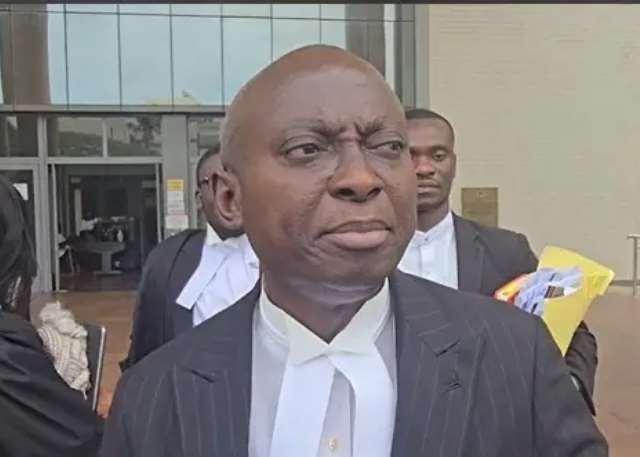

Lawyer for former National Signals Bureau Director General Kwabena Adu Boahene, Samuel Atta Akyea, has strongly criticised the decision to continue his client’s criminal trial during Ghana’s legal vacation, describing the development as an unwelcome departure from long standing traditions governing the country’s legal profession.
Speaking on Joy FM’s Top Story programme on Tuesday, August 11, the veteran lawyer questioned the rationale for treating the case differently from other criminal proceedings during the period when the courts traditionally scale back their substantive activities.

Mr Atta Akyea acknowledged that the presiding judge possessed the authority to direct that proceedings should continue, but maintained that he could not endorse what he regarded as an abandonment of established judicial practice.

He argued that while the court could insist on continuing the proceedings and require the accused persons to participate in the cross examination of prosecution witnesses, he would not lend his professional support to what he described as an aberration of the longstanding traditions shared by the Bench and the Bar.

His comments followed proceedings at the High Court in Accra during which Mr Adu Boahene and his wife, Angela Adjei Boateng, were given six days to secure legal representation before the case resumes on August 17.
The court warned that should the two accused persons appear at the next sitting without their lawyers, they could be required to personally undertake the cross examination of the fourth prosecution witness.

Justice Francis Apangabonu Achibonga, a Court of Appeal judge sitting as an additional High Court judge, further directed that if the accused persons declined to conduct the cross examination themselves, the prosecution witness could be discharged.
The directive followed Tuesday’s proceedings, during which Mr Adu Boahene and his wife appeared before the court without members of their legal team.

The development has intensified the debate surrounding the decision to allow substantive criminal proceedings to continue during the legal vacation and has raised questions about the circumstances under which certain cases may be permitted to proceed while the wider judicial system operates under a reduced schedule.

Mr Atta Akyea argued that the purpose of the legal vacation was to provide judges and legal practitioners with a period of respite while ensuring that genuinely urgent matters could still receive judicial attention.
He questioned why the Adu Boahene case had been classified as sufficiently urgent to justify its continuation during the vacation.
“What is the meaning of legal vacation? The CJ is on legal vacation, is it not? The Supreme Court is shut down. The Court of Appeal is shut down. And the High Court is also shut down in substantial respects, save a few who should handle emergencies,” he said.
The lawyer subsequently challenged the authorities to explain what specific emergency justified continuing the trial at this particular time.
He argued that the mere fact that a criminal case was already before the court should not automatically make it an emergency requiring exceptional treatment during the legal vacation.
“What is the emergency about the Adu Boahene case that if today we don’t want to rest, we want to continue, so that what happens? … Spare us this selective justice. I will not be part of it,” he said.
Mr Atta Akyea further contended that the decision had created the impression that certain criminal matters were being prioritised over others without a sufficiently clear explanation.
He pointed to other serious criminal proceedings involving allegations of murder, manslaughter and rape and questioned why those matters should not receive similar consideration if the justification for setting aside the normal legal vacation arrangements was simply the importance of the cases.
The lawyer maintained that the principle underlying legal vacation should either be respected or formally reconsidered rather than selectively applied to particular proceedings.
“If we believe that legal vacation is not important, let’s delete it from the Cause Act and the C.I. 47,” he said.
His criticism, however, did not amount to a withdrawal from his representation of Mr Adu Boahene. Mr Atta Akyea made it clear that his objection was directed at what he considers a problematic judicial practice rather than at his commitment to his client.
“I’m not giving up on my client, but I’m upholding principle,” he said.
The lawyer argued that if the established legal vacation arrangement was going to be relaxed in certain circumstances, there should be a consistent and transparent basis for determining which cases qualify for such treatment.
He maintained that selective application of the system could undermine public confidence in the administration of justice and create the perception that some accused persons were being subjected to a different standard from others.
“What kind of justice delivery system is this one? I don’t get it,” he added.
The dispute comes at a time when the continued proceedings against Mr Adu Boahene and his wife have attracted increasing attention because of the unusual circumstances surrounding the scheduling of their trial during the legal vacation.
The immediate issue is now whether the accused persons will secure legal representation before the August 17 sitting or whether they will be expected to continue the cross examination of the prosecution witness themselves.
The court’s directive has consequently placed the defence team in a difficult position, with Mr Atta Akyea maintaining his commitment to his client while simultaneously refusing to endorse what he considers a departure from the established traditions of Ghana’s legal profession.
The development has also broadened the debate beyond the individual case, raising fundamental questions about the purpose of legal vacation, the criteria for determining judicial emergencies and the need for consistency in the administration of criminal justice.
For Mr Atta Akyea, the central issue is not whether the court possesses the power to continue the proceedings, but whether exercising that power in the present circumstances is consistent with the principles and traditions that have historically governed the relationship between Ghana’s Bench and Bar.

