
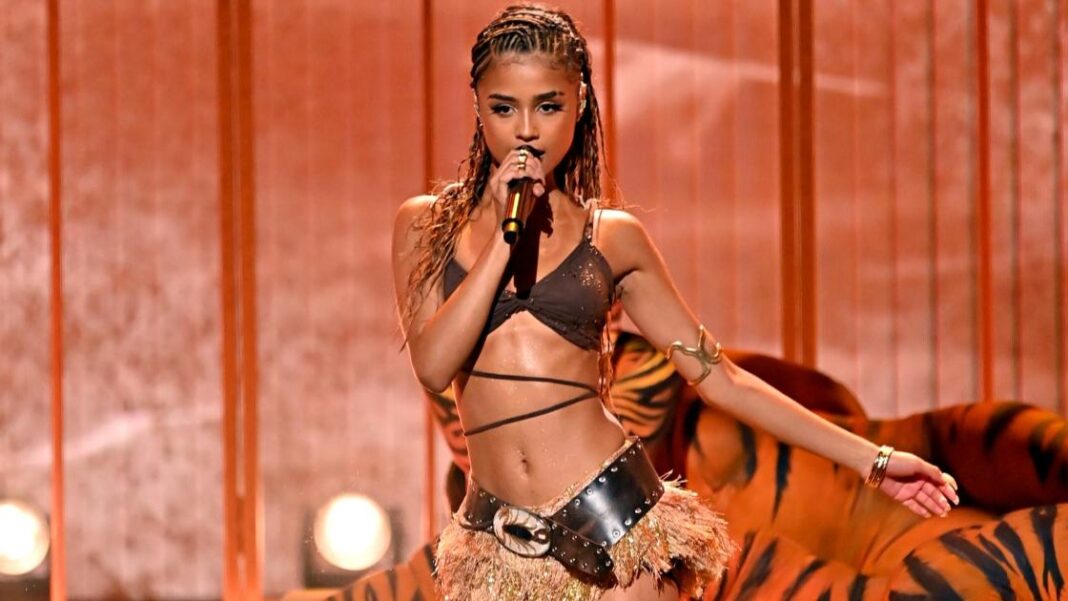

The removal of Lagos from Grammy Award winner Tyla’s upcoming world tour has intensified an already fragile relationship between Nigeria and South Africa, highlighting how political tensions, migration disputes and public sentiment are increasingly reshaping the African entertainment industry. What initially appeared to be a routine adjustment to an international concert schedule has evolved into a continental debate over xenophobia, artistic responsibility and the growing intersection between popular culture and diplomacy.
Only days after unveiling her highly anticipated global tour in support of her newly released album APOP*, Tyla announced performances across thirty four cities spanning several continents. The original itinerary included Lagos alongside Johannesburg and Cape Town, raising excitement among thousands of Nigerian fans eager to welcome one of Africa’s fastest rising international music stars.

However, by the end of the week, an updated version of the tour schedule published on her official platform no longer included Lagos. Neither Tyla nor her management has publicly explained the sudden change, but the timing has fueled widespread speculation that the decision may be connected to escalating public pressure surrounding the recent wave of anti migrant demonstrations in South Africa.

The development comes amid one of the most difficult periods in diplomatic relations between Africa’s two largest economies. Nigeria has repeatedly expressed concern over recurring xenophobic attacks against foreign nationals living in South Africa, arguing that many Nigerians have been subjected to violence, intimidation and discrimination. Successive incidents involving attacks on migrants have strained bilateral relations for years, periodically triggering diplomatic engagements aimed at restoring confidence between the two nations.

Recent protests demanding the removal of undocumented migrants from South Africa have further heightened tensions. Thousands of foreign nationals, including many Nigerians, have departed the country in recent weeks, with numerous individuals returning home aboard specially arranged repatriation flights. Although South African authorities insist that immigration enforcement is separate from criminal acts committed against foreigners, the perception across much of the continent remains that migrants continue to face significant hostility.
Against this backdrop, Tyla has unexpectedly become the latest public figure drawn into the controversy. Shortly after her tour announcement, an online petition demanding that Nigerian authorities prevent the South African singer from entering the country until xenophobic attacks cease began circulating widely across social media platforms. The campaign quickly gathered thousands of signatures, reflecting growing frustration among sections of the Nigerian public.

Social media discussions intensified further as many Nigerians questioned why the internationally acclaimed singer had not publicly addressed the migration crisis unfolding in her home country. Comment sections beneath her promotional posts became increasingly dominated by calls urging her either to condemn xenophobia or postpone any performances in Nigeria until relations between the two countries improve.
Despite mounting public attention, Tyla has remained silent on the matter and has not issued any public explanation regarding either the cancellation of the Lagos performance or the broader political controversy. Her representatives have likewise declined to comment publicly.

The controversy extends well beyond one musician. South African comedian and television personality Trevor Noah has also recently encountered criticism after appearing in a promotional campaign supporting South African tourism. Online users accused the internationally recognized entertainer of promoting the country’s attractions while remaining silent on allegations of xenophobia directed at foreign nationals. Many responses beneath the campaign questioned whether South Africa was welcoming to visitors from elsewhere on the continent.

The backlash illustrates how African celebrities are increasingly expected to comment on politically sensitive issues, even when their careers primarily revolve around entertainment rather than public policy. For many observers, silence is now interpreted by some audiences as indifference, while others argue that artists should not be compelled to assume political positions solely because of their nationality.
The economic implications are becoming increasingly evident. South Africa’s Justice Minister Mmamoloko Kubayi recently disclosed that at least one South African performer had informed her that every scheduled international performance had been cancelled amid the growing diplomatic tensions. Although she did not identify the artist, her remarks underscored concerns that South Africa’s international reputation is beginning to affect its creative industries as well as its tourism and cultural sectors.
The South African government continues to defend its approach, insisting that law enforcement agencies have acted against individuals responsible for criminal conduct during recent demonstrations. Authorities have pointed to the arrest of more than nine hundred people following the protests while maintaining that every sovereign nation retains the legitimate authority to regulate immigration within its borders. Nevertheless, many African governments and civil society organizations continue to argue that stronger measures are required to guarantee the safety of foreign nationals.
The debate has also divided commentators across Africa. Nigerian activist, opposition politician and former presidential candidate Omoyele Sowore argued that public anger should be directed toward political leadership rather than individual entertainers. According to him, musicians should not be held responsible for the failures of governments unless there is compelling evidence that they actively support discriminatory conduct. His intervention has added an important dimension to the conversation by questioning whether public figures can fairly be blamed for national political disputes.
Cultural analyst Mayowa Idowu similarly believes that while demands for accountability are understandable, directing public frustration toward artists risks distracting attention from the deeper institutional issues driving xenophobia. He argues that Tyla has consistently collaborated with Nigerian musicians and has previously performed successfully before Nigerian audiences, making claims that she harbors anti Nigerian sentiments difficult to substantiate.
Idowu further contends that compelling entertainers to adopt political positions simply because of their nationality could create dangerous precedents for artistic freedom across the continent. In his assessment, creative professionals should retain the right to determine when and how they engage with political questions without fear of professional retaliation.
The discussion is further complicated by Tyla’s remarkable success within African music. Earlier this year she secured her second Grammy Award for Best African Music Performance, once again defeating several prominent Nigerian nominees. Her consecutive victories have elevated her into one of Africa’s most celebrated international artists while simultaneously intensifying long standing rivalries between Nigerian and South African music supporters.
For some sections of the public, these achievements have unintentionally transformed Tyla into a symbolic figure within broader debates about continental artistic recognition and national pride. Cultural writer Dami Ajayi argues that many Nigerians have interpreted her repeated Grammy victories over Nigerian artists through the emotional lens of sporting style rivalry rather than objective artistic evaluation, creating perceptions that have little connection to the singer’s own public conduct.
South African journalist Thango Ntwasa believes the controversy demonstrates how entertainment and politics have become increasingly intertwined across Africa. According to him, public figures may understandably wish to remain politically neutral, yet the influence they command means many audiences now expect them to address significant social issues affecting their countries. He also warns that sustained hostility toward South African entertainers across the continent could eventually reduce touring opportunities, a critical source of income for many performers.
The historical significance of the unfolding controversy extends beyond a single concert cancellation. For decades, music has served as one of Africa’s most powerful instruments for promoting unity, cultural exchange and regional integration. Nigerian and South African artists have collaborated extensively, producing globally successful music that has strengthened cultural ties despite periodic diplomatic disagreements. The current dispute therefore raises important questions about whether political tensions may increasingly undermine those creative partnerships.
As Africa’s entertainment industry continues its rapid international expansion, the Tyla controversy serves as a reminder that celebrities now operate within a complex environment where artistic success, national identity and political developments are becoming ever more interconnected. Whether Lagos ultimately returns to the singer’s world tour or not, the episode has already sparked one of the continent’s most consequential conversations about xenophobia, accountability and the evolving responsibilities of public figures in an increasingly interconnected Africa.

