
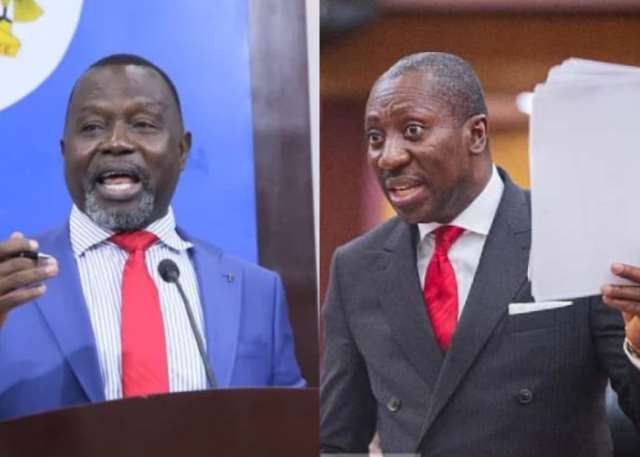

The political atmosphere in Ghana’s Parliament intensified during deliberations on the 2026 Mid Year Fiscal Policy Review after Minority Leader Alexander Afenyo Markin accused the government of using the justice system to target political opponents and cautioned the Attorney General against what he described as an escalating pattern of politically motivated prosecutions. His remarks transformed what had begun as a debate on fiscal policy into a broader national discussion about democratic governance, the rule of law, political accountability and the protection of constitutional freedoms.
Addressing Parliament shortly after Finance Minister Dr Cassiel Ato Forson presented the Mid Year Fiscal Policy Review on Thursday, July 23, the Effutu Member of Parliament alleged that the current administration was pursuing a deliberate campaign of political persecution against members of the opposition New Patriotic Party. According to him, recent legal actions involving prominent opposition figures have created growing concerns about the impartiality of state institutions and the potential politicisation of criminal prosecutions.

Afenyo Markin argued that Ghana’s democratic credentials depend on the independence of its judicial and prosecutorial institutions and warned that the country must avoid creating an environment in which political rivalry becomes intertwined with criminal justice. He asserted that governments should remain committed to due process, fairness and equal treatment before the law regardless of political affiliation, stressing that democratic competition must never undermine confidence in the institutions responsible for administering justice.

He referred to the conviction of New Patriotic Party Ashanti Regional Chairman Bernard Antwi Boasiako, widely known as Chairman Wontumi, together with the legal proceedings involving social media personality Camila Alhassan, as examples of what he characterised as politically driven actions against individuals associated with the opposition. The Minority Leader maintained that these developments have reinforced perceptions among sections of the public that political considerations are increasingly influencing the application of the law.

The Effutu legislator further claimed that several Members of Parliament belonging to the New Patriotic Party had received warnings suggesting they could face criminal prosecution because of statements made while performing their constitutional responsibilities as legislators. According to him, such developments could create a chilling effect on parliamentary oversight and weaken the ability of elected representatives to scrutinise government decisions without fear of legal repercussions.
Directing his comments toward Attorney General and Minister for Justice Dr Dominic Ayine, Afenyo Markin urged caution in the exercise of prosecutorial authority, reminding government officials that political power is ultimately determined by the electorate and can change through democratic elections. He argued that every administration must appreciate the temporary nature of political office and therefore avoid actions that could establish precedents capable of being used against future governments.

He cautioned that if the current pattern of prosecutions against opposition figures continues, members of the present administration could eventually become vulnerable to similar legal actions should political power change hands after the 2028 general election. In his assessment, Ghana’s democracy is better served when successive governments strengthen institutional independence rather than deepen cycles of political retaliation.
Despite his strong criticism of the government, Afenyo Markin acknowledged what he described as a constructive aspect of the Finance Minister’s Mid Year Fiscal Policy Review. He commended Dr Cassiel Ato Forson for recognising the contribution of digitalisation reforms introduced under the previous New Patriotic Party administration, particularly improvements in government payment systems and digital public financial management. According to the Minority Leader, such recognition reflected political maturity and demonstrated that national development should transcend partisan divisions.

He emphasised that while opposition parties have a constitutional responsibility to scrutinise government policies, constructive acknowledgement of successful initiatives introduced by previous administrations is equally important for sustaining continuity in national development. He argued that bipartisan recognition of effective policies encourages institutional stability and strengthens public confidence in governance.

The Minority Leader also called on the government to ensure that the administration of justice remains transparent, impartial and free from political influence. He appealed for what he described as the release of individuals he considers political prisoners and insisted that no amount of intimidation would prevent opposition legislators from exercising their constitutional mandate to hold the Executive accountable.
According to Afenyo Markin, parliamentary oversight remains one of the most important safeguards within Ghana’s constitutional democracy, and Members of Parliament must be able to question government decisions, investigate public expenditure and challenge executive actions without fear of intimidation or prosecution. He maintained that robust democratic governance depends on preserving the independence of Parliament as an institution capable of providing effective checks and balances on executive authority.
The broader significance of his intervention extends beyond the immediate parliamentary exchanges over the Mid Year Fiscal Policy Review. Ghana has long been regarded as one of Africa’s most stable constitutional democracies, with successive peaceful transfers of political power strengthening its international democratic reputation. Consequently, allegations concerning political interference in the justice system often attract heightened public interest because they touch on fundamental constitutional principles, including judicial independence, prosecutorial discretion, freedom of expression and the rule of law. These issues remain central to public confidence in democratic governance and the credibility of state institutions.
At the same time, the government has consistently maintained that ongoing investigations and prosecutions involving current and former public officials are based on evidence gathered by law enforcement agencies and are intended to strengthen accountability, combat corruption and ensure that all persons are subject to the law irrespective of political affiliation. Government officials have repeatedly rejected allegations of political persecution, insisting that prosecutorial decisions are guided by legal merit rather than partisan considerations.
Afenyo Markin concluded his address by urging government officials to reflect carefully on the long term consequences of their decisions, warning that ongoing investigations into public procurement and the management of state resources could eventually expose members of the current administration to legal scrutiny in the future. His remarks added another layer of political intensity to Parliament’s debate on the 2026 Mid Year Fiscal Policy Review, reinforcing the widening divide between the governing National Democratic Congress and the opposition New Patriotic Party over issues of accountability, governance, justice and the future direction of Ghana’s constitutional democracy.

