
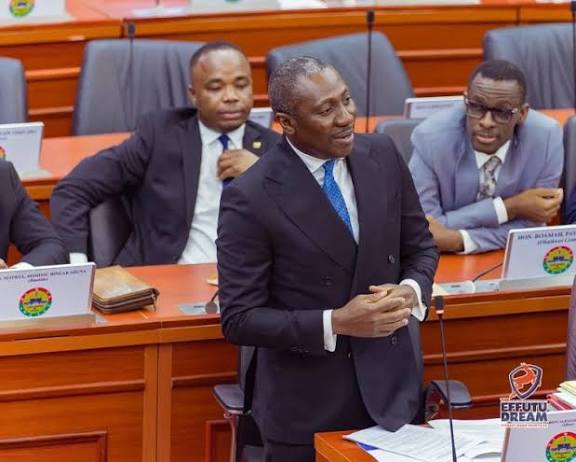

The debate surrounding Ghana’s 2026 Mid Year Fiscal Policy Review has intensified after Minority Leader Alexander Afenyo Markin mounted a forceful critique of the government’s economic stewardship, describing the Finance Minister’s presentation as a document rich in rhetoric but deficient in practical solutions. His remarks have deepened the growing contest between the governing National Democratic Congress and the opposition New Patriotic Party over the country’s fiscal direction, public expenditure, agricultural recovery and the sustainability of major economic intervention programmes.
Addressing Parliament immediately after Finance Minister Dr Cassiel Ato Forson delivered the Mid Year Fiscal Policy Review on Thursday, the Effutu Member of Parliament argued that the government’s economic assessment failed to confront the pressing realities facing households, businesses and productive sectors. According to him, the statement relied heavily on persuasive language while offering little in terms of concrete policy initiatives capable of resolving the country’s most urgent economic concerns.

Afenyo Markin questioned what he described as contradictory expenditure figures presented by the government, insisting that inconsistencies in public financial reporting undermine transparency and weaken confidence in fiscal management. He pointed to previous public assurances made by the Deputy Minister for Finance that GH¢1.6 billion had been released to the Ministry responsible for Roads, contrasting that figure with the Finance Minister’s declaration that only GH¢1.1 billion had been disbursed. In his view, such disparities demand clear explanations because Parliament and the Ghanaian public deserve complete accountability regarding the use of state resources.

He further maintained that the performance of any Finance Minister should never be evaluated solely by the volume of public spending but rather by the measurable impact of economic policies on employment, investment, infrastructure development, inflation control and the general welfare of citizens. He argued that effective economic management must ultimately be reflected in tangible improvements in the lives of ordinary Ghanaians instead of financial allocations alone.

The Minority Leader also devoted significant attention to Ghana’s cocoa industry, which remains one of the country’s most strategic export sectors and a vital source of livelihood for millions of households. He expressed disappointment that the Mid Year Fiscal Policy Review contained no significant policy measures aimed at revitalising the cocoa sector despite the persistent challenges confronting producers, including declining output, financing difficulties, illegal mining activities affecting cocoa growing communities, climate related pressures and concerns over producer prices.
According to Afenyo Markin, cocoa farmers continue to endure severe economic hardship, and he argued that the Finance Minister, who also oversees the cocoa sector, had missed an important opportunity to introduce interventions capable of restoring confidence and accelerating the industry’s recovery. He contended that the absence of fresh initiatives represented a missed opportunity to strengthen one of Ghana’s most historically significant pillars of economic growth and foreign exchange earnings.

Another major focus of his criticism centred on the Gold for Reserves programme, which has occupied an important place in Ghana’s recent monetary policy strategy. The initiative was introduced by the Bank of Ghana to strengthen the country’s international reserve position through the acquisition of domestically produced gold while reducing dependence on foreign currency for reserve accumulation. Although the programme initially received broad attention as an innovative policy instrument, it has also attracted sustained scrutiny regarding its financial implications, operational costs and long term sustainability.
Afenyo Markin argued that the Minority had repeatedly cautioned the government over the cost structure associated with the programme, particularly concerning charges that were initially maintained at fifteen percent. He claimed those warnings were ignored until the International Monetary Fund raised concerns, eventually contributing to a reduction in the applicable charges to nine percent. He further pointed to the Bank of Ghana’s recent decision to discontinue its direct participation in the programme as evidence that earlier concerns raised by the opposition had ultimately been validated. He asserted that the policy had already generated substantial financial losses estimated at GH¢9.6 billion, referencing assessments associated with Ghana’s engagement with the IMF programme.

The disagreement reflects a broader political and economic debate over Ghana’s post crisis recovery strategy. Since entering an IMF supported economic reform programme, the government has pursued fiscal consolidation, debt restructuring, revenue mobilisation and structural reforms intended to restore macroeconomic stability. While government officials argue that these measures have contributed to declining inflation, improved investor confidence, stronger public finances and renewed economic expansion, the Minority maintains that many households and productive sectors continue to experience significant financial pressure despite those macroeconomic gains.

Historically, parliamentary debates on Mid Year Budget Reviews have served as critical moments for assessing the government’s fiscal performance, evaluating progress against budget targets and determining whether changing domestic or international conditions require policy adjustments. These reviews frequently shape subsequent legislative deliberations, influence investor sentiment and provide an important indication of the government’s ability to respond to evolving economic realities before the presentation of the next national budget.
Afenyo Markin concluded his intervention by dismissing the Mid Year Fiscal Policy Review as a presentation that relied heavily on polished language while failing to introduce meaningful policy responses capable of addressing Ghana’s economic challenges. His criticism is expected to fuel further parliamentary scrutiny of the government’s fiscal programme in the coming days as lawmakers continue debating the review and its implications for economic management, public accountability, agricultural development and the country’s long term fiscal sustainability.

