

SOURCE: BBC
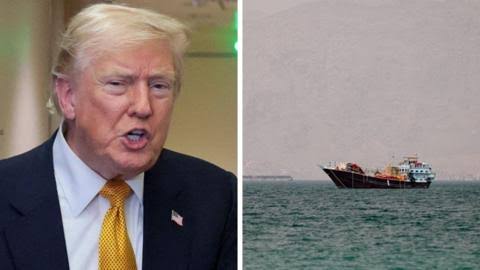
Donald Trump says the US is reinstating its blockade of Iranian ports in the Strait of Hormuz, beginning “immediately”

In a post on Truth Social, he says the US will be the “guardian” of the vital waterway and impose a 20% charge on all cargo shipped to pay for the cost of “safety and security” – how this will work in practice is unclear, writes our White House reporter

Earlier, Iran’s military said it wouldn’t allow the US to “interfere in the management” of the key shipping route

Meanwhile, the US and Iran have continued to exchange strikes – US Central Command (Centcom) said overnight it had hit a submarine and Iranian ship maintenance facility, in response to Iran targeting commercial ships in the strait
While a small number of vessels appear to be moving through the key waterway, traffic remains restricted, according to ship tracking website MarineTraffic

Iran has said it is targeting US bases in Jordan, Bahrain, and Kuwait, plus radar systems in Oman – Bahrain accuses Iran of targeting civilians
Mojtaba Khamenei pictured on screen during a rally in Tehran, 2 July

Iran’s Supreme Leader Mojtaba Khamenei has not been seen in any verified videos or photos since his succession to the position of his father in early March.

He was reportedly injured in the same strike that killed his father Ali Khamenei on 28 February in Tehran, when US and Israel attacked Iran in the first day of the war. But Iran’s health ministry has rejected claims that his injuries were severe.
US President Donald Trump said about Mojtaba Khamenei today that he’s “90 per cent gone”.
So far, since 8 March, we have seen several written messages attributed to Mojtaba Khamenei. In the latest one two days ago, Khamenei vowed to avenge his father’s killing. Iranian officials have followed suit recently.
Mojtaba Khamenei did not appear publicly during the week-long commemoration ceremonies held in early July for his father, although brothers of Mojtaba Khamenei did.
The question still remains about his whereabouts.
But Israel had vowed before and after Mojtaba Khamenei became Iran’s supreme leader that it would target him, although we are yet to see when, or if, he will appear if public.17:09
If you’re just joining us, here’s a quick rundown of events this afternoon:
Donald Trump announced a new blockade on Iranian ports, which will prevent “Iran’s ships or customers” from entering or leaving the Strait of Hormuz
He added that for doing so, the US will impose a 20 per cent charge “on all cargo shipped” to cover any and all costs of providing “safety and security” in the “volatile” region
It is not the first time Trump has imposed a blockade on the vital shipping route. The one in April lasted three months, during which the US military fired on at least nine vessels which it said refused to comply with directions
Trump’s announcement followed a fresh round of strikes between the US and Iran overnight. US Central Command (Centcom) said it struck several targets, including a submarine and ship maintenance facility in response to Iranian attacks in the strait
Responding to the introduction of a new blockade, Iranian parliamentarian Ebrahim Rezaei said: “We don’t need foreign workers to protect the strait!”
This latest escalation has once again halted traffic through the strait, with two vessels appearing to have sailed east into the Gulf of Oman earlier today. Two other ships stopped transmitting their locations after previously appearing to head out of the strait
On one hand, President Trump’s announcement that the US will impose a 20% toll on all cargo passing through the Strait of Hormuz is one that, broadly, is in line with his foreign policy.
Trump often remarks that US allies do not pay enough for their own defence or security. The US, he claims, shoulders the financial and logistical burden for global security issues.
Reimbursement for the heavy commitment of US naval and air power to secure shipping in the Gulf is aligned with that sentiment, even if allied nations push back on it.
On the other hand, it directly contradicts recent statements from his own Secretary of State, Marco Rubio.
“No country is allowed to charge tolls or fees on an international waterway,” Rubio told reporters in early July.
“That’s existing international law. That’s the way it is in international waterways all over the world, and that’s the way we expect it’ll be here.”
Moving forward, the White House is likely to take steps to publicly differentiate between the tolls Trump announced and those that have been called for by the government in Tehran.6:34
The Strait of Hormuz connects the Gulf with the Arabian Sea and is deep enough for the world’s biggest crude oil tankers to pass through.
In 2025, about 20 million barrels of oil and oil products passed through the Strait of Hormuz per day, according to estimates from the US Energy Information Administration (EIA).
About 20% of the world’s oil and liquefied natural gas is shipped through the strait. The oil comes not only from Iran but other Gulf states such as Iraq, Kuwait, Qatar, Saudi Arabia and the UAE.
About 3,000 ships usually sail through the strait each month but this dramatically decreased during the US-Iran war.
At the narrowest point, the strait and its shipping lanes lie entirely within Iran and Oman’s territorial waters – making it a particularly prominent sticking point in the ongoing hostilities.
We’ve heard from Iranian parliamentarian Ebrahim Rezaei, a spokesperson for the country’s National Security and Foreign Policy Commission, following Trump’s announcement of a new blockade of Iranian ports.
In response to the US president’s assertion that the US will be the “guardian” of the Strait of Hormuz, he writes on X: “We don’t need foreign workers to protect the strait!”
After the deal to end the war between the US and Iran was signed on 17 June, Washington lifted its two-month blockade of Iranian ports in the Strait of Hormuz.
It also eased decades-old sanctions by allowing for the temporary sale of Iranian oil.
This was due to expire on 21 August but the US withdrew its permission after a series of attacks on ships in the strait early last week.
In the month since the license was issued, 59 tankers left the Gulf laden with oil and petrochemicals, according to United Against a Nuclear Iran, an advocacy and monitoring group.
It says the exports amounted to about 72 million barrels of oil which could provide potential revenue of more than $5.5bn (£4.1bn) for the Iranian government.
US stock markets have fallen in morning trading on Monday as investors react to the escalating situation in the Middle East.
All three of the main indexes, the Dow Jones, Nasdaq and S&P 500, are down amid fears of inflation, with oil prices climbing more than 4% to around $79 (£59) a barrel for Brent crude, the global benchmark.
The US and Iran renewed attacks over the weekend and Tehran said it had closed the Strait of Hormuz, a key waterway used in global trade.
However, President Trump says the strait will remain open and that he will reinstate a blockade on Iranian ports, which he claims will stop “Iran’s ships or customers from entering or leaving”, but be open for other countries which will be required to pay a 20% cargo charge.
Concerns over global oil supplies since the outbreak of the war have led to prices becoming volatile. While they have risen on the latest news, they remain well below where they were in May.
The US stock markets are also being affected by a tough start to the month for technology and microchip firms, with investors continuing to grapple over high valuations and concerns of an AI bubble. Shares in Nvidia, SpaceX and Intel were all in the red in early trading.:33
US Central Command (Centcom) says, in an update, that American military forces struck a submarine and ship maintenance facility in Iran overnight.
It says multiple one-way attack surface drones hit the port at Bandar Abbas Naval Base in southern Iran, and shares video footage of the operation.
“Last night’s strikes degraded Iran’s ability to continue attacking commercial shipping,” Centcom adds in a statement on X.
The US had previously said it conducted its strikes in response to Iranian attacks on commercial ships in the Strait of Hormuz.
President Donald Trump first introduced a US naval blockade of Iranian ports three months ago to the day on 13 April, after Tehran effectively closed the Strait of Hormuz in response to US and Israeli strikes on Iran.
The blockade was lifted last month as part of a deal to end the war between the US and Iran.
During the blockade, the US military says it redirected at least 142 commercial ships going to or from Iranian ports and fired on at least nine vessels which it said refused to comply with its directions.
While the Pentagon did publish a blockade line, stretching across the entrance to the Gulf of Oman, US forces intercepted multiple ships well outside of the region too.
A tanker called Tifani, for example, was intercepted east of Sri Lanka more than a week after leaving the Gulf.

