
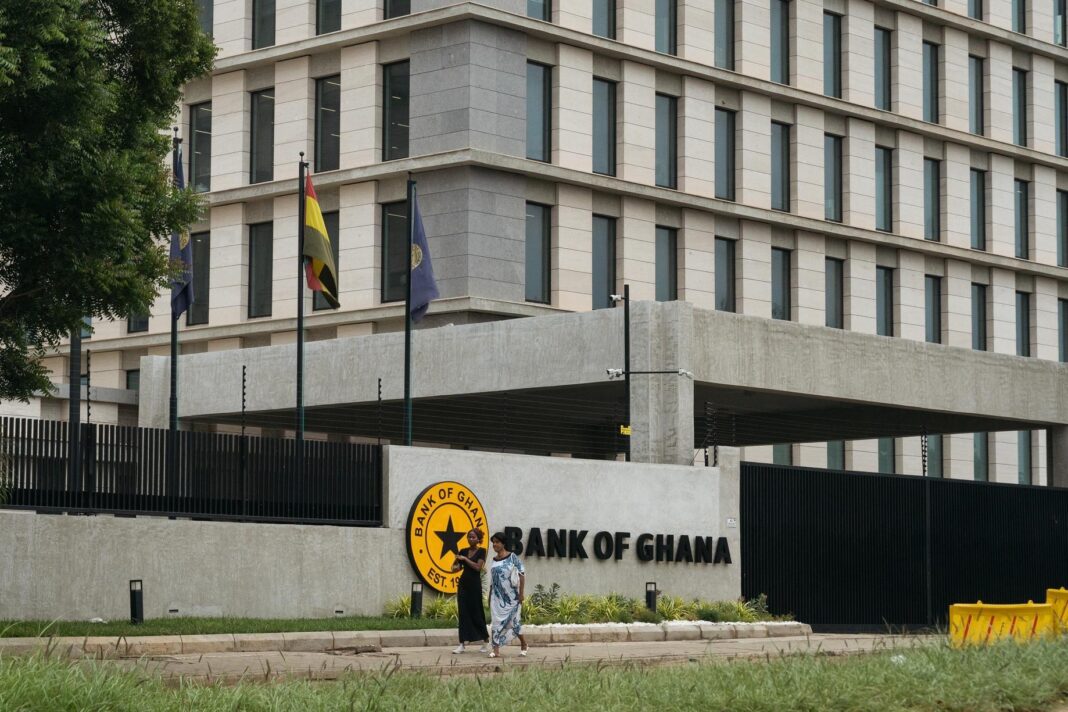

The accelerating expansion of Ghana’s digital financial ecosystem has been accompanied by an equally disturbing escalation in financial crime, with the country’s financial services industry confronting its most significant fraud challenge in recent years. Fresh figures contained in the 2025 Fraud Report released by the Bank of Ghana reveal that fraudulent activities across banks, Specialised Deposit Taking Institutions and Payment Service Providers climbed dramatically during the past year, highlighting the growing vulnerability of the country’s increasingly digitised payment landscape and reinforcing concerns over the ability of criminals to exploit technological innovations faster than security systems can adapt.
The latest assessment presents a sobering picture of an industry under sustained pressure from increasingly sophisticated fraud schemes. Reported fraud incidents across Ghana’s regulated financial institutions expanded by an alarming forty eight percent, climbing to 24,778 cases in 2025 from 16,733 incidents recorded in 2024. Simultaneously, the total monetary exposure associated with these criminal activities rose beyond the symbolic GH¢100 million threshold, increasing from GH¢99 million in the previous year to GH¢101 million, underscoring the enormous financial threat confronting institutions and customers alike.

Although the overall value at risk registered only a modest increase, the dramatic rise in reported incidents illustrates the changing character of financial crime within Ghana’s economy. The findings suggest that fraud is becoming increasingly widespread, technologically advanced and concentrated within rapidly expanding digital payment channels that have transformed the way millions of Ghanaians conduct everyday financial transactions.

The Bank of Ghana attributed the overwhelming surge almost entirely to the Payment Service Provider sector, which has become the backbone of Ghana’s digital economy through mobile money platforms, electronic wallets, fintech innovations and other cashless payment solutions. As digital financial inclusion continues to accelerate across the country, fraudsters have increasingly redirected their operations towards these platforms, exploiting both technological vulnerabilities and unsuspecting consumers.

Payment Service Providers experienced an extraordinary fifty four percent increase in reported fraud cases, with incidents surging from 15,673 in 2024 to 24,124 in 2025. Even more concerning was the rapid escalation in financial exposure within the sector, where the amount placed at risk almost doubled from GH¢19 million to GH¢37 million over the same period. These figures demonstrate that while digital finance continues to deepen financial inclusion and stimulate economic activity, it has simultaneously created an attractive environment for increasingly organised cybercriminal networks seeking to exploit weaknesses in electronic transaction systems.
In sharp contrast, Ghana’s traditional banking industry registered notable improvements in fraud management. Fraud incidents within banks declined by thirty four percent to 472 cases during 2025, while the corresponding value at risk contracted by twenty four percent to GH¢57 million. Specialised Deposit Taking Institutions also achieved considerable progress by reducing reported fraud cases by forty seven percent to 182 incidents. Nevertheless, the financial consequences within that subsector became more severe, as the value exposed to fraud expanded by seventy seven percent to approximately GH¢8 million despite the lower number of reported cases.

Despite the reduction in banking related fraud occurrences, the report identifies cash suppression as the single most financially destructive form of fraud confronting Ghana’s banking industry. The amount exposed through this fraudulent practice expanded dramatically to GH¢40.7 million during 2025, representing an astonishing eighteen fold increase from the GH¢2.3 million recorded a year earlier. According to the central bank, this extraordinary escalation was largely driven by one exceptional fraud case involving approximately GH¢36 million, illustrating how a single large scale internal fraud can significantly distort industry wide financial losses while exposing weaknesses in institutional controls.
Beyond cash suppression, several additional fraud categories recorded worrying increases in financial exposure. Electronic money related fraud expanded by thirty two percent to GH¢4.6 million, reflecting the continued migration of criminal activity towards digital payment systems. Fraudulent withdrawals more than doubled to GH¢3.97 million, while Automated Teller Machine fraud together with Point of Sale related offences and burglary continued to impose substantial financial costs on banking institutions.

The report nevertheless provides encouraging evidence regarding internal governance within regulated financial institutions. Staff involvement in fraudulent activities across banks and Specialised Deposit Taking Institutions declined substantially during the review period. Employees implicated in fraudulent conduct decreased by forty percent from 365 individuals in 2024 to 219 in 2025, suggesting that stronger internal controls, improved staff monitoring mechanisms and enhanced compliance frameworks are beginning to produce measurable results. However, the persistence of cash theft together with cash suppression as the dominant forms of employee related fraud demonstrates that institutions cannot afford complacency in strengthening internal accountability systems.

The findings carry profound implications for Ghana’s financial sector and the broader national economy. Over the past decade, Ghana has emerged as one of Africa’s leading digital finance markets, with mobile money transactions reaching unprecedented levels and financial technology companies transforming access to banking services for millions of previously unbanked citizens. The remarkable success of digital financial inclusion has become an important pillar of economic growth, tax mobilisation, electronic commerce and government payment systems. However, the unprecedented increase in fraud cases now represents one of the greatest threats to sustaining public confidence in this digital transformation.
International experience consistently demonstrates that confidence remains the most valuable asset within every financial system. Where consumers begin questioning the safety of digital transactions, adoption rates can slow, financial inclusion objectives may be undermined and economic activity could suffer significant setbacks. Consequently, the latest fraud statistics extend far beyond institutional financial losses because they represent an emerging challenge to Ghana’s long term ambition of building a secure, modern and technology driven financial ecosystem.
Recognising the evolving nature of the threat, the Bank of Ghana has emphasised the urgent necessity for stronger fraud detection mechanisms, more sophisticated cybersecurity infrastructure, continuous customer education and intensified collaboration among financial institutions, regulators, Payment Service Providers and law enforcement agencies. Such coordinated action has become increasingly indispensable as cybercriminals continue refining their methods while exploiting expanding digital transaction networks.
Historically, Ghana’s financial sector has weathered numerous structural reforms, including banking sector recapitalisation, regulatory consolidation, mobile money expansion and accelerated financial technology innovation. The sharp escalation in fraud within the digital payments ecosystem now represents the next defining challenge confronting regulators and industry leaders. The effectiveness of the country’s response will determine not only the resilience of its financial institutions but also the credibility and sustainability of Ghana’s transition towards a fully digitised economy.
The 2025 Fraud Report therefore serves as far more than a statistical account of financial crime. It constitutes a critical warning that technological advancement must be matched by equally robust investment in cybersecurity, regulatory oversight, institutional resilience and consumer protection. As Ghana continues embracing digital finance as a cornerstone of economic development, safeguarding the integrity of electronic payment systems will remain indispensable to preserving investor confidence, protecting consumers and securing the future of the nation’s financial architecture.

