
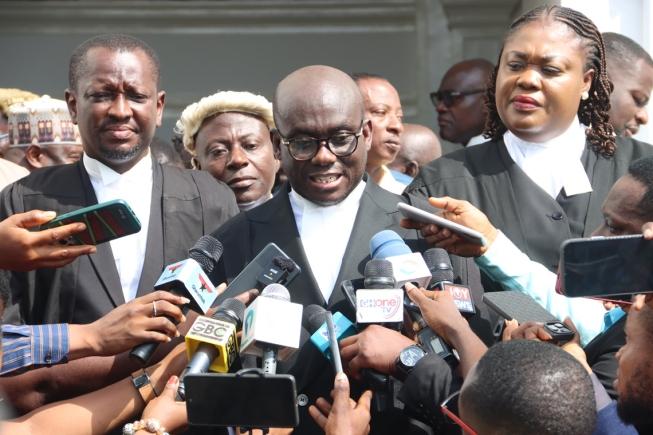

Lawyers acting for Hanan Abdul Wahab have signaled their intention to commence contempt proceedings against Ghana’s Attorney General, the Deputy Attorney General, and the Director of the National Intelligence Bureau, formerly the Bureau of National Investigations, alleging a deliberate and calculated disregard of a High Court directive which had permitted their client to travel abroad for medical purposes.
The legal team maintains that Abdul Wahab’s arrest at the Accra International Airport was carried out in direct contradiction to a subsisting judicial authorization that had granted him leave to travel to the United Kingdom between July 4 and July 12, 2026, for a scheduled medical consultation with an optician. According to counsel, this approval was issued by the High Court in Accra on June 29, 2026, under the authority of Justice Achibonga, a Court of Appeal judge sitting in an additional capacity as a High Court judge. The application, they assert, was heard in the presence of both prosecution and defence representatives, including Deputy Attorney General Dr Srem Sai, and was granted after full legal argument.

In a strongly worded statement released on Sunday, July 5, 2026, lead counsel Godfred Yeboah Dame, a former Attorney General and current legal representative for the accused, dismissed public comments attributed to Dr Srem Sai as misleading. The Deputy Attorney General had earlier taken to social media in a post dated July 4, 2026, to justify the arrest, a position the defence now characterises as factually inaccurate and legally unsustainable.

The defence further argues that the arrest was executed in the absence of any valid subsisting court order freezing Abdul Wahab’s bank accounts. They contend that any prior restraining orders ceased to exist once earlier charges against their client were withdrawn on May 5, 2026, resulting in his formal discharge from those proceedings.

According to the legal submission, a subsequent High Court ruling in Adentan delivered on May 20, 2026, in relation to fresh charges filed on May 15, 2026, made it clear that the reinitiation of proceedings constituted a new legal process, thereby nullifying any reliance on earlier enforcement directives. On this basis, counsel insists that no lawful freezing order could have been in effect at the time of the alleged airport incident.
The statement also notes that this legal interpretation had already been formally communicated to the Executive Director of the Economic and Organised Crime Office, an institution responsible for financial crime investigations, in correspondence delivered approximately two weeks prior to the arrest. The defence therefore accuses state authorities of acting in disregard of established legal notice and judicial clarity.

Responding to allegations that Abdul Wahab attempted to withdraw funds from a restricted account before departing the country, the legal team issued a categorical denial and challenged the prosecution to produce verifiable evidence of any such transaction occurring after the purported freezing directive. They insist that no financial activity in violation of any lawful order has taken place.
The lawyers further characterise the airport arrest as a blatant and intentional breach of a court order, asserting that it represents an unlawful exercise of executive power over a matter already determined by judicial authority. They argue that such conduct undermines the authority of the High Court and threatens the constitutional balance between the judiciary and law enforcement agencies.

Citing comparative precedent, counsel referenced several high profile criminal cases in which accused persons including Dr Stephen Opuni, Seidu Agongo, Alhaji Collins Dauda, Dr Cassiel Ato Forson, and Dr Kwabena Duffuor were previously granted permission by Ghanaian courts to travel abroad while standing trial, arguing that Abdul Wahab’s case falls within an established pattern of judicial discretion in such matters.

The legal team has therefore declared its intention to proceed with contempt actions against the Attorney General, the Deputy Attorney General, and the head of the National Intelligence Bureau, insisting that accountability is necessary to preserve judicial authority and prevent what they describe as repeated institutional overreach in the administration of justice.

