
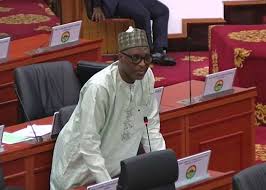

The Minister for the Interior, Mohammed-Mubarak Muntaka, has disclosed that Ghana has recorded its highest monthly rainfall in documented history, describing the June 2026 downpours as unprecedented and a key driver of the severe flooding that has devastated multiple parts of the country.
Addressing Parliament on Tuesday, June 30, on the scale of destruction and the government’s emergency response measures, the Interior Minister presented rainfall data from the Ghana Meteorological Agency indicating that June 2026 not only ranked among the wettest months typically experienced in Ghana’s seasonal cycle, but significantly exceeded all previously recorded levels.

He explained that a single day of intense rainfall on Monday produced 169.2 millimetres of rain, marking what meteorological records classify as the fourth highest single day rainfall total since 1995. According to him, this extreme rainfall event overwhelmed drainage systems and triggered widespread flooding across major urban centres, particularly in the Greater Accra Region.

“In the month of June we normally expect a lot of rains. But what happened yesterday gave us 169.2 millimetres of rainfall, and this is the fourth largest volume of rainfall recorded in a single day since 1995,” Mr. Muntaka told Parliament.

The Minister further revealed that Ghana recorded a cumulative rainfall total of 593.2 millimetres for June 2026, establishing the month as the wettest ever documented in the country’s meteorological history. He stressed that this figure represents a sharp departure from long term climatic patterns and historical averages.
“For the month of June, we had a total of 593.2 millimetres of rainfall. It is the highest our country has ever received in its history in one month,” he stated.

He added that previous records were significantly lower, citing 2002 as the closest comparison year with 420.6 millimetres of rainfall, followed by 380.3 millimetres recorded in 2015. These figures, he noted, underscore the extraordinary nature of the 2026 rainfall intensity.
“The closest was in 2002 with 420.6 millimetres, and the other was in 2015 with 380.3 millimetres. I will make these statistics available to the House,” he added.

While acknowledging the role of human activities such as indiscriminate dumping of waste into drainage channels and the construction of buildings on waterways, Mr. Muntaka emphasised that the scale of rainfall was so extreme that flooding would likely have occurred regardless of existing infrastructural weaknesses.

He argued that the intensity and volume of rainfall placed exceptional pressure on drainage systems, turning what might have been manageable water flow into widespread urban flooding across vulnerable communities.
The Interior Minister described the situation as one of the most difficult natural disasters Ghana has faced in recent years, stressing that the government is coordinating closely with emergency response institutions to provide immediate relief to affected populations while also pursuing long term strategies to strengthen national flood resilience.
He reaffirmed that disaster management agencies remain actively engaged in rescue operations, relief distribution, and damage assessment, even as policymakers consider structural reforms aimed at improving urban planning enforcement, drainage infrastructure capacity, and climate adaptation readiness to reduce the impact of future extreme weather events.

