
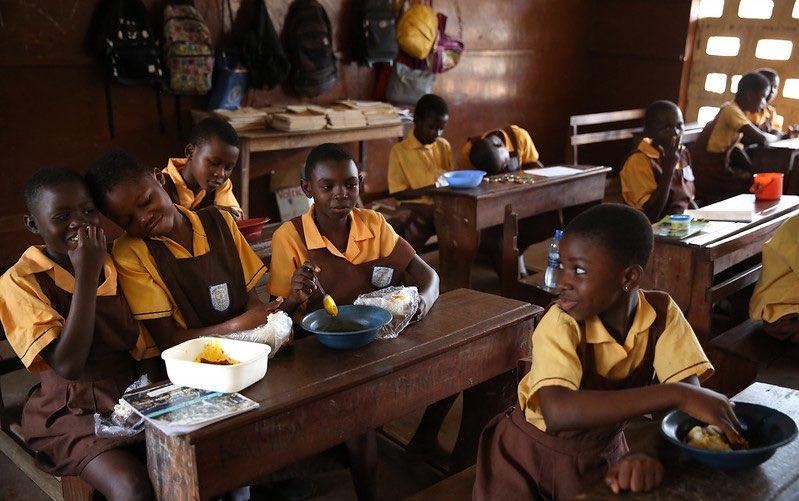

The Ministry of Gender, Children and Social Protection Ministry of Gender, Children and Social Protection has announced the removal of taxes applied to payments made to caterers under the Ghana School Feeding Programme, in a policy shift aimed at improving meal quality and strengthening the implementation of one of the country’s key social intervention schemes.
The decision follows a recent government adjustment that increased the feeding grant from GH¢1.50 to GH¢2.00 per child per meal, reflecting efforts to respond to rising costs and improve nutritional standards for pupils in public basic schools across Ghana.

Responding to questions on the floor of Parliament on Wednesday, June 24, Minister for Gender, Children and Social Protection Agnes Naa Momo Lartey explained that the tax exemption is intended to ensure that caterers receive the full value of approved government allocations without deductions that previously reduced their operational capacity.

She noted that the removal of the tax component is designed to ease financial pressure on caterers, allowing them greater flexibility to improve the quality, balance, and nutritional content of meals served to schoolchildren under the programme.

According to her, the policy adjustment is part of a broader strategy to strengthen the effectiveness of the Ghana School Feeding Programme Ghana School Feeding Programme, which continues to serve as one of the government’s flagship social protection initiatives.
She emphasized that the intervention is expected to improve not only the quality of meals but also the consistency of service delivery, ensuring that children in beneficiary schools receive adequate nutrition to support learning, attendance, and overall development.

The Minister further explained that additional improvements to the programme will depend on the availability of financial resources and the necessary fiscal approvals from government, indicating that reforms will continue in phases.
The School Feeding Programme remains a central pillar of Ghana’s social protection framework, providing daily meals to pupils in public basic schools while also supporting increased enrolment, improved attendance, and better retention rates, particularly in vulnerable communities.

Government officials maintain that strengthening the programme is critical to broader national development goals, as child nutrition remains closely linked to educational performance and long term human capital development.

The latest policy adjustment is therefore positioned as part of sustained efforts to enhance both the efficiency and impact of social protection interventions targeted at children across the country.

