
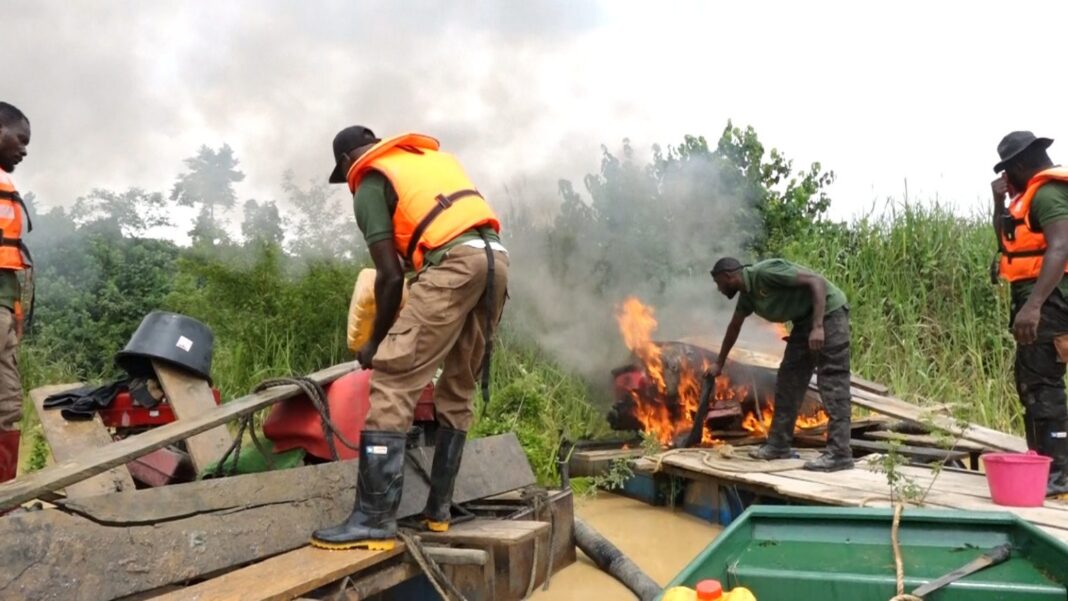

The National Concerned Small-Scale Miners Association of Ghana has carried out a large scale operation along the River Offin in the Atwima Mponua District of the Ashanti Region, destroying about 80 changfan machines being used for illegal mining activities directly within the river channel.
The intervention, which targeted active illegal mining sites along the river, also uncovered excavators and other heavy duty equipment operating dangerously close to riverbanks, with mining waste being discharged directly into the waterway.

The Association, National Concerned Small-Scale Miners Association of Ghana, expressed deep concern over the continued degradation of the River Offin, warning that ongoing illegal mining activities pose a serious threat to water security, environmental sustainability and the livelihoods of communities that depend on the river.

Speaking to the media, the Director of Operations of the Association, Philip Bawa Ajamujobe, said the group had taken independent action in response to what it described as escalating destruction of river bodies, particularly along the Offin basin.

“We have observed massive destruction of our river bodies, particularly the River Offin, where we have acted before and today. We have destroyed about 80 changfan platforms mining in the river bodies,” he stated.
The Association explained that the operation is self financed and forms part of efforts to support government action against illegal mining, commonly known as galamsey, while also protecting the legitimacy and reputation of responsible small scale miners.

According to the group, the intervention began at Adiembra along the River Offin near the bridge towards Nyinahin and extended through several communities including Agogoso, Ntobroso, Enyinam, Akumfere and eventually Tobroso, where extensive environmental damage was also recorded.
The Association indicated that the operation will continue in the coming days, citing limited time as a constraint in fully covering all affected sections of the river.

During the exercise, the team reportedly observed widespread environmental destruction along the river, with heavily polluted water, damaged riverbanks and active dredging activities contributing to the degradation of the ecosystem.

The River Offin, a key water source for domestic, agricultural and industrial use, has in recent years become one of the most affected water bodies in Ghana’s struggle against illegal mining, with repeated interventions by both state and non state actors aimed at curbing its destruction.
The Association issued a stern warning to illegal miners operating in the area, urging them to immediately desist from activities that destroy water bodies and undermine the efforts of responsible mining operators.
“We will not spare anybody when found,” Mr. Ajamujobe cautioned, while calling on traditional authorities and community leaders to take a more active role in addressing illegal mining activities within their jurisdictions.
He further raised concerns about the apparent silence or limited enforcement by local leadership structures in areas severely affected by environmental degradation.
The Director of Operations noted that some communities, including Tobroso, have experienced flooding linked to disrupted river flow and environmental damage caused by mining activities along the river.
He questioned the effectiveness of oversight mechanisms at the local level, arguing that the scale of destruction suggests gaps in enforcement and accountability.
The operation also revealed instances where illegal miners reportedly abandoned sites and fled into nearby forests upon noticing the approach of enforcement teams, leaving behind excavators and equipment still engaged in river dredging activities.
Despite these evasive actions, several pieces of heavy machinery were observed actively polluting the river, reinforcing concerns about the persistence and organization of illegal mining networks operating along the Offin.
Environmental experts have long warned that unchecked galamsey activities threaten Ghana’s water security, destroy aquatic ecosystems and increase the cost of water treatment for urban and rural communities.
The latest intervention by the Association adds another layer to ongoing national efforts to protect water bodies, even as debates continue over enforcement capacity, regulation of small scale mining and the long term sustainability of Ghana’s mineral resource governance.

