

President John Dramani Mahama has disclosed that the late former President Jerry John Rawlings repeatedly rejected attempts to have major national institutions and infrastructure named in his honour, including the University for Development Studies and an offshore oil production vessel, insisting instead that his legacy should be preserved in the memories and lives of citizens rather than through physical monuments.
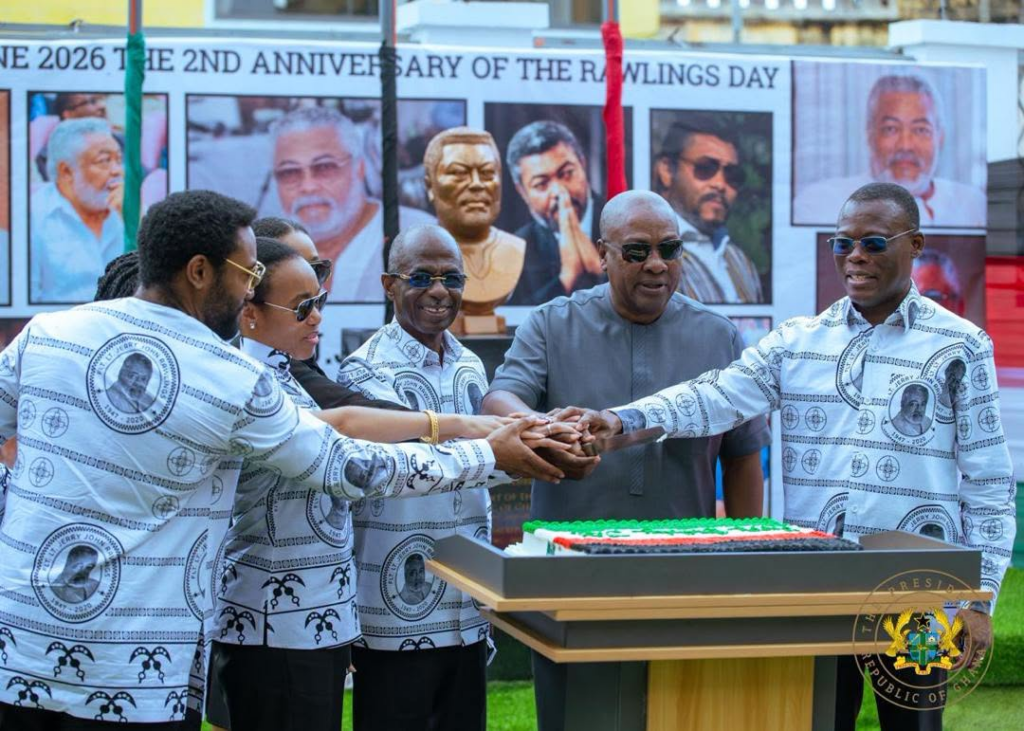
Speaking at a ceremony in Accra where the National Democratic Congress renamed its headquarters the “JJ Rawlings House” and unveiled a bust in honour of its founder, President Mahama said Rawlings consistently resisted efforts to immortalise his name despite his central role in the party’s formation and Ghana’s political transformation.

According to the President, Rawlings would likely have objected to the very ceremony that sought to permanently associate his name with the party’s administrative headquarters, given his long standing discomfort with public commemoration through statues, buildings and institutional naming.

“He himself, if he were alive, would have been very uncomfortable with this ceremony we are holding, by which we seek to immortalise his name,” Mahama stated.

The President explained that during his lifetime, Rawlings consistently declined several formal requests to have prominent national projects bear his name, even when such proposals were linked to institutions he had directly contributed to establishing.
One such instance, Mahama revealed, involved the University for Development Studies, an institution whose seed funding was partly derived from Rawlings’ donation of his World Food Prize award. Despite this contribution, Rawlings reportedly refused to have the university named after him.

“He politely declined to have the University for Development Studies named after him, even though he had given up his World Food Prize Award as seed funding to start that university,” Mahama said.
He also recounted a personal encounter during his presidency in which he sought Rawlings’ approval to name the Floating Production Storage and Offloading vessel for the ENI Sankofa oil project in his honour.

According to Mahama, Rawlings declined the request and instead redirected the proposal to former President John Agyekum Kufuor, stating that he preferred a different form of remembrance.

“He said, ‘Pass it on to President Kufuor. I prefer to have my name inscribed in the minds and hearts of men than on statues and monuments,’” Mahama recounted.
The President described Rawlings as a leader who was neither driven by vanity nor personal aggrandisement, noting that his approach to leadership was rooted in service rather than symbolism.
“Rawlings was neither vain nor ostentatious,” he remarked.
Mahama further observed that while Rawlings would have opposed efforts to name the party headquarters after him, his absence made it possible for the party to proceed with the decision as a symbolic act of remembrance.
The event marked a significant moment in the history of the National Democratic Congress, which Rawlings founded and which has remained one of the dominant political forces in Ghana since the advent of the Fourth Republic.
President Mahama explained that the decision to rename the headquarters was intended to preserve the institutional memory of the party and embed Rawlings’ legacy within its operational and ideological core.
He described the headquarters as the nerve centre of the party’s political activity, where policies are developed, strategies are crafted and electoral decisions are shaped.
“It is the place where ideas are debated, policies are formulated, manifestos are written, strategies are developed and decisions are taken in pursuit of our mission to serve the people of Ghana,” he said.
By naming the building after Rawlings, Mahama noted, the party was ensuring that future generations of members would remain connected to the founding ideals and sacrifices that shaped its identity.
The ceremony also featured the unveiling of a bust of the late former president, which party leaders described as a symbolic representation of his leadership, discipline and enduring influence on Ghanaian politics.
According to Mahama, the tribute was not merely about honouring Rawlings as an individual but about preserving the values he embodied throughout his political life, including courage, conviction and a strong commitment to public accountability.
“We celebrate not only Jerry Rawlings’ life but also the values he embodied,” he said. “We celebrate his courage and leadership, his conviction in times of uncertainty, his commitment to national service and his enduring belief that public office should be used to improve the lives of ordinary citizens.”
National Democratic Congress National Chairman Johnson Asiedu Nketia also confirmed that Rawlings had vigorously opposed attempts to name monuments after him during his lifetime, describing him as firm in his preference for a more intangible legacy.
However, Asiedu Nketia said changing generational realities had made physical commemoration necessary, arguing that future citizens would need tangible symbols to connect with the party’s founding history.
“When he was alive, we thought that was okay because the people who knew him had the means of connecting with him in their hearts. But today he is no more, and generations are changing,” he explained.
He warned that without physical markers of remembrance, Rawlings’ legacy could gradually fade as those who personally experienced his leadership pass away.
“If we allow his memory to remain only in the hearts and minds of people, it will also die when those hearts and minds that knew him pass on,” he said.
Rawlings’ son, Kimathi Rawlings, also addressed the gathering, describing the event as a moment of reflection and recommitment to the principles his father stood for.
He noted that the renaming of the headquarters represented a lasting institutional affirmation of values such as justice, accountability and national service.
“By naming this headquarters after Flight Lieutenant Jerry John Rawlings, the NDC has permanently inscribed his name into the very home of the ideals, sacrifices and aspirations to which he devoted his life,” he said.
The ceremony concluded with renewed calls from party leaders for unity and continued adherence to the principles of probity, accountability and service, which they say defined Rawlings’ political legacy and continue to shape the identity of the party he founded.

