

The Government of the Ghana has revealed that it has deployed armoured buses disguised as ordinary commercial passenger vehicles as part of a covert security strategy aimed at detecting, tracking, and apprehending highway robbery syndicates operating along major national road corridors.
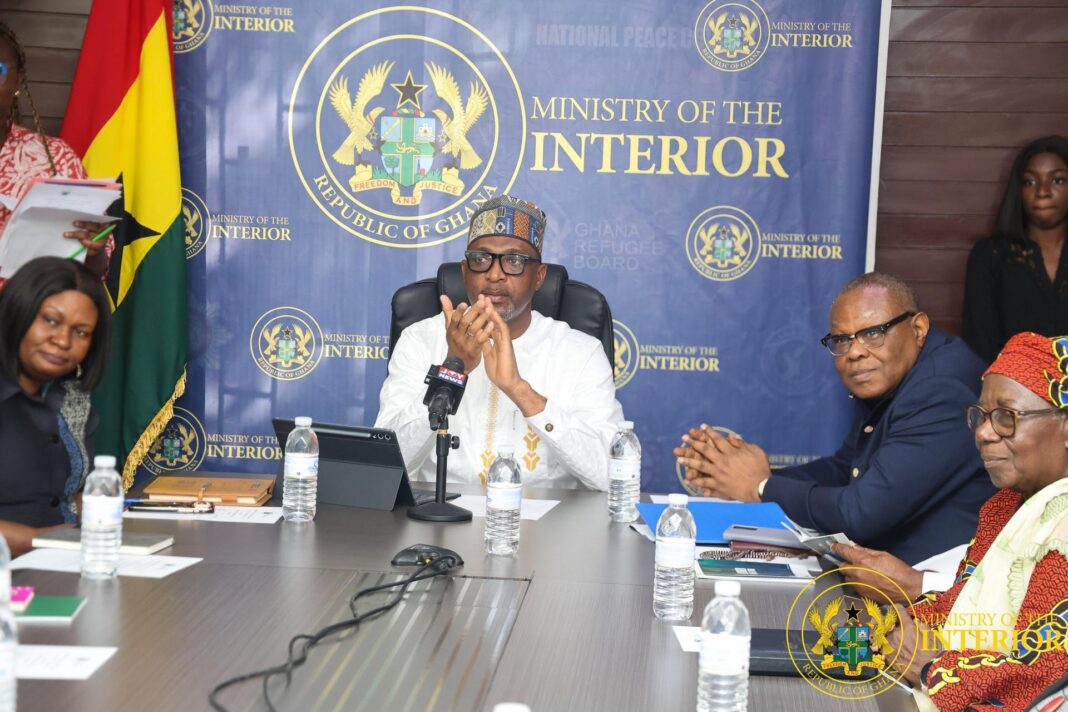
The disclosure was made by the Interior Minister, Muntaka Mohammed Mubarak, during a town hall engagement held in Damongo in the Savannah Region on Saturday, May 23, 2026, where he detailed the operational tactics being used to counter rising incidents of highway crime.

According to the Minister, the security vehicles are intentionally rebranded at intervals to avoid identification by criminal networks. He explained that the buses are alternately disguised as well known commercial transport services, including STC, VIP, and OA, in order to blend seamlessly into regular passenger traffic while monitoring and intercepting suspected robbers.

He indicated that the strategy has already contributed to the arrest of multiple suspects involved in highway robbery, crediting the Inspector General of Police and operational security teams for what he described as significant progress in improving road safety.

At the same forum, the Minister for Roads and Highways, Governs Kwame Agbodza, drew attention to the relationship between deteriorating road infrastructure and criminal activity, arguing that poorly maintained roads often create conditions that facilitate ambushes and illegal operations by armed groups.
He further expressed concern over delays in the implementation of several road projects under the government’s Big Push infrastructure programme, specifically referencing contractors along the Wa to Wiawso corridor, and urging inactive contractors to return to project sites and resume work without further delay.

The “Resetting Ghana” town hall meeting also provided a platform for the Savannah Regional House of Chiefs to present a range of developmental concerns on behalf of the Yagbonwura, including challenges related to water supply in Damongo, inadequate road infrastructure, delays in the construction of a regional hospital, and calls for the establishment of additional districts, a university, and increased recruitment of Gonja language educators.
President John Dramani Mahama, who is currently leading a nationwide “Resetting Ghana” engagement tour, responded to several of the concerns raised by traditional leaders and community representatives.

He announced that preparatory works for the Damongo water supply project had been completed and that the scheme, designed to draw water from Yapei to supply Busunya, Damongo, Larabanga, and surrounding communities, had progressed into the procurement phase.

The President also disclosed plans for the establishment of a science and technology university in the region, noting that the Government of China had provided a US$30 million grant toward the project, while an additional US$100 million funding request had been submitted to the Arab Bank for Economic Development in Africa.
On healthcare infrastructure, President Mahama stated that the Savannah Region would benefit from a 300 bed regional referral hospital equipped with advanced diagnostic facilities, including MRI, CT scan, and X ray machines, as part of efforts to strengthen healthcare delivery in the region.
Source: adomonline.com

