
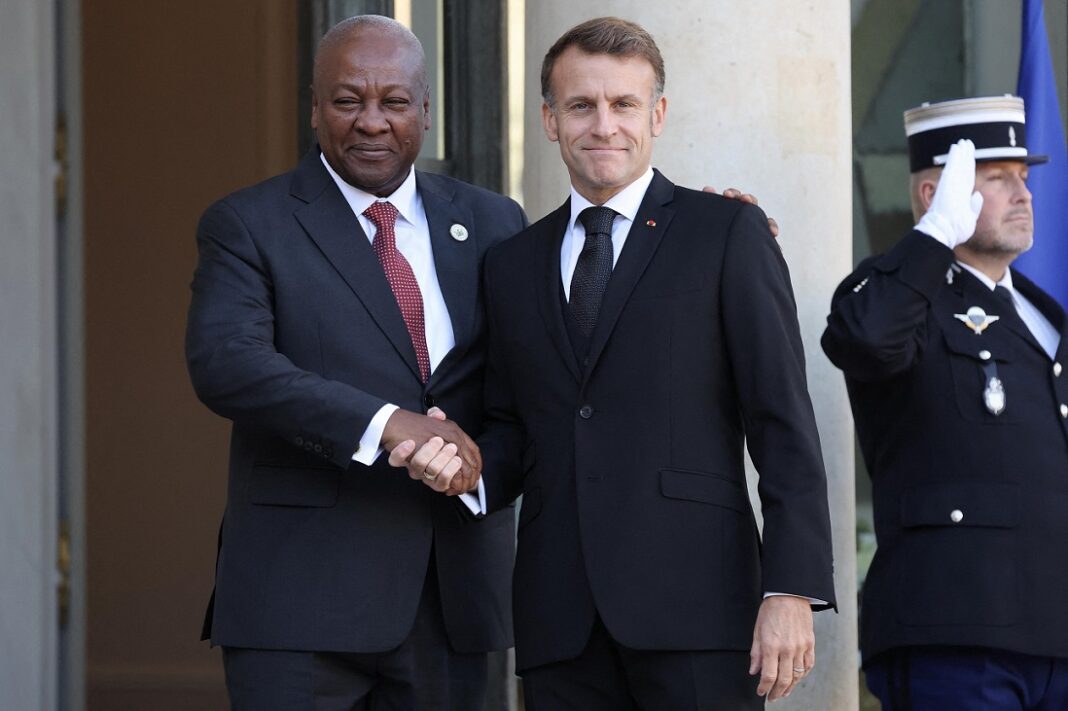

The Government of Ghana has expressed strong approval of what it describes as a landmark and morally significant shift by France to engage in formal reparatory justice discussions concerning the transatlantic enslavement of Africans, following a series of policy statements issued by French President Emmanuel Macron.
In an official communiqué released on Friday, May 23, 2026, through the Ministry of Foreign Affairs, the Ghanaian government praised President Macron’s leadership as candid, reconciliatory, and exemplary, characterising his stance as a rare but important acknowledgment of one of history’s most profound injustices against people of African descent.

The statement comes in the wake of President Macron’s remarks during commemorative events marking the 25th anniversary of France’s legislative recognition of slavery as a crime against humanity. During those engagements, he outlined new anti-slavery initiatives and indicated France’s readiness to collaborate with Ghana on structured reparatory justice frameworks.

According to the Government of Ghana, this evolving position represents a significant step within the broader global effort to confront the historical realities of transatlantic slavery and colonial exploitation, while also advancing dialogue on acknowledgment, repair, and reconciliation.

As part of the developing partnership, Ghana has expressed interest in strengthening institutional cooperation with France through the proposed establishment of a Ghana–France Scientific Commission to be based in Accra. The body is expected to support rigorous academic research, archival documentation, and policy-oriented studies focused on slavery, historical accountability, and reparatory justice mechanisms.
President John Dramani Mahama, who also serves as the African Union Champion on Reparatory Justice, has welcomed France’s engagement and confirmed his appreciation for President Macron’s acceptance of an invitation to attend the upcoming “Next Steps” High-Level Conference on Reparatory Justice scheduled to be held in Accra from June 17 to June 19, 2026.

The conference is expected to convene heads of state, senior government officials, diplomats, academics, civil society actors, and advocacy groups from Africa, the Caribbean, Europe, and the Americas. Discussions will focus on transforming reparatory justice from symbolic recognition into actionable policy commitments and sustained international cooperation.
The Ministry further highlighted that these developments build upon a historic resolution adopted by the United Nations General Assembly on March 25, 2026. The resolution, spearheaded by Ghana, formally recognised the transatlantic enslavement of Africans as one of the gravest crimes against humanity.

With the backing of 123 member states, the resolution called for constructive international engagement on reparatory justice and the creation of structured mechanisms to address the enduring consequences of slavery across generations and societies.

The Government of Ghana described the adoption of the resolution as a decisive turning point in global discourse, noting that it has elevated reparations from a historical debate to an urgent international policy concern. It further stated that President Macron’s recent declarations complement and reinforce the momentum generated by this multilateral development.
Ghana reiterated its openness to collaborate with France and other willing partners on a broad spectrum of reparatory justice measures, including formal state apologies, guarantees of non-recurrence, compensation frameworks, restitution of cultural artefacts, repeal of colonial-era legal instruments, and long-term institutional partnerships aimed at addressing structural inequalities rooted in historical injustice.
The government also welcomed France’s intention to repeal the “Code Noir,” the colonial legal framework established under King Louis XIV in the seventeenth century to regulate slavery within French territories, describing it as an important symbolic and legal step toward historical accountability.
Officials emphasized that sincere confrontation with historical wrongdoing forms the essential foundation for meaningful reconciliation, adding that honest acknowledgment of the past is indispensable for building equitable international relationships in the present.
Ghana further reaffirmed its commitment to sustained bilateral and multilateral engagement with states willing to pursue reparatory justice in good faith, positioning itself as a central advocate within global efforts for restorative justice.
Analysts note that Ghana has increasingly assumed a leading role in this international movement through initiatives such as the “Year of Return” and “Beyond the Return” campaigns, alongside active diplomatic engagement within continental and global institutions.
The upcoming Accra conference is expected to further consolidate Ghana’s position as a key voice in shaping global discussions on historical accountability, reparations, and justice for descendants of enslaved Africans.

