
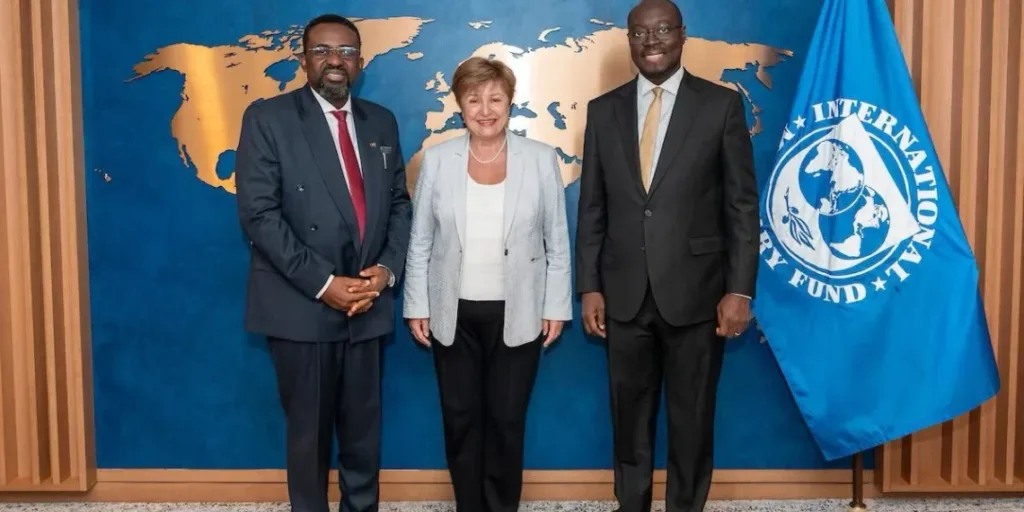

Individuals familiar with the deliberations indicated that Ghana achieved notable advancement across several major benchmarks and policy reforms connected to the IMF backed Extended Credit Facility programme.
Nonetheless, a number of matters are believed to have remained unsettled at the conclusion of the engagement.

Ever since Ghana entered the IMF supported arrangement in 2023, each assessment mission has traditionally concluded with a Staff Level Agreement between the Fund’s delegation and the Government of Ghana.

However, by the time this report was compiled, uncertainty persisted over whether a fresh agreement had been secured after the sixth review exercise.

Expectations remain high that greater certainty could emerge later today when officials from the Government of Ghana together with representatives of the IMF hold a scheduled media briefing to announce the outcome of the latest review discussions.
Questions also remain over whether the IMF delegation will outline additional prior measures for Ghana to implement before the programme is presented to the IMF Executive Board for consideration in August 2026.

Despite the unresolved matters, the final staff evaluation is anticipated to praise Ghana for maintaining dedication toward implementing policy reforms under the programme while preserving recent economic improvements amid continuing global financial uncertainty.
The sixth assessment concentrated on Ghana’s overall programme implementation since the fifth review earlier this year.

The mission evaluated whether delayed benchmarks together with institutional reforms had either been completed or were approaching completion.

On the fiscal side, negotiations centred extensively on developments within the energy sector, institutional transformation efforts, and public debt administration.
Within the monetary and financial sector, sources close to the process disclosed that considerable advancement was recorded across most areas, although one matter reportedly remains outstanding.
During his opening engagement with the IMF delegation, Finance Minister Cassiel Ato Forson underscored what he characterised as substantial progress since Ghana’s economic difficulties in 2022.
According to him, cooperation between the government and the IMF had produced strong and measurable achievements.
He described the process as a lengthy and demanding undertaking that had ultimately produced transformative results.
The Finance Minister explained that the programme had contributed significantly toward stabilising the economy, rebuilding confidence, and restoring optimism among citizens.
Dr Forson additionally conveyed appreciation to the IMF on behalf of President John Dramani Mahama and the people of Ghana, describing the progress achieved as meaningful and driven by discipline together with difficult policy choices pursued in the national interest.
While recognising the gains already attained, he emphasised that government remains committed to preserving the current recovery trajectory.
According to him, the next phase of the programme would focus heavily on measures designed to stimulate private sector expansion while ensuring that macroeconomic stability delivers tangible improvements in the lives of ordinary citizens.
He stressed that stability must translate into increased investment, expanded employment opportunities, and broader economic prospects for the population.
The Finance Minister further noted that the true measure of economic recovery extends beyond favourable headline statistics.
Ghana’s thirty six month Extended Credit Facility arrangement received approval in May 2023, providing access to SDR 2.2419 billion, equivalent to approximately three billion dollars.
At the fifth review stage, the IMF described Ghana’s programme implementation as broadly satisfactory despite delays involving certain institutional reforms. The Fund observed that the reforms were beginning to generate positive outcomes after earlier policy setbacks.
Meanwhile, reserves held by the Bank of Ghana have climbed to historic levels, strengthening the country’s protection against external economic shocks.
Within its latest economic projections, the IMF maintained Ghana’s 2026 growth forecast at 4.8 percent, marginally above the projected 4.6 percent expansion expected across Sub Saharan Africa.
The global economy, however, continues to experience mounting strain. The IMF recently adjusted global growth expectations downward to 3.1 percent, pointing to escalating energy prices together with geopolitical instability as key risks.
The Fund is also forecasting Ghana’s inflation rate to decline to 7.9 percent in 2026, slightly beneath government projections, provided current disinflation trends are sustained.
Inflation is further expected to remain within single digit territory throughout both 2026 and 2027.

