
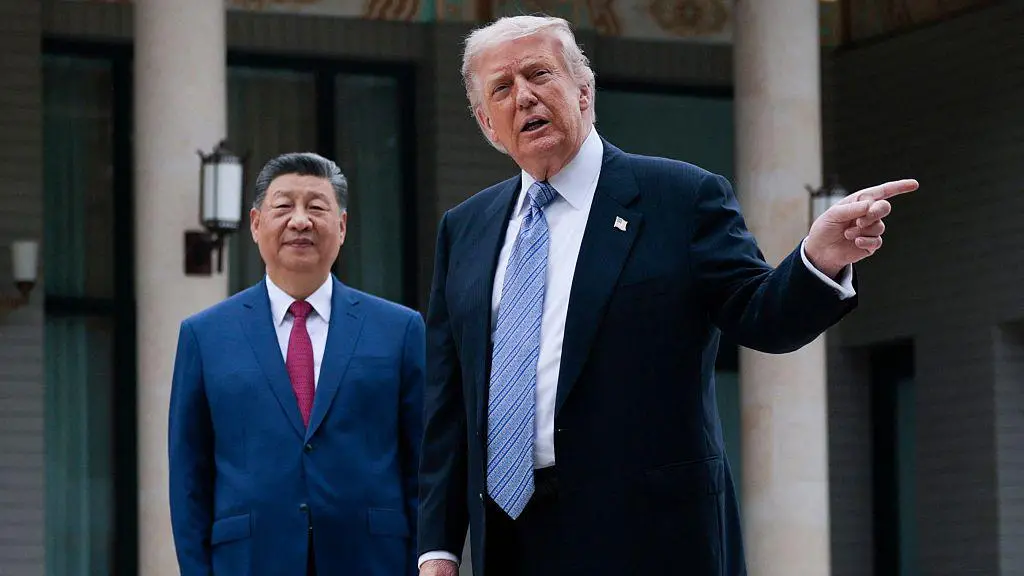

Donald Trump has concluded his final round of talks with Xi Jinping and wrapped up his state visit to Beijing
Trump said the meeting was “very successful, world-renowned, and unforgettable”, while Xi called it a “historic and landmark” visit, according to Chinese state media

He may speak to the media on Air Force One soon, potentially revealing details of the talks which have so far remained scarce

Trade, oil, Iran and Taiwan were among the topics discussed over two days of meetings

Earlier Trump said Xi had committed to withholding military equipment from Iran, in an interview with Fox News
The US president also said China wants the Strait of Hormuz open again and that Beijing has agreed to

Donald Trump is en route back to Washington after two days of what he called “very successful” and “unforgettable” talks in Beijing with Xi Jinping.
For Xi’s part, Chinese media reports said he hailed the “historic and landmark” visit.

Here’s what happened on the summit’s last day:

At a joint press conference, we learned the two leaders had discussed trade, Iran and “a lot of other things” during their bilateral talks
Very little about the substance of the talks has been announced by either side, though – particularly on the contentious issue of Taiwan
No major deals on trade or policy were announced – even though Trump arrived flanked by US business figures
In a Fox News interview aired during the summit, Trump said China had promised to buy US oil and purchase 200 Boeing jets – but Beijing has not commented on these updates
We saw Xi guide Trump around Zhongnanhai, the secretive compound where top Chinese officials live and work
Trump was unusually tame on the visit, quietly listening to Xi’s lesson on Chinese history, writes our China correspondent Laura Bicker
We’re ending our live coverage of the summit here, but you can read more in our news story.
Putin visited Xi last summer in Beijing, where he watched a military parade marking the 80th anniversary of World War Two’s end
Russian President Vladimir Putin will meet Xi Jinping in Beijing “really soon”, where the pair will discuss Donald Trump’s recent visit among other subjects, a Kremlin spokesman says.
Dmitry Peskov told reporters that the exact date of the visit would be announced shortly, after revealing yesterday that preparations for the trip were already complete.
Earlier, on a tour of Zhongnanhai, the Chinese president told Trump that Putin was one of the few foreign guests who had also been allowed to visit the complex.
Trump’s response: “Good, I like it.”
No announcements were made on artificial intelligence (AI) or advanced semiconductors at the Trump-Xi summit, despite expectations that AI would be a central topic of discussion.
US Treasury Secretary Scott Bessent told CNBC that “guardrails” for AI would be discussed, and said it was “of utmost importance” for the United States to maintain its lead over China in AI.
The talks come as Anthropic’s Mythos model has raised cybersecurity concerns, with officials warning it could be exploited by criminal or terrorist groups. Chinese state media has also flagged the model.
At the same time, the US continues tightening export controls on advanced AI chips, despite Nvidia CEO Jensen Huang attending the summit in Beijing.
AI and chips sit at the centre of a fierce strategic rivalry between the US and China, with Washington seeking to prevent Beijing from closing the gap.
“If China was leading, we wouldn’t be having these discussions,” Bessent said.:25
China stocks fell on Friday as the Trump-Xi summit ended without any major deal announcements to excite investors.
The country’s blue-chip CSI300 Index and the Shanghai Composite Index each closed down more than 1%, retreating from modest gains in early trade. Both remain close to recent peaks, though.
The Hang Seng in Hong Kong meanwhile lost 1.6%.
Investors will be watching the two leaders closely now the summit is over, in case any detailed agreements are announced.
Taiwan’s Ministry of National Defence said today that they did not detect any Chinese aircraft activity during Trump’s state visit on 14 May.
The ministry added that it tracked seven Chinese naval vessels and one official ship operating around the island in a 24-hour period ending 0600 local time today.
Chinese military activities around the island have been considered low this week, with the highest number coming on Monday, when Taipei detected five sorties of Chinese aircraft helicopters operating near the southwestern and eastern part of the island.
Taiwan has been posting daily notices to inform the public of Chinese military activities that could deem a threat to the island.
US trade representative Jamieson Greer has offered one of the clearest glimpses yet into what was discussed during the Trump-Xi summit in Beijing.
Speaking to Bloomberg TV, Greer said it had not yet been decided whether to extend the current US-China trade truce beyond its expiry later this year.
Greer also said rare earth exports from China to the US were improving, although approvals for some shipments remain slow.
The US expects China to buy “double-digit billions” of dollars worth of American farm goods following the summit, he added.
Trump separately told Fox News that “China will buy a lot of our farm products”.
Analysts expect soybeans – America’s biggest export to China – to remain central to any agreement.
China, however, did not confirm any agricultural deals.
Asked whether Beijing had agreed to further farm purchases, foreign ministry spokesperson Guo Jiakun said only that both countries had agreed to maintain stable economic and trade relations.
Chinese state media has been highlighting Xi’s role in arresting the deterioration of relations between the US and China.
Xi “has always taken a strategic and long-term perspective” when it comes to relations with Washington and “offered principles” on how the two countries should “find a right way to get along” the reports say.
After Beijing confirmed Trump’s visit on 11 May, the Global Times published an editorial on how Xi had held several calls and meetings with Trump in the past year, which helped “correct the course of the bilateral relationship”.
Yesterday, the People’s Daily ran a commentary by Xie Feng, the Chinese ambassador to the US, who wrote that Xi had “steered the direction” of China-US relations “at crucial moments” and guided bilateral relationship forward over the “storms” over the last nine years – a reference to the ups and downs of ties with Washington since Trump’s last visit in 2017.
Such messaging is a deliberate move to portray Xi as an experienced statesman, and to assure the Chinese public that Xi’s approach to diplomacy is beneficial for the country.
Xi seemed to enjoy giving Trump a Chinese history lesson as they toured the 15th Century Temple of Heaven. The US leader revelled in the carefully choreographed stagecraft.
But for a president who built his brand on being tough on China, he seemed rather deferential in his tone and unusually quiet in front of the cameras – especially when asked about Taiwan.
He also hasn’t announced any major trade – something he has been pursuing since he first became US president in 2016.
Xi will view Trump as a leader that has been forced to U-turn on trade tariffs and that is now embroiled in a war in the Middle East that he cannot seem to end.
For the last five years there has been a saying in China – “the east is rising, the west is declining.”
Trump’s volatility and mercurial style has allowed Xi to re-position his country.
China was once eager to catch up to the west – now Xi may feel after playing host to the US president, that he is on the verge of surpassing it.

